Ever since Piaget introduced the 9P manual-wind movement back in 1957, the pursuit of the ultra-thin has been one of the more rarefied fields of high watchmaking. And while Piaget is still a contender in the field – as are Richard Mille and, surprisingly, Konstantin Chaykin – there’s one name that’s lapped the competition twice and is now chilling with a negroni back at the members’ club. I of course mean Bulgari.
While the battle for the crown is still very much raging – currently the thinnest overall watch in the world is Konstantin Chaykin’s ThinKing, though that’s still in the prototype phase – Bulgari’s swept every other ultra-thin accolade going. If records were Oscars, Bulgari is Titanic. Or Return of the King, surprisingly. But that wasn’t always the case. In fact, if you go back to the before times of the early 2010s, it was a very, very different story.
Back then they were better known for gem-encrusted serpent bangles and printing their name on various rings than they were watches. Sure, there was the occasional horological showpiece and the Genta-designed Octo certainly… existed. But they weren’t the kind of pieces that proper watch lovers got excited about. Nicely finished, sure, but mechanically nothing to write home about. The last genuinely cool thing they’d brought out was the then-defunct (now recently re-introduced) Aluminium. In a watch sense, they were floundering.

That all changed in 2014. Or at least, that’s when Bulgari made the splash that would lead to them being taken seriously as a high watchmaker. That’s because at the Baselworld watch show of that year, the Italian jeweller launched the Octo Finissimo – and broke the record for the world’s thinnest tourbillon in the process. At the time, the Octo Finissimo came out of nowhere. But in many ways, it was a hail Mary for Bulgari’s horological aspirations. Let Bulgari’s Fabrizio Buonamassa Stigliani explain: “I started to pose a few questions to Guido [Bulgari CEO Guido Terrini], questions about the future of the brand. I said, ‘tell me, in the next 10 years, where the brand will be. Tell me why in 10 years I would want to buy a Bulgari watch?’. We didn’t have any field. We weren’t close to racing, to polo, to aviation. We knew we had amazing manufacturers on our side, so we looked to them.”
The manufacturers in question were those of the combined workshops of Gerald Genta and Daniel Roth, two icons of modern watchmaking bought by Bulgari in 2000. Between them, they came with a level of expertise that few manufacturers could aspire to, a solid horological bedrock to build an in-house framework on top of. Fortunately, it wasn’t just expertise that they came with.
“Daniel Roth and Gerald Genta began to develop ultra-thin watches many, many years before. When we looked into it more, we realised that there were movements already developed. And so, when we started to think what would set us apart, what would be different from our competitors, we knew what we had to do: ultra-thin complications.”

As for what watch the new collection would be based on, that was a lot more obvious. Just two years earlier, Buonamassa had completely revamped Gerald Genta’s Octo for the modern era, taking the faceted, octagonal case and adding a circular bezel, combining Genta’s original Roman architectural inspirations and refreshing it into something a lot more wearable by today’s standards. Now it just needed to be approached again through the lens of the ultra-thin.
“You have to imagine,” explains Buonamassa, “that at the time you only had the Patrimony, Calatrava, and Altiplano on the market with this kind of thinness. They were all round with leather straps. We wanted something different. An integrated bracelet, very Italian, very sports chic, something you can hide under a shirt but in a very modern way.”
The result was a refined, visually sporty tourbillon that measured just 5mm thick. The manual-wind BVL 268 calibre inside itself was just 1.95mm – not much thicker than a penny – where all 249 components were turned towards the singular goal of slimness. It chucked out the idea of a chunky rotor and instead, sensibly opted for manual-wind. The watch was dramatic, angular, a sleek, modern ode to ultra-thin watchmaking. In short, it was incredible. It was also rather tricky to achieve.
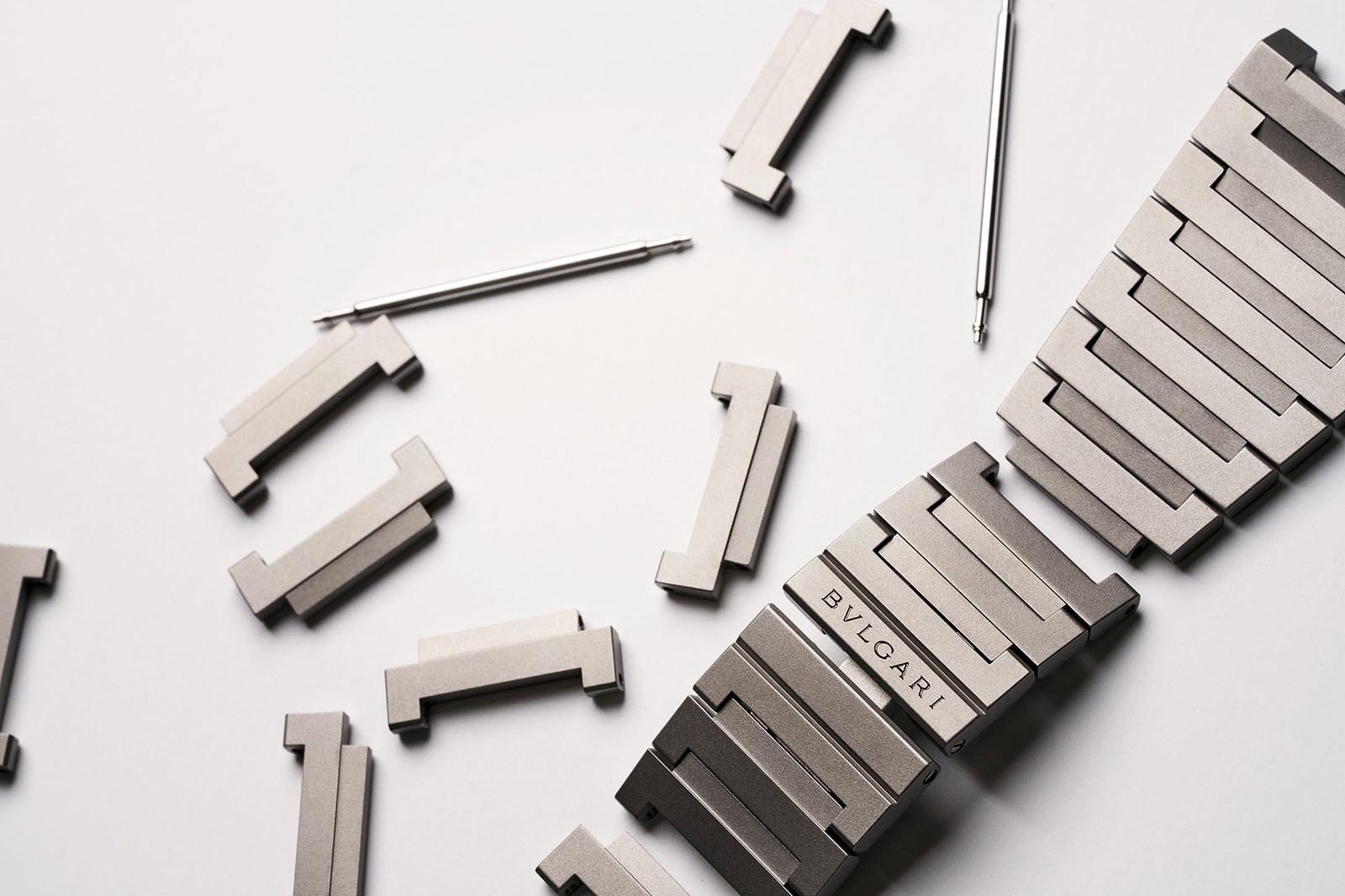
Bulgari Octo Finissimo Bracelet
“The big challenge was the case and bracelet. The Gerald Genta Octo before the Finissimo was well known to be very thick, very chunky with some fancy dials. When we refreshed it, we took a look at the base calibre, hands and everything, but it was still very thick, with 110 different facets front and back. But with the Finissimo we needed to squeeze into just 5mm or so. And so we redid the caseback entirely, streamlined the entire case. It took off some of the facets, but with the Finissimo that 110 number wasn’t something we were worried about anymore.
“Another big challenge was the bracelet and buckle. We had a case that was very thin but a bracelet that was 3mm, if I remember well, and a buckle that was absolutely thick. When you closed the clasp and had it on your wrist, you had a buckle thicker than the case! It was nonsense for us. So we opted to hide the buckle inside bracelet – and today it’s still a real statement.”

Bulgari Octo Finissimo 2014
Needless to say, all that effort paid off. The Bulgari Finissimo Tourbillon took the watch world by storm, scooping every headline around Baselworld 2014. It was a tour de force of design meets watchmaking, and even if it was very, very limited, it was the kind of watch people loved to talk about – and yes, a lot of that praise was lavished on the bracelet.
And then Bulgari struck again. In 2016, they encouraged horological lightning to strike twice with their second world’s thinnest high complication, the not-so-humble minute repeater. It had less of an impact than the tourbillon simply due to exposure, but it was nevertheless groundbreaking.
There was, however, a slight problem. Once the dust had settled, the headlines had been written and the watch world had finished politely applauding, people began to move on, perhaps putting money on which high complication would be next. After all, impressive as the Octo Finissimo tourbillon and minute repeater were, they weren’t game changers. They were showpieces, novelties.

Bulgari Octo Finissimo Tourbillon Chronograph Skeleton Automatic
Anyone brand with a bit of capital can make short-run, incredibly limited watches. Yes, it bought them a couple of records, but none that many watchmakers were competing for.
“Everybody was saying, ‘okay, good, you are able to make 30 pieces of the thinnest tourbillon on the market.’ It was a little, but who cares? It was still important to us. Then year two in Basel fair we arrived with the minute repeater, this one for the first time in titanium, another 30 pieces. And again we heard ‘okay, so you can make another 30 pieces, who cares?’ It wasn’t considered an achievement because it was a very, very short quantity for very few collectors.
“The game changer was the hour, minute and second. It was made with an automatic movement; it was not limited. It was made in titanium with the same aesthetic as the minute repeater, which everyone already loved, but this proved we could do what we did on a bigger scale.”

Bvlgari 2025 Octo Finissimo Ultra ref. 104313
And so it was that the Octo Finissimo Automatic was the watch that cemented Bulgari’s reputation. Not only was it the thinnest automatic watch in the world – a much more competitive arena than high complications. This, traditionally, was Piaget’s domain. Now it was anyone’s game. Or at least, it would be – if Bulgari didn’t triple down.
Just a year later, Bulgari broke their own record twice over with the Octo Finissimo Tourbillon Automatic, which was both the thinnest tourbillon and automatic watch. Forget 2014’s manual-wind number, this was just 3.95mm thick – over 20% thinner. 2019’s Octo Finissimo Chronograph did the same for the common stopwatch complication and 2020 threw in a tourbillon as well – each earning yet more world records. Finally, 2021’s Octo Finissimo Perpetual Calendar rounded off the rogue’s gallery of high complications.
Since then, Bulgari has been all but unassailable at the pinnacle of ultra-thin watches. 2022’s Octo Finissimo Ultra took the record down to 1.8mm – thinner than just the movement of the original Octo Finissimo Tourbillon. And while Richard Mille’s RM UP-01 (1.75mm) took the crown for a brief moment in time, the second generation Ultra snatched it right back with 1.7mm. At this point, the only watch thinner is that aforementioned ThinKing, and while that 1.65mm watch is spectacular, it is just a prototype. Who knows? By the time Konstantin Chaykin brings it out, perhaps Bulgari would have shaved yet more metal off.
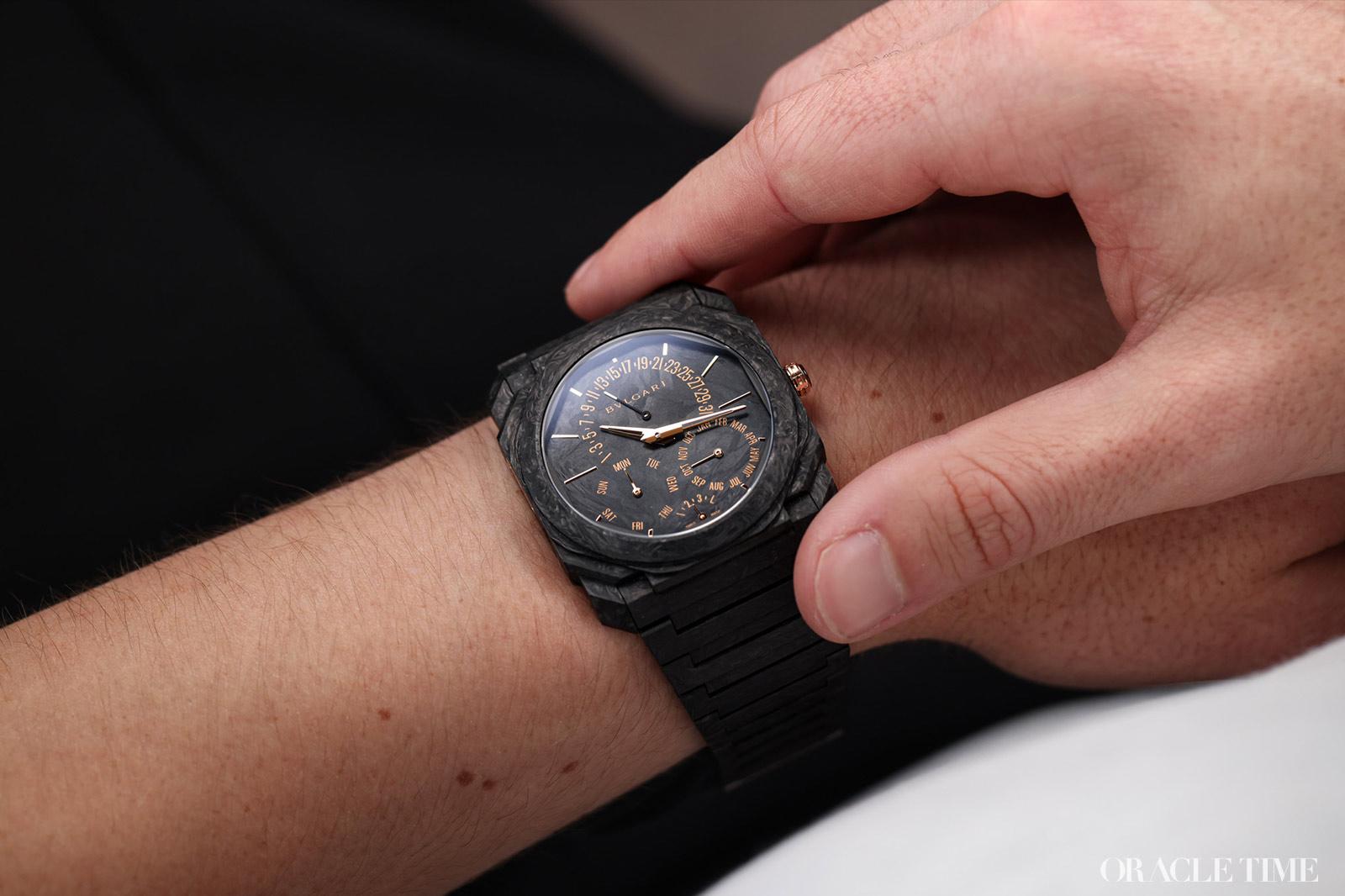
Bulgari Octo Finissimo Perpetual Calendar CarbonGold
All of this, however, begs a question I’m sure plenty of you have been wondering this whole time. Why? Why this emphasis on ultra-thin? Who even wants watches the thickness of a credit card? It’s something Kessler Snr. has been debating recently (in the latest edition of Christopher Ward’s Loupe, if you’re interested) and it’s an entirely valid question, one that Buonamassa has pondered too.
“For me, the ultra-thin watch is not the start of a journey. It’s a different kind of style. At the beginning of your collecting career, you appreciate a watch that everybody knows, when a watch is a sort of key to enter into a club. When you wear the wrong watch at the beginning, it’s not so cool.
“After that, they start to appreciate the complexity of the movement, they start to discover that it’s harder to produce a thin movement than a thick one. That’s when they start to appreciate the Ultra watches, they’re the ultimate expression, a showcase of Bulgari’s know-how.”

Bulgari Piccolissimo
For Bulgari, it’s also worked as a way of field-testing a few innovations, innovations that led to pieces like the Piccolissimo, the BVL 100 that represents the smallest movement of the 21st century. Debuted inside the glittering Serpenti Misteriosi Secret, it represents a nice feedback loop. First there was jewellery, then there was watches, now back to jewellery – via serious watchmaking.
I, for one, love an ultra-thin watch. They feel fantastic, look fantastic, and I’m one of those suckers for a mechanical showpiece that Buonamassa seems intent on designing for. Where Bulgari will go next with the concept, only time will tell. Thinner, smaller, more complicated, if there’s one thing we’ve learned over the last 10 years of Bulgari watchmaking, there’s always room to downsize.