The Panerai Luminor 31 Giorni PAM01631, unveiled at Watches & Wonders Geneva 2026, is the first Panerai watch – and one of only a handful of mechanical watches – to offer a 31-day power reserve. It is powered by the in-house P.2031/S calibre, developed over seven years by Panerai’s Laboratorio di Idee, and is limited to 200 pieces at a price of £69,100.
There were a lot of watches that were worthy of their own headlines this year. TAG Heuer refined the chronograph, Parmigiani hid the chronograph, and Breitling took their chronograph to space. Believe it or not, there were advancements outside of stopwatches and one of the most significant came from a brand that, on the surface, might seem like an outlier: Panerai.

Panerai’s aesthetics have remained relatively true to their Italian frogman roots in the eight decades since they were used in World War II. Think oversized cushion cases, chunky straps and sandwich dials aplenty. It’s a strong enough throughline that you often know what to expect. Even this year’s Watches & Wonders line was full of manual-wind Luminor models drawn from the archives. There’s a certain level of safety there. It’s generally a line-up that’s more about refinement than revolution, quality-of-life improvements over dramatic changes.
But while that makes up their core, there are genuine mechanical advancements happening in the wings. On one hand there’s the watchmaker’s emphasis on cutting-edge materials; on the other, there’s the movement development wing, an arm of the company that’s had its fair share of headliners, like the light-up Submersible Elux LABID. While the new Luminor 31 Giorni isn’t quite as sci-fi, it is much, much more important.

If you speak a modicum of Italian, the reason this watch matters is obvious. Giorni means day and a 31-day power reserve means that the Luminor 31 Giorni has the longest power reserve of any Panerai model in history thanks to the new P.2031/S calibre.
While the P.2031/S calibre is the most impressive power reserve Panerai have ever produced, it’s not the first time they’ve dabbled in long-term autonomy. In the 1950s, their military watches housed the Angelus SF240 movement, with 200 hours of power reserve. The first movement produced after their move to Neuchâtel in 2005, the P.2002 also included eight days of power with its three barrels, followed in 2007 by the automatic P.2003 with a 10-day reserve. It may be quite a leap from 10 to 31 days, but for Panerai the Luminor 31 Giorni falls neatly in line with historical precedent.

In the new P.2031/S calibre, the power is provided by a quadruple set of mainspring barrels that take up the larger part of the 276-part movement. To put that in perspective, when unwound those four series-linked mainsprings stretch 3.3 metres; when wound they can hold 36 days of power. Which brings up an interesting question: where did the other five days go?
At full wind or near depletion, a movement’s chronometric performance is all over the place. This is because the amount of energy being pushed through the movement isn’t consistent. Instead, the torque is higher the more energy wants to push through the movement and lower when it’s nearly out of energy. This bell curve of accuracy makes the middle days the most optimal to use.
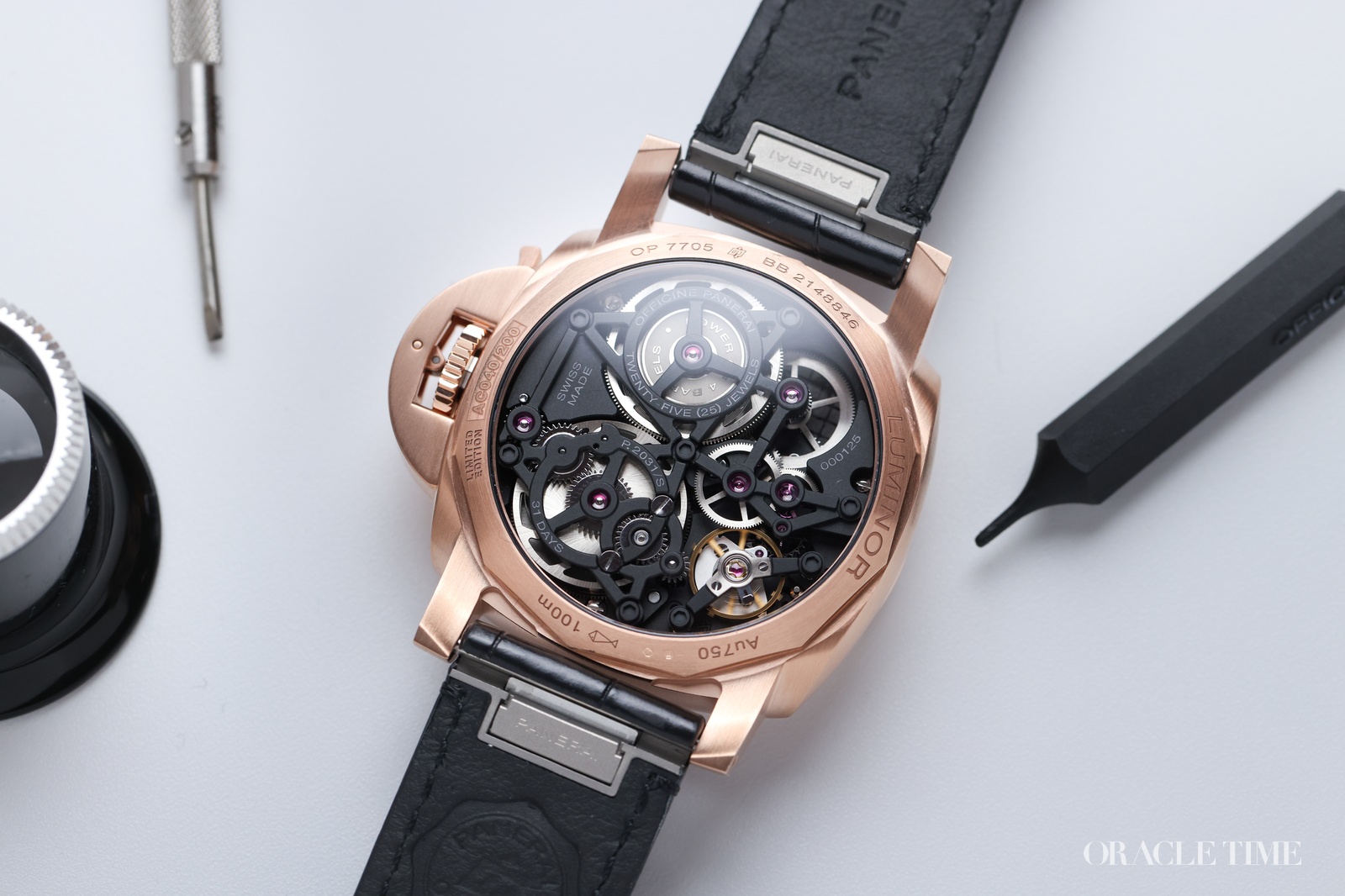
And so Panerai installed a torque limit into the winding system. It’s a complicated mechanism, but its results are straightforward. It won’t let the mainsprings wind beyond the 31-day mark and it stops the watch before it’s fully out of energy. It’s not a new idea – my 1955 Jaeger-LeCoultre Futurematic also stops before empty – but the mechanism itself is patent-pending. That’s not patent-approved of course, but it shows Panerai’s faith that this is indeed something new.
This not only gives you a month of autonomy, but one that maintains greater accuracy across its power reserve. This is a manual-wind movement of course, so if winding that level of power already had your fingers aching, it’s worth noting that the entire 31 days can be wound from empty to full with 128 rotations of the crown. It’s not as flashy as, say, the bezel winding system of the Haut-Rive Honoris or Moser & Cie’s new Streamliner Pump. Instead, it’s a familiar solution adapted to the new mainspring paradigm that is easily adaptable to other Panerai models.

What’s perhaps less historical is how it’s presented. The dial has been skeletonised with a grid pattern to properly show off everything that’s going on underneath. It’s not as open as some skeletons and is all the more readable for it, helped by gold hands, big, lumed indexes and a power reserve scale rightly dominating the scene at 4 o’clock. It’s an aesthetic used previously in the Radiomir 1940 Minute Repeater Carillon Tourbillon GMT, though I have to say more tastefully done here. Where the Radiomir’s grille was ornamentation around the edges, here it’s the main event.
The grille isn’t the only element borrowed from a previous rarity. The date indicator at three o’clock uses the same polarised date disc as the Submersible S BRABUS eTitanio PAM01403. This disc is completely transparent except when it crosses into the date window where the date shows. It’s less readable than a solid, high-contrast date wheel would be, but it allows an unobstructed view of the movement, which when the movement is the P.2031/S, makes sense.

The entire ensemble is housed in a surprisingly svelte (for Panerai) 44mm Goldtech case, the watchmaker’s proprietary, harder wearing rose gold alloy. Goldtech is a Panerai-exclusive alloy combining gold with copper, platinum and silver, making it more durable and scratch-resistant than standard rose gold. While I absolutely love the brand’s faux-worn Brunito finish and would love to see it on many more watches, it makes sense to present a piece like the 31 Giorni in one of Panerai’s most exclusive materials. The Luminor 31 Giorni PAM01631 is limited to 200 pieces, priced at £69,100.
Power reserve as a concept is being talked about more and more. Most brands have upped the power of their in-house movements this year and even Sellita have launched their new-generation SW200-2 Power+ with an extended 65-hour power reserve. And with the 31 Giorni, Panerai have put themselves at the centre of the conversation.

Theirs isn’t the longest power reserve in the world nor the most novel (that title belongs to the Vacheron Constantin Twin Beat at 65 days, while the A. Lange & Söhne Lange 31 shares the same 31-day figure) but it is one of the few that is both large and user-friendly. It doesn’t require special tools, it’s intuitive to use and won’t wear your wrist out before the indicator hits full, all the while maintaining greater reliability than most other movements. That’s innovation.
Price and Specs:
More details at Panerai.