At 8:07pm ET, 10th April – early on the morning of the 11th here in the UK – NASA’s Orion spacecraft splashed down in the Pacific Ocean. Having left 10 days previously with a suit full of instruments and a broken toilet, astronauts Reid Wiseman, Victor Glover, Christina Koch, and Jeremy Hansen were pulled from their bobbing craft by Navy divers of the USS John P. Murtha, concluding the record-breaking Artemis II mission.
This mission was the biggest test for NASA – and indeed manned spaceflight – since we first landed on the moon in 1969, the second in a programme of five missions that aim to not only return to the moon, but to go further and build an actual base on the moon by late 2028. Artemis II was a test flight, albeit one that went further into deep space than humans have ever gone before.

While this was a trial by fire for the Orion spacecraft, plenty of the equipment on board was tried and tested – not least the crew’s watches. They were all issued their official NASA timekeepers, the Omega X-33, and no surprise there. The Biel-based watchmaker’s relationship with the moon is well-documented, making the Speedmaster a horological icon. But the eagle-eyed of watch spotters might also have noticed another brand on the wrists of the Artemis II crew: Breitling.
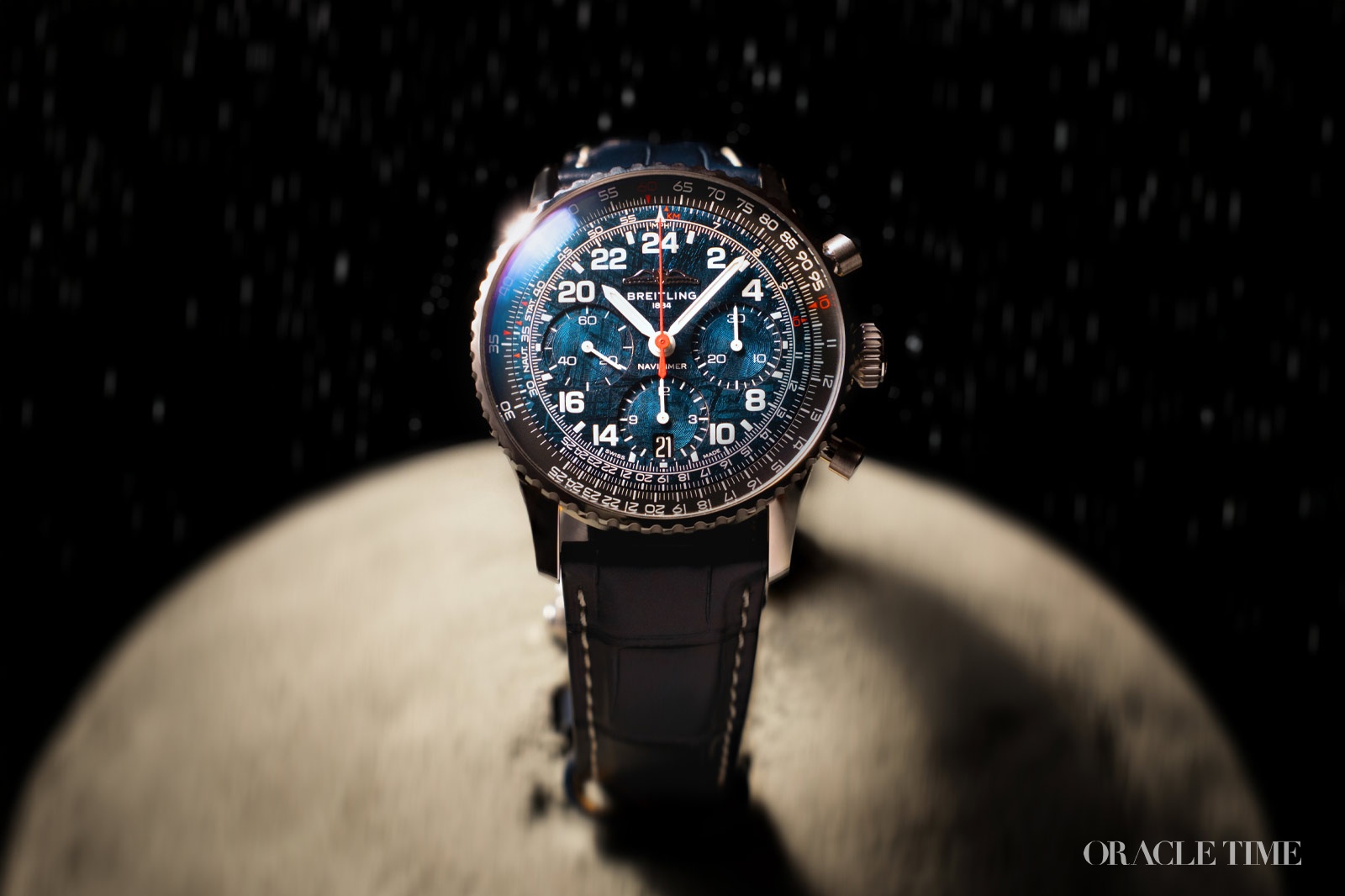
In the pre-launch snaps, all four astronauts are shown with their NASA-issued Omegas strapped to their space suits. But once they were outside the atmosphere, floating in zero-g, they all supplemented their specialist tool for a new, unreleased Breitling Cosmonaute. Through the footage beamed back to Earth from the Orion, it was hard to see precisely what model this mystery pilots’ watch was. We knew it had a blue dial and a Cosmonaute case. Now that the crew are back on terra firma however, we know it to be the fittingly named Breitling Cosmonaute Artemis II and that dial is actually blue meteorite.

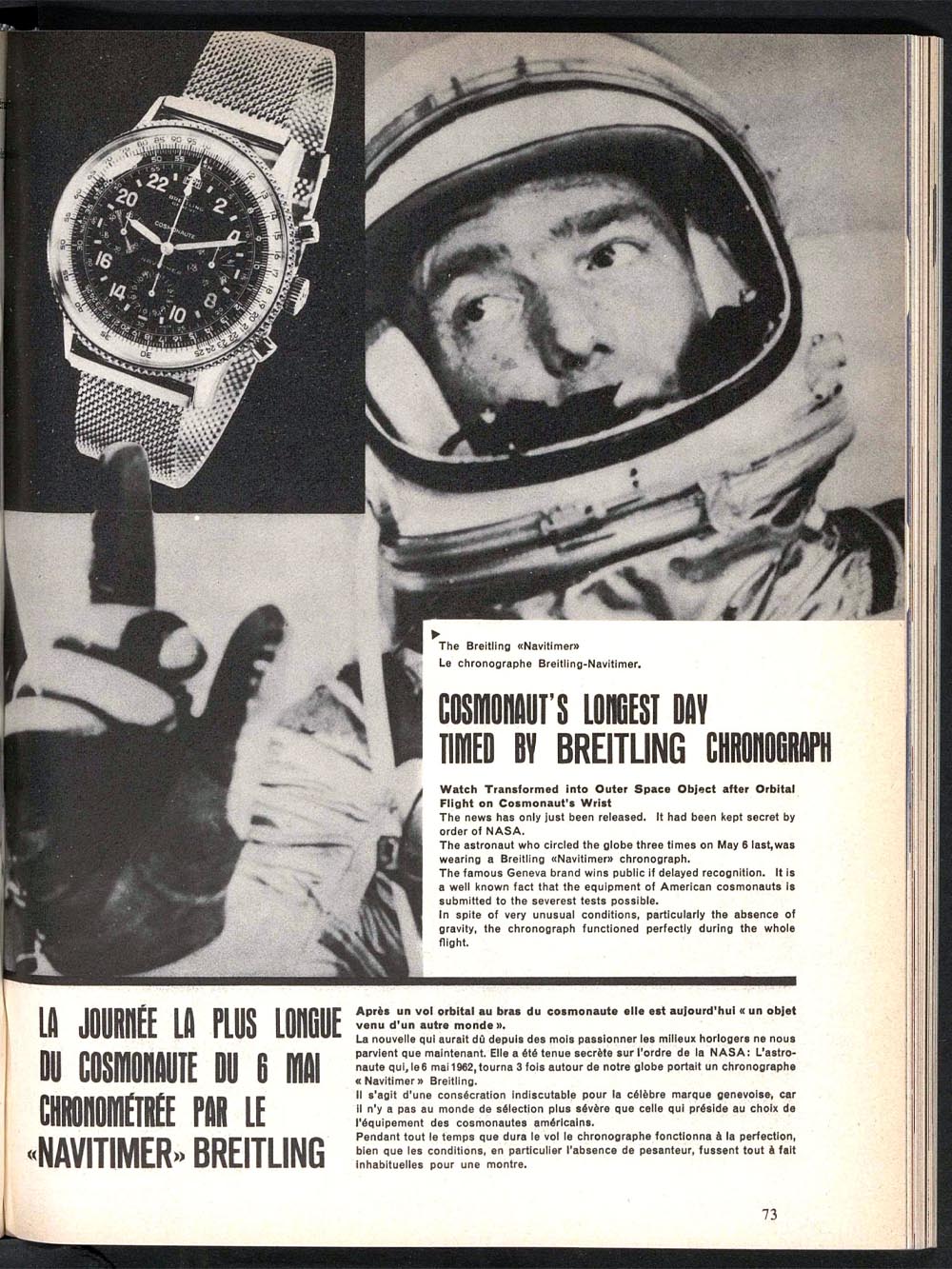
Before we get onto the new watch, it’s worth talking a bit more about Breitling’s own history with space flight. After all, Omega does tend to suck up all the very limited oxygen on board. And while it was indeed the Speedmaster that first landed on the moon, Breitling’s story starts years earlier with the 1962 Aurora 7.
On 24 May 1962, astronaut Scott Carpenter launched aboard the Mercury-Atlas 7 – named Aurora 7 – for three Earth orbits, a repeat of John Glenn’s previous Mercury-Atlas 6. It lasted just four hours, 56 minutes and five seconds. Fun fact: Carpenter’s home address growing up in Boulder Colorado was Aurora Ave. and Seventh Street. This has nothing to do with the naming of the spacecraft, it’s sheer coincidence.
Pre-mission, Carpenter was preparing. There was no established NASA timepiece in these early days, and he wanted a mechanical failsafe for his on-board equipment. Like many astronauts, Carpenter was a US Navy test pilot and was already familiar with the Breitling Navitimer and its ‘aviation computer’ slide rule. However, as his threefold orbit would take in multiple sunrises and sunsets in a day, he needed a watch with a 24-hour display. Breitling quickly adapted the Navitimer, slowing down the hour hand to turn once a day, and in doing so the Cosmonaute became the first Swiss wristwatch in space.
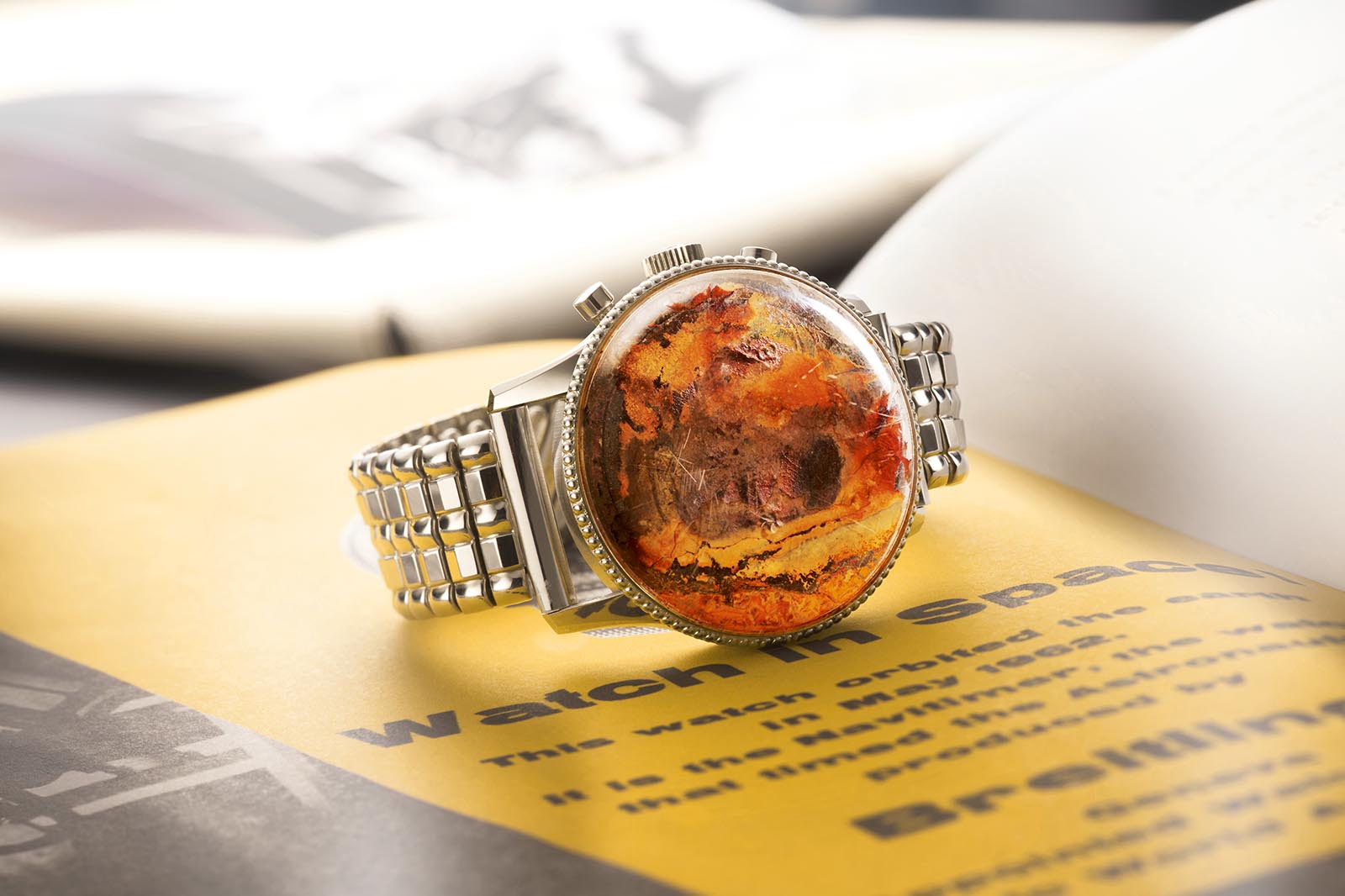
Things were less smooth on Carpenter’s re-entry. An apparent pilot error caused Aurora 7 to land dramatically off-course, overshooting its target and causing Carpenter to wait for three hours, bobbing in the ocean, for pickup. In that time, his new watch was damaged by seawater. Breitling gave Carpenter a replacement, hiding the old, corroded prototype in its archives and the Cosmonaute collection was born.
That first production model was the Reference 809 and to this day you can still find good condition models for under £5,000. For a piece of spaceflight timekeeping history, it’s a great buy. Since then, the Cosmonaute has been a core part of Breitling’s line-up, a more specialised take on their perennially popular Navitimer.

It’s a story that was brought back into sharp focus in 2022, on the occasion of the 60th anniversary of the Aurora 7 mission. Breitling of course released a limited edition Cosmonaute to celebrate, a 362-piece limited edition with a platinum bezel. But they also revealed for the first time Carpenter’s original, water-damaged prototype. And yet while Carpenter’s mission marked the first Breitling in space, it was not the last.
In 1996, the first French woman in space, Claudie André-Deshays, double-wristed Breitling with a Cosmonaute on one wrist, an Aerospace on the other. In 2022, Robert Hines wore a Navitimer B-1 en route to the International Space Station and as recently as 2025 Polish ESA astronaut Sławosz Uznański-Wiśniewski wore a 24-hour Navitimer during his 20-day spaceflight. They were joined by spaceflight alumni like John Glenn, the first American to orbit Earth, and Gemini 4 and Apollo 9 commander James McDivitt, who both wore Cosmonaute models on the ground.

While NASA can dictate which timepieces astronauts are issued, they can’t control what they wear personally, and as Artemis II has shown, the Cosmonaute remains as popular among astronauts as the Navitimer is among pilots. So perhaps it’s not surprising that Breitling has returned to space once again aboard the most significant programme of manned missions in history – or that the new Breitling Navitimer B02 Chronograph 41 Cosmonaute Artemis II might be the best-looking yet.
As the less-than-catchy name suggests, this is the classic 41mm Navitimer at its heart. That means a stainless-steel case with 30m water resistance (be as careful of seawater as Carpenter should have been) with that notched, slide-rule bezel.

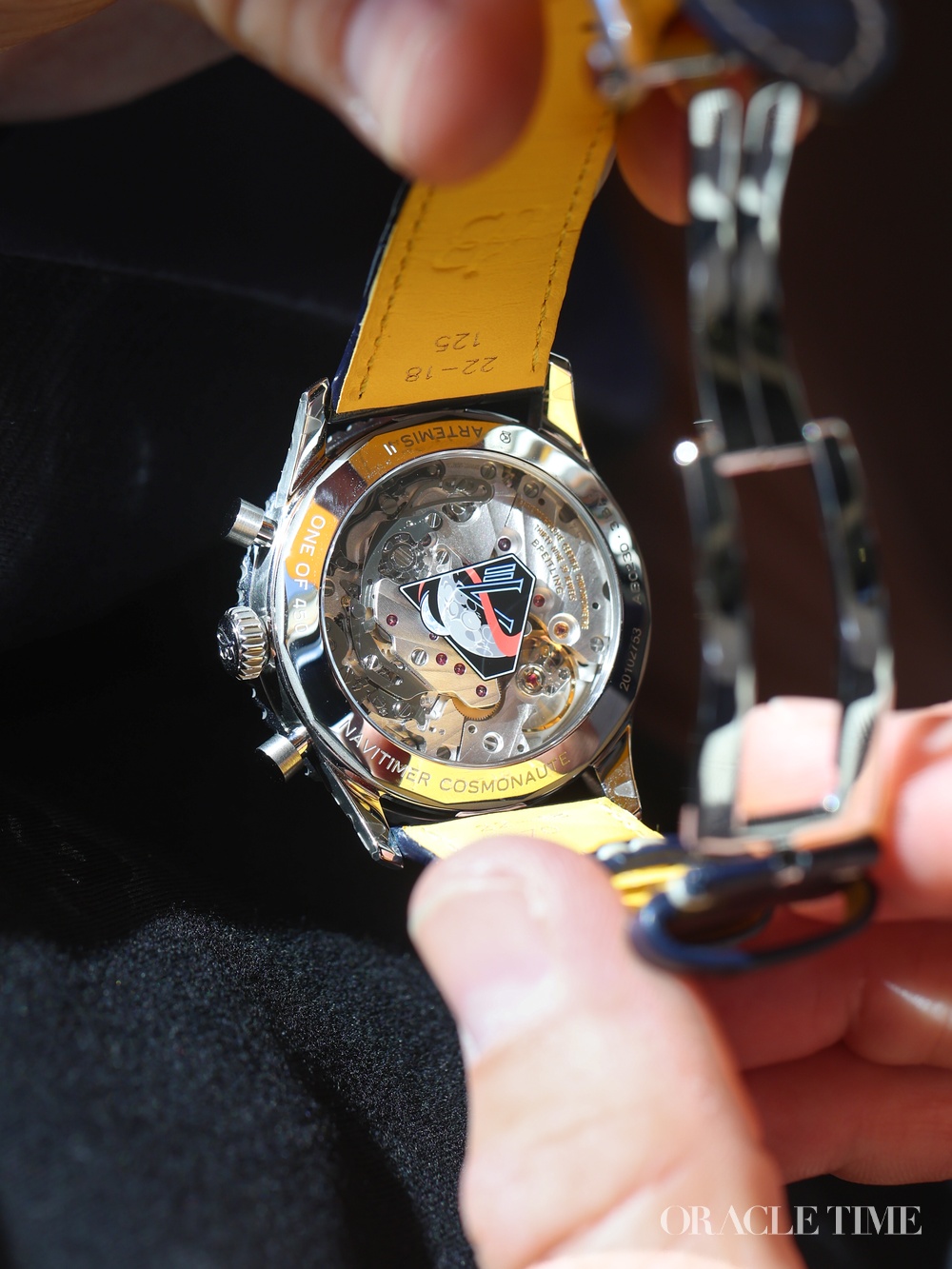
Inside is the calibre B02 column-wheel chronograph movement, with a weekend-proof 66-hour power reserve and a 4Hz frequency. With COSC-certification, that means it’s tested to an accuracy of -4 to +6 seconds per day. It’s visible through the sapphire caseback along with, of course, the Artemis II mission logo printed on the rear crystal.
The difference here of course is that the new Cosmonaute has a 24-hour dial rather than 12 and, more importantly, that new dial is made from meteorite. While we could see the blue colour as the Artemis II crew were floating in space, we couldn’t catch the signature Widmanstätten pattern created by the iron-nickel alloys cooling over millions of years.

The Artemis II mission has stoked space fever to new heights as humanity gets closer than ever to having a permanent foothold into the cosmos. And while Breitling aren’t the only watchmaker capitalising on it – just check out IWC’s new partnership with Vast, for one – Breitling has arguably the most authentic spacefaring heritage of any watchmaker.
More details at Breitling.