Michael Jordan wears one. So do Johnny Depp, Ed Sheeran and, as of this summer, the man who runs OpenAI. Vanguart has made fewer than 200 watches in nine years, yet seems to have put many on the most-photographed wrists on the planet without a marketing machine behind it. We find out how four men and a living room in Basel pulled it off.
Somewhere in Marbella last year, Michael Jordan was photographed wearing a watch with no hands, twin crowns that work like joysticks and a tourbillon spinning at its centre like the plughole of an emptying bath. Johnny Depp wore one to a premiere. Ed Sheeran and John Mayer have them. And in August, Sam Altman, one of the most talked-about and, depending on your view of artificial intelligence, most divisive men on the planet, commissioned seven of them for the people who run his company: numbered, engraved ‘Limited OpenAI’, and not for sale at any price. The maker’s president says the commission “will remain unique in our history”, which means you can’t get one. Even if you could afford it.
That maker is Vanguart, a company with 33 employees based in Switzerland’s watchmaking heartland of La Chaux-de-Fonds that has built fewer than 200 watches, ever. The obvious question is how a brand this small gets on some of the most powerful wrists on the planet. The answer starts nine years ago with a drawing, a spreadsheet and a flat in Basel.
The Living Room
For a watch company, Basel in 2017 was exactly the right place to be born: the city had hosted the biggest watch fair on earth for a century, and Baselworld still had two editions left in it (albeit shadows of their former selves). It was from his living room there that Axel Leuenberger started Vanguart. He is a mechanical designer by trade, and he learned it at Audemars Piguet Renaud & Papi, the Le Locle workshop that builds the complications other houses put their names to. He and Jérémy Freléchox met there in 2010, both working alongside Giulio Papi on movements for Audemars Piguet, Richard Mille and Chanel; Freléchox went on to run movement creation projects after six years at Girard-Perregaux. If you were going to pick a primordial soup from which one of the most interesting watches of the past decade might crawl, APRP is where you would pick.
The drawing belonged to Thierry Fischer, an industrial designer from the design specialist Etude de Style. A decade earlier, as a diploma project, he had designed a watch without hands and without much regard for what a movement could physically do, and called it the Black Hole. The two engineers looked at the thing every watchmaker would have told him was impossible and started working out how to build it. The fourth man, Mehmet Korutürk, an Istanbul financier with a Formula 1 background, brought the address book and, eventually, money from outside the industry. Four prototypes and more than a hundred case shapes later, a 2020 launch slid into 2021, but by then the philosophy had set. Vanguart thinks of itself as an engineering company that happens to make luxury objects, and the brand’s stated first pillar is quality that goes beyond what is visible. A few dozen watches a year, and no target to make more. “The low volume is a consequence of our level of execution,” says Leuenberger. “The objective is not to make more watches, but to keep improving.” Two shops on earth, Material Good in New York and Ahmed Seddiqi & Sons in Dubai, and everything else direct.
The Black Hole
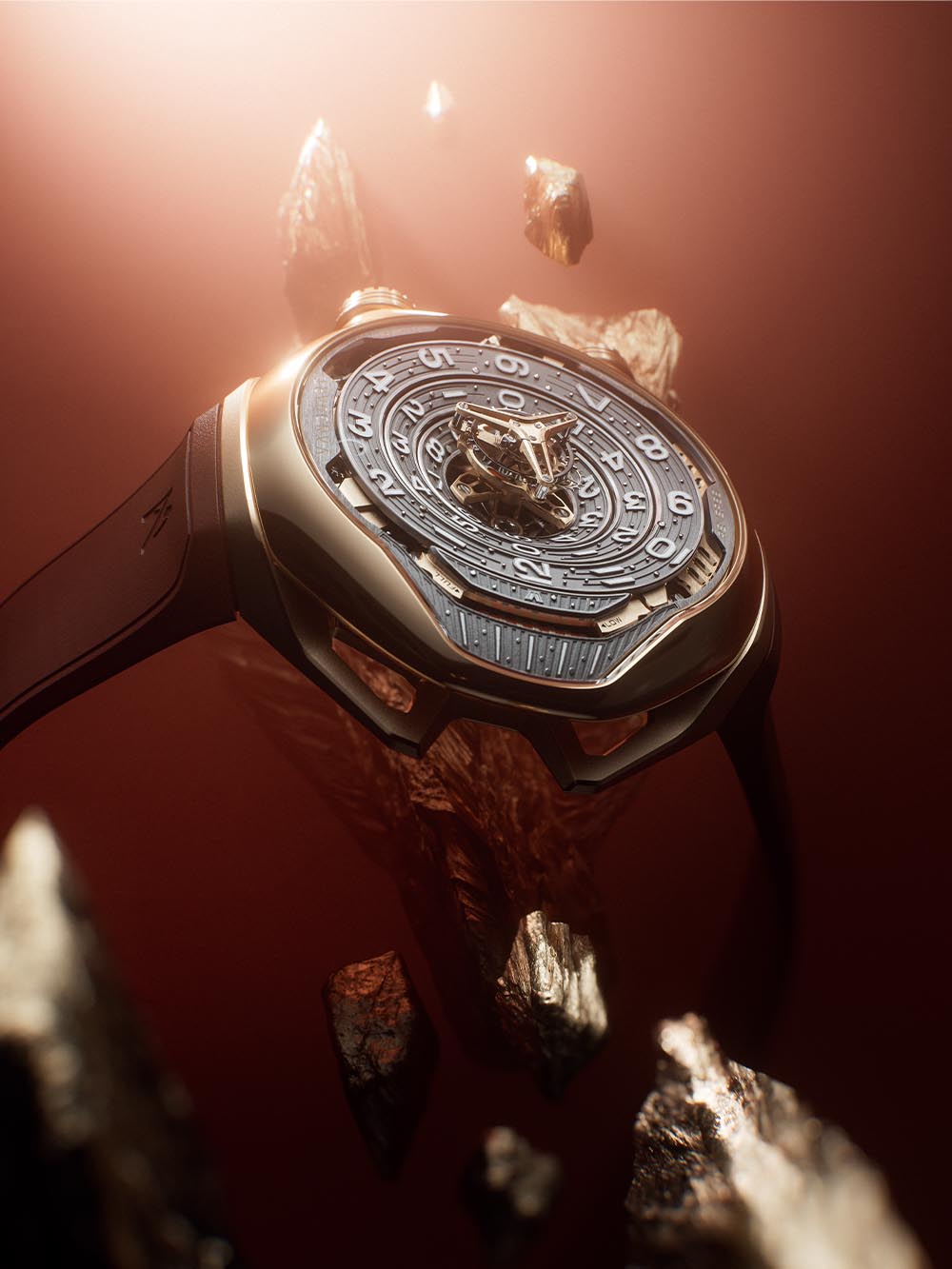
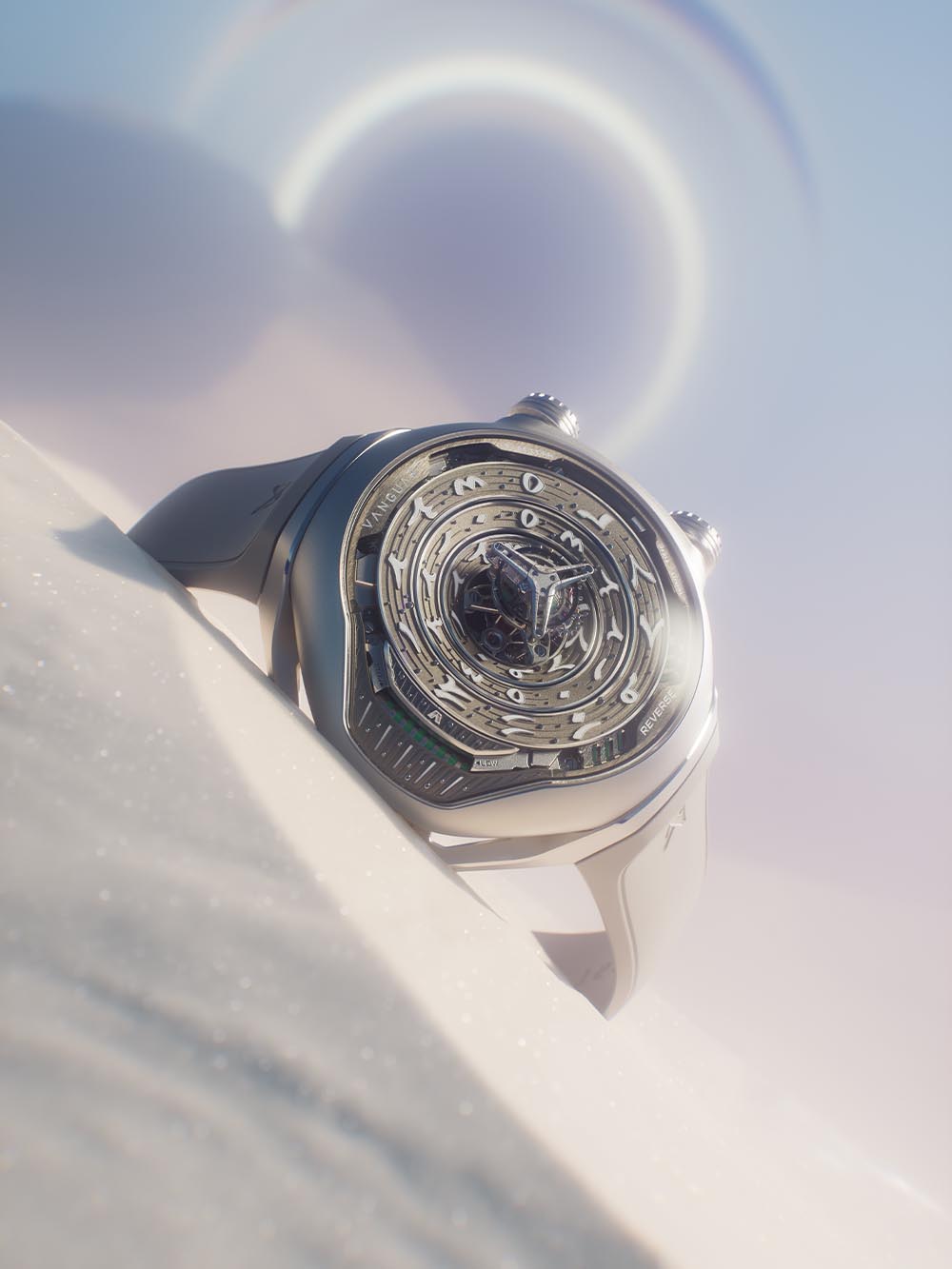
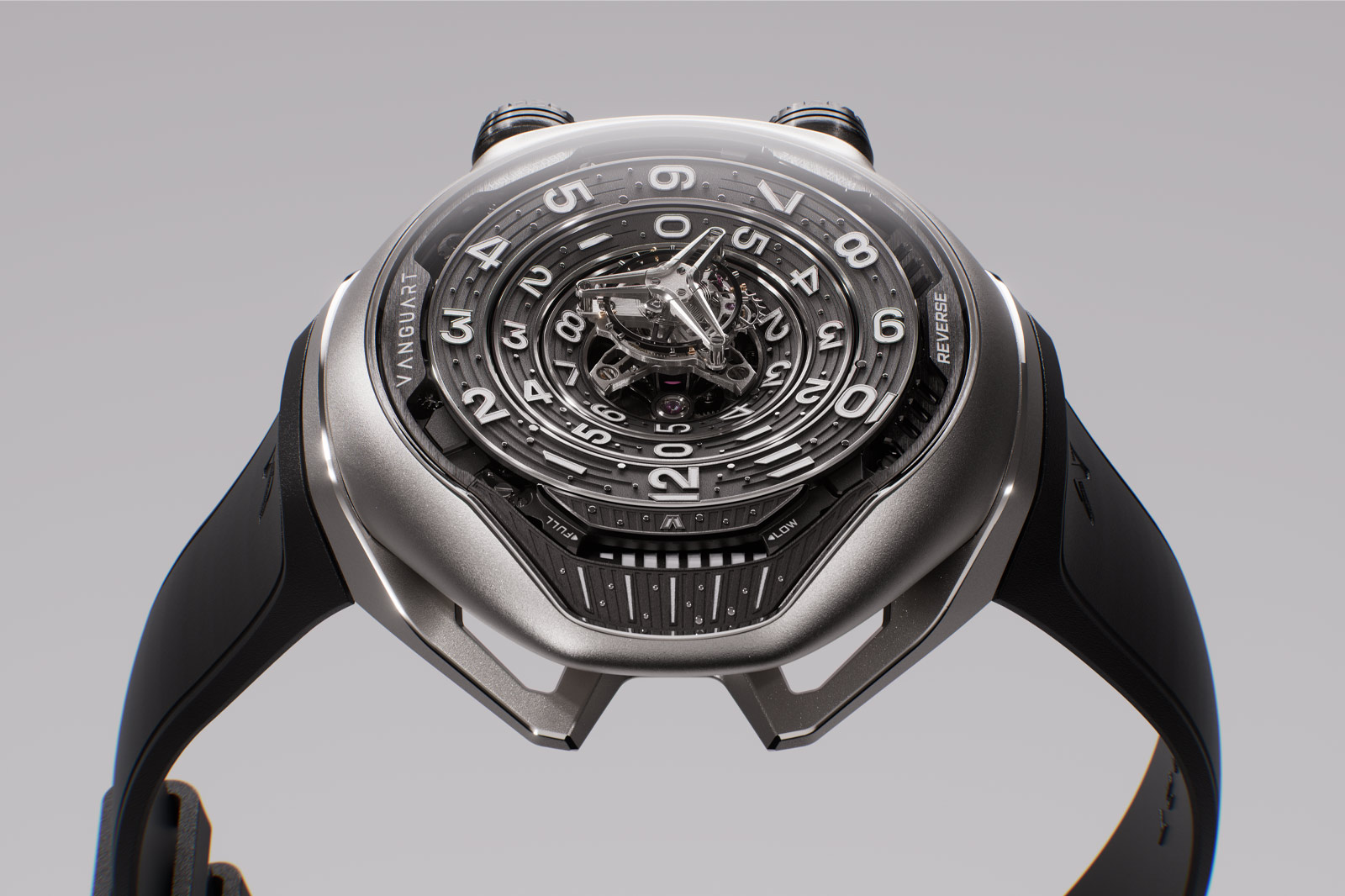
The watch that started it is still the most extraordinary thing the company makes, and it has to be seen in the metal. I have had that pleasure a couple of times, most recently at Dubai Watch Week last November, where a chance meeting with the brand coincided with two new editions: a rose gold version with textured rings at CHF 410,000 and a titanium one with hand-painted Eastern Arabic numerals at CHF 355,000, which in a room full of very good watches was the one people kept coming back to. Set the time and there is a fractional lag before the display changes, a pause that makes a 750-component mechanical movement feel, for half a second, as if it runs on a battery, or is computerised in some way.
At the centre sits a flying tourbillon of 88 parts weighing 0.225 grams, placed exactly where a tourbillon is hardest to put, so the whole architecture radiates from it. Around it, three rotating discs carry the hours and minutes and jump into position in 200 to 500 milliseconds, a linear, almost digital readout the brand likens to spacetime bending around a mass. The two crowns behave less like crowns than joysticks, twisting to advance or reverse the display. Beneath it all is calibre T-1701: two barrels, twin gear trains, 42 hours, mainplate and bridges in titanium, micro-blasted, satin-finished, black-polished and hand-bevelled, inside a 43mm micro-blasted exoskeleton of a case that is all curves and polished bevels. “When you pass the light and see it moving over the watch it’s incredible,” Leuenberger told us back in April 2025, and he is right. Editions run to eight pieces at prices from around CHF 300,000. Jordan’s, for the record, is the original.
The Orb
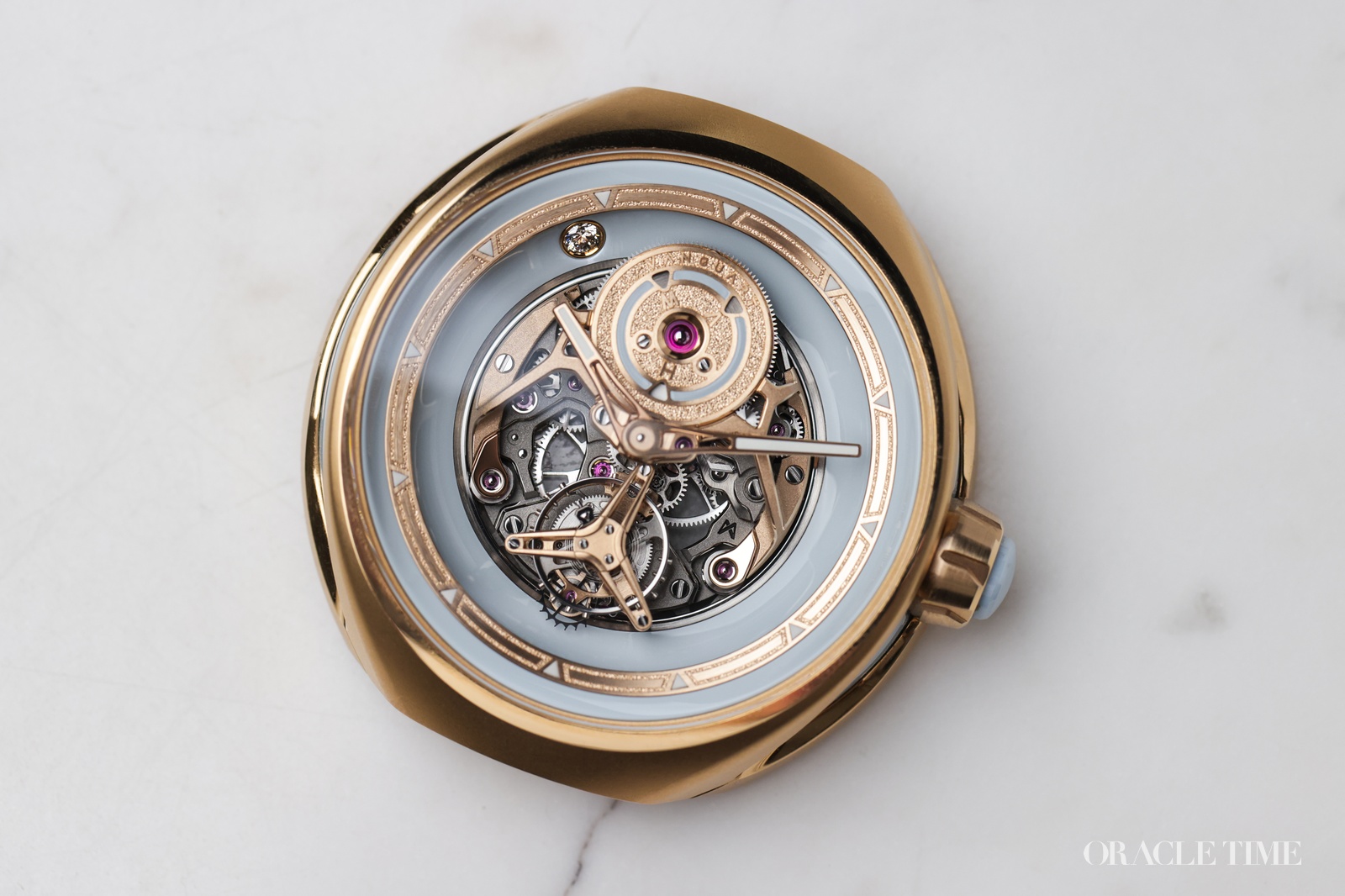
If the Black Hole is the big bang, the Orb is the planet that formed afterwards: still spectacular, but you could live on it. Launched in 2024, it is round, 41mm across and a surprising 10.5mm thick, with a caseback curved to the wrist and a fully exposed titanium movement: 395 components, a 3Hz free-sprung balance, a flying tourbillon at six and 60 hours of reserve. Its party trick is a pusher in the crown. Press it and a ring around the barrel at 12 shows M, A or H: manual winding, automatic or time-setting. In A, a bowl-shaped titanium mass tipped with a two-millimetre diamond is released to orbit the dial on a sloped track. It sounds like a gimmick until you have spent five minutes flicking between modes and watching the diamond go round. CHF 150,000 in titanium, CHF 180,000 in rose gold.
In April the Orb got its first splash of colour, and how that happened tells you a lot about how this company works. In 2025 a private client commissioned a series of unique Orbs with ceramic in them. There was no ceramic Orb, so one client’s order became a year of research, and the result is two 25-piece editions: the Orb Pink Ceramic Titanium and the Orb Blue Ceramic Rose Gold. The colours are the surprise. Not the usual black or white but soft, sun-faded pastels, a dusty pink and a powder blue, the sort of shades you would expect on a summer linen shirt rather than a six-figure tourbillon. The ceramic sits in the case flanks and in the pusher set into the crown, sculpted into the Orb’s compound curves and polished by hand, and it will neither scratch nor fade. The curved rehaut and the orbital mass, which have to stay metal to do their jobs, are colour-matched with an automotive-style micro-painting process that took months to get right.
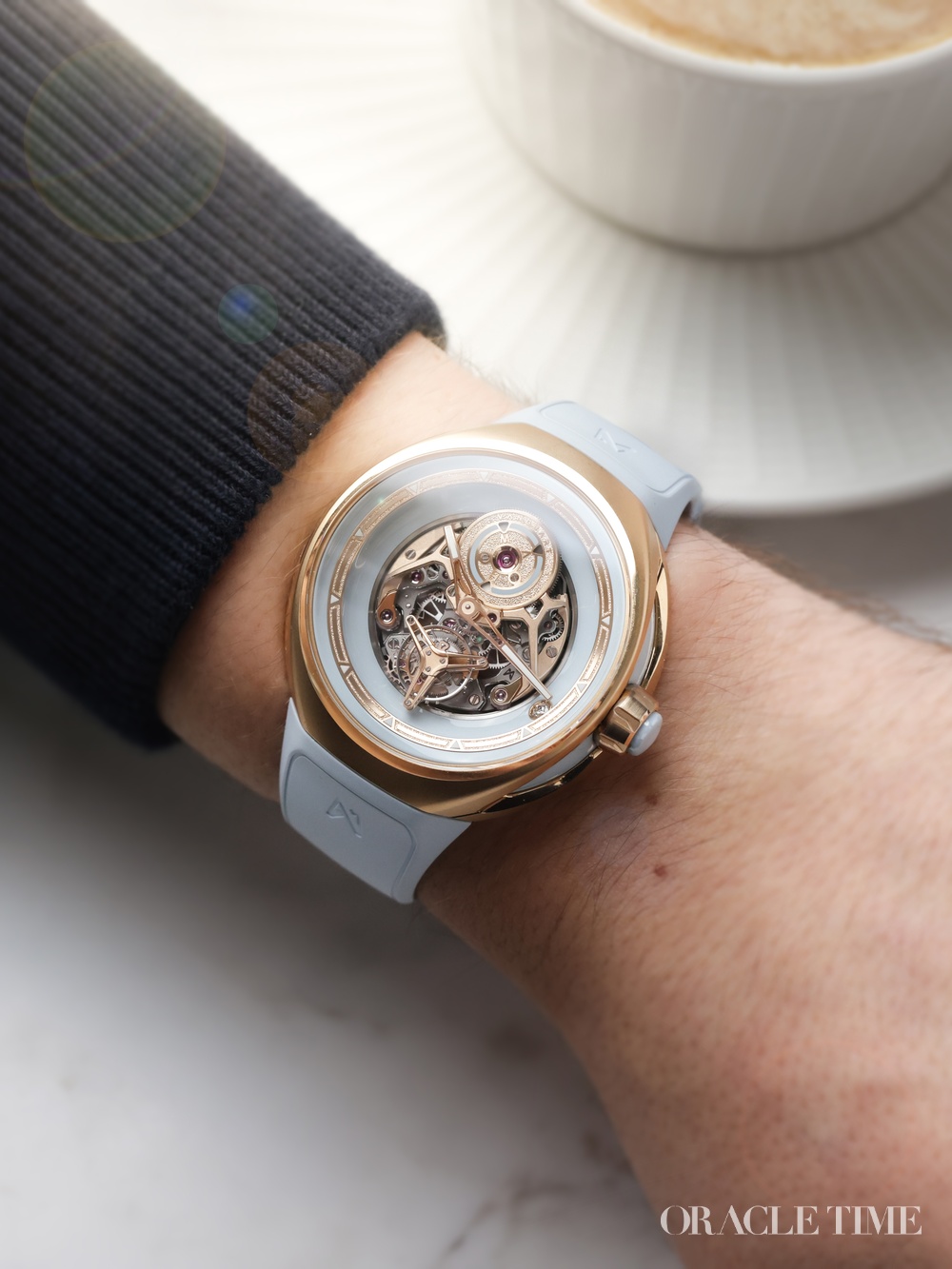
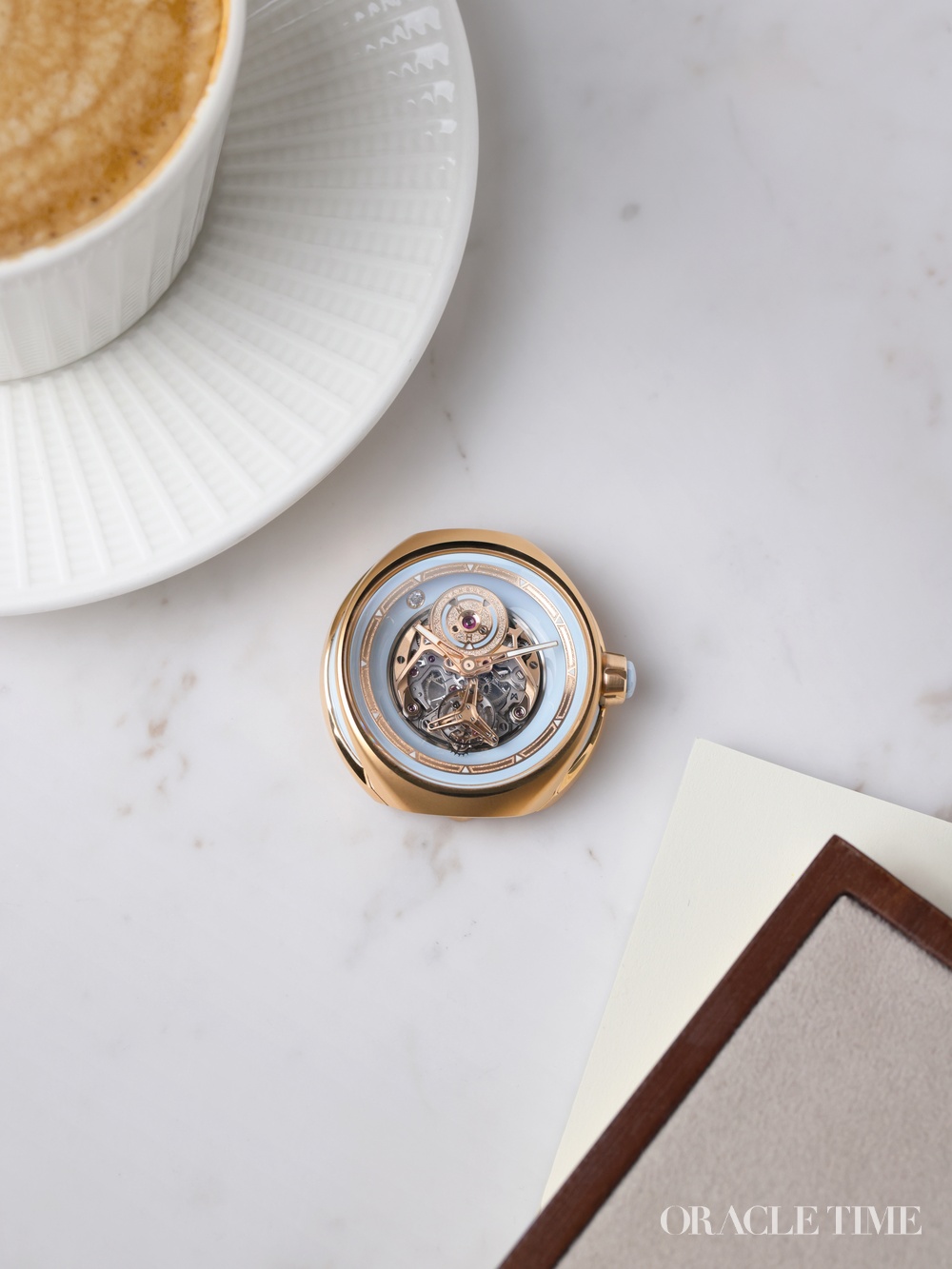
Anyone who has toured a ceramic workshop will know why the colour is the hard part. I learned it at IWC in Schaffhausen: the pigment is mixed into the zirconium oxide powder before the case is pressed and fired at around 1,400 degrees, the part shrinks by roughly a quarter as it sinters, and the heat does unpredictable things to the pigment. Black and white are forgiving. A pastel is not, because the tiniest shift in temperature or dosage turns pink to salmon or blue to grey, and every batch has to match the last. Vanguart’s answer was a new formula of its own and bespoke tooling to press it. The finishing was pushed on too: the pink model’s mainplate is PVD-coated in a deeper rose and then bevelled again by hand so the polished titanium shows through the edges; the blue wears its barrel bridge and tourbillon cage in gold; both get new three-dimensional bevelling on the central bridge and colour-matched rubber straps that swap out via a concealed pusher on the caseback. The pink is sold only through Material Good in New York, each caseback engraved with an MG monogram. “Our clients expect pieces that move with them, across different moments, different environments, different lives,” says Koruturk. A commission became a collection. Remember that.
The Company They Keep
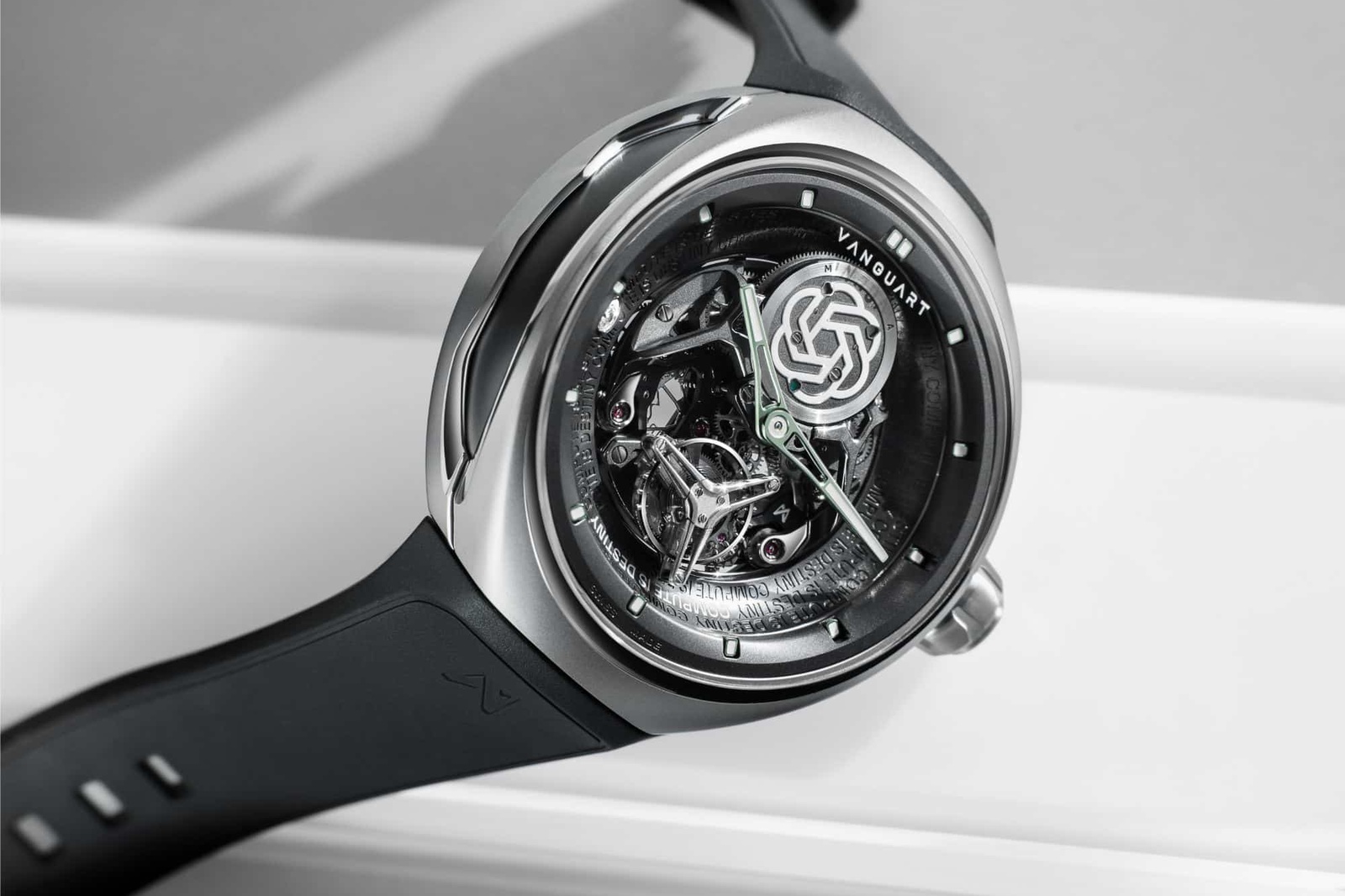
Which brings us to OpenAI. In August, Vanguart confirmed that Sam Altman, the man whose company gave the world ChatGPT and who now sits in the room with presidents and prime ministers, had come to La Chaux-de-Fonds for a private commission: seven Orbs, one for himself and six for his senior team. For a nine-year-old manufacture with 33 staff, it is a remarkable client to land. The Orb underneath is untouched. The OpenAI logo sits on the barrel cover; ‘Compute is destiny’, a phrase attributed to Altman, runs in capitals around the rotor; ‘Scaling’ is on the crown pusher; and on the back, a single line of code that reads as either prophecy or prayer, depending on your mood. In a month when the people building artificial intelligence have been voicing their own worries about it, it lands as the latter: Koruturk says it “means that artificial intelligence must be used for peaceful purposes”. The brand’s own summary is the sharper one: the challenge “was not mechanical but narrative. It is about understanding who the client is, what resonates with us, and translating that into the watch,” says Leuenberger.
You do not need to care about AI to see what has happened. A watchmaker this small has become the place the world’s most demanding clients go when they want something made for them alone. And those commissions do not stay private for long: the pink and blue ceramic Orbs began life as one collector’s bespoke order and ended up as a collection, so it is worth watching what the OpenAI project becomes. New models are promised for 2026 or 2027, among them an entirely new line, and the company is about to move into a new manufacture to build them. On the evidence of a Basel living room, a student’s impossible drawing, two pastel tourbillons and seven watches nobody can buy, this decade’s space for a new independent has been taken.
More details at Vanguart.

![Ulysse Nardin Introduce Freak [One Blue Enamel] and Freak [One Guilloché] for 25th Anniversary](https://oracleoftime.com/wp-content/uploads/2026/09/Ulysse-Nardin-Freak-ONE-Featured-600x337.jpg)