Previously in the Euros: Round of 16
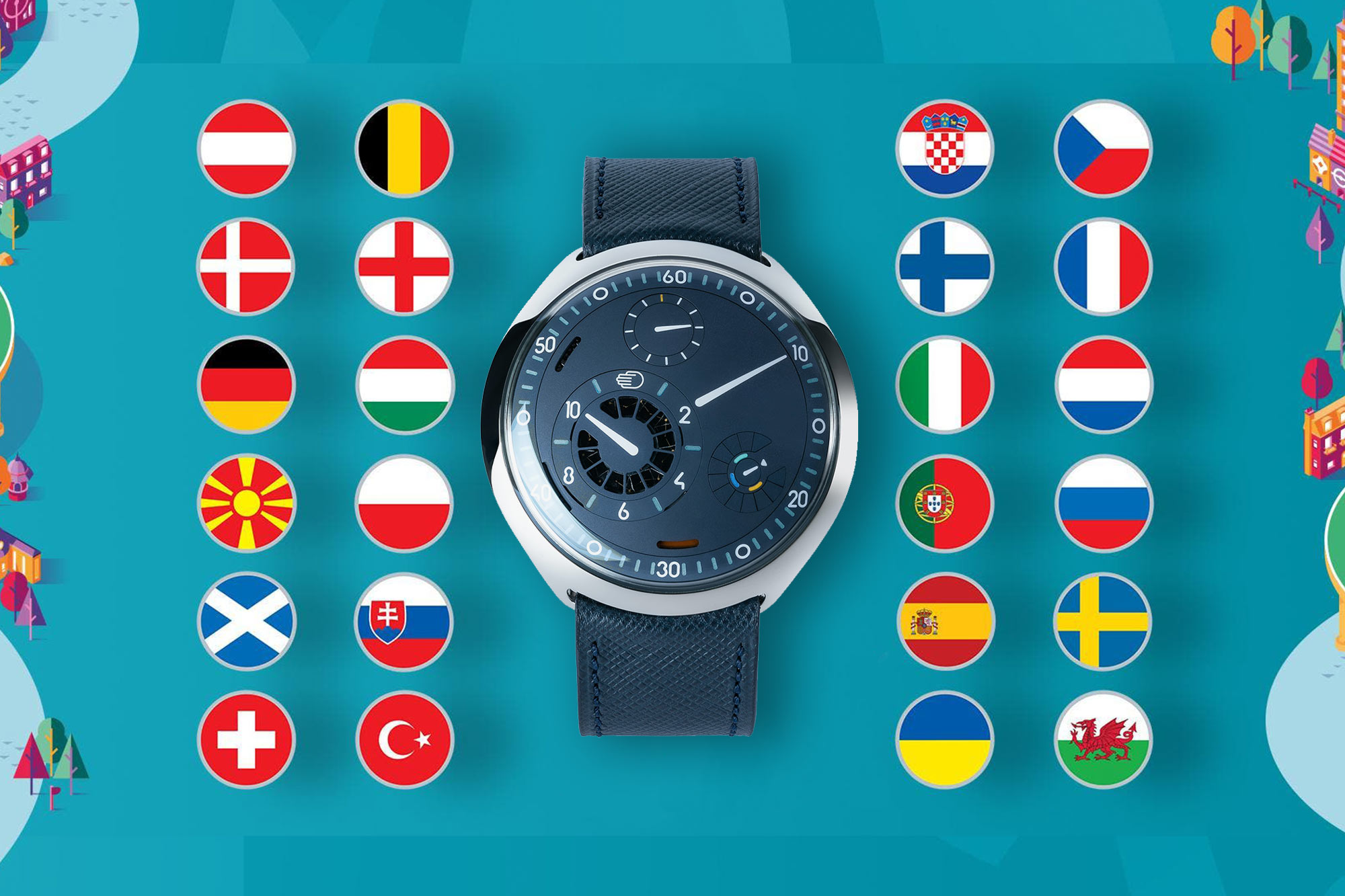
Welcome to the quarter-finals of the Euros of Watches, our imaginary championships to determine the best watchmaker in Europe. However, it seems reality is stranger than fiction, because while we had England losing in the Round of 16, the real football players at the actual Euros achieved the impossible last Tuesday by knocking out Germany!
If you haven’t been following along with our watchmaking tournament, don’t worry you can still catch up with our full list of competitors and the results of the round of 16, although at the end of the day this is just a bit of fun. As a reminder, each country is represented by a single watch that epitomises their watchmaking skills, going head-to-head until only one timepiece and one country remain.
With the hypothetical crowd filling the stands, it’s time for the national anthems and for the games to begin.
Germany (A. Lange & Söhne Lange 1 Perpetual Calendar) vs Scotland (anOrdain Model 1)

Kicking the quarters off is Germany’s A. Lange & Söhne against Scotland’s anOrdain. With the game is in its early stage – the ball being passed around midfield – let’s take this opportunity to take a closer look at our two teams.
AnOrdain is one of the lesser-known names who have made it to this stage in the competition but they’re certainly deserving. The 38mm case of the Model 1 is simple and attractive with a cool engraving of Scotland on the reverse side. However, the star feature has to be the green fumé dial, which is absolutely gorgeous and smoky.
On the other end of the pitch, the Lange 1 has been a dominant player in the watchmaking scene throughout its existence and the addition of the perpetual calendar has only made the watch stronger –
We have to cut straight back to the action as the Scottish side launch a strong offensive into the German half, making it as far as the box where their finishing capabilities make them extra dangerous. But the German defence is strong and they’re well aware of the risk, as masters of enamel themselves.
That one attempt is the closest that the Scots get to scoring for the remainder of the match, because while they can equal the German’s enamelling, that’s about it, and the patron saints of Glashütte horology make for an unassailable opponent.
Winner: Germany
Netherlands (Grönefeld 1941 Principia) vs Italy (Unimatic U2 F)

The Italian Unimatic U2 F is hoping to turn its form around after a close match against the Russians in the round of 16, closer than many were expecting. But the competition is tough with the Netherlands’ Grönefeld 1941 Principia flying through the previous round relatively untested, although that makes it difficult to gauge their true strength.
On paper, both sides look strong: the Dutch are big believers in haute horology, relying on their G-06 calibre to push the ball over the line. It’s a formidable weapon in their arsenal with a strong 56-hour reserve and handcrafted decoration, complimenting the 39.5mm stainless steel case.
In contrast, Unimatic prefer to prepare for the game with a field watch bootcamp, running the U2 F through numerous drills to keep it lean and utilitarian with very little embellishment. The rugged aesthetic makes up for the NH35A automatic movement, which can’t stand up to its opposing number.
With the game underway, predictions are split as to who will take the win: lots of people favour the award-winning haute horology of the Dutch despite its niche appeal but the sleek field watch of the Italians is much more of a crowd pleaser. The Italians are up against it as Grönefeld land the first goal.
However, as the match progresses, fate intervenes as the heavens open and rain begins to pour onto the pitch. With the ground slick underfoot the Grönefeld begins to struggle with their 30m water resistance while the Unimatic continues to sail around the pitch with its 300m water resistance leaving it unaffected by the weather. The Italians claw back the win.
Winner: Italy
Belgium (Ressence Type 2 N) vs Switzerland (Rolex Explorer Bi-Colour)

Prestige against innovation here and any other year it would be an obvious win for the Swiss. 2021 hasn’t been their strongest though and as we discussed pre-game, people are questioning if fielding the new Rolex Explorer bi-colour was the right decision.
In the early game people’s fears are assuaged as the slim 36mm diameter proportions of the Rolex let it slips past the defence of Belgium’s Ressence Type 2 N, which has a much chunkier 45mm case. That happens a couple of times and Switzerland take a comfortable lead.
But the Explorer hadn’t reckoned on the Ressence’s secret tech. The Belgian has a mechanical movement controlled by an e-Crown, which is capable of locking the power reserve barrel in place so that it doesn’t wind down when the piece isn’t being worn. It turns out that Rolex’s tactics were so predictable, with little innovation for 50 years, that the e-Crown thought Ressence wasn’t active and was limiting its power.
Fully unleashed, the modern innovations of the Belgian side begin to take their toll on the Swiss and the score ties up. With no decisive outcome as the clock ticks down, it’s on to penalties. The Explorer starts with a good showing, getting plenty of power from the 3230 calibre behind its shots. However, with its carousel display, the Ressence can get some truly outrageous spin on the ball, sealing the match for Belgium and upsetting the natural order.
Winner: Belgium
Spain (Pita Barcelona Molinos Orbital ‘Classic Edition’ display) vs France (Yema Navygraf Marine Nationale)

After three competitive quarter-finals, we’re looking forward to a good showing from the Spanish and French sides as the Yema Navygraf Marine Nationale takes on the Pita Barcelona Molinos Orbital ‘Classic Edition’.
The attitudes of the teams couldn’t be more different as they take to the pitch: the Spaniard looks confidant after breezing through the round of 16 and spends its pre-game time playing to the crowd, once again relying on the flashy gear display dial to carry them onwards. In contrast, the French side is laser focussed, running through a few last-minute drills with military precision – unsurprising as the team works closely with the French Navy.
As soon as the game starts the French take control of the ball and really that’s the end of it. Despite Spain’s hand-finished automatic Calibre Pita W6.6 with 42-hour power reserve they barely get a foot to the ball more than a few times in the first half – it’s a tough reality check and hopefully they can reset their mental for the second.
Unfortunately, it wasn’t meant to be for Spain as the Yema Navygraf uses its GMT function at half-time to show a second time zone, revealing that they have second, more aggressive strategy prepared and totally breaking the Pita’s ankles again.
After a relatively easy ride through to the quarters, Spain’s haute horologists can’t compete with the French savoir faire and heritage of Yema.
Winner: France
That wraps it up for the quarter-finals and it’s been an eventful couple of games. Most notably seeing the elimination of tournament favourites Switzerland. Italy is certainly the dark horse (dark horologist?) of the competition with a few unexpected wins under their belt. You shouldn’t rule out the German and French competitors though, who could well meet in final given the way the draw works out.
Again, we say farewell to those timepieces that haven’t progressed to the next stage of the competition, which will begin later this week.