The British watch industry is a highly diversified space full of brands exploring exciting concepts and specialised designs. I think of Garrick’s ultra-high end engraved dials, anOrdain and their mastery of enamel, and more recently the founding of McQuaide, the first British brand dedicated to creating Damascus steel watches. I’ve been hands-on with their debut creation, the Q1 (in its Crimson edition), to learn all about it.
Starting with the case, it is styled in the archetypical dive watch style. Meaning it is a substantial piece of wrist-kit, measuring 43.2mm in diameter with a 15mm thickness. That is unquestionably bulky and on the whole it’s too large for my wrist personally, though mercifully it’s quite light weight in comparison to its size (in part due to the rubber strap) so wearing it is surprisingly comfortable. However, the size of the Q1 is not arbitrary.
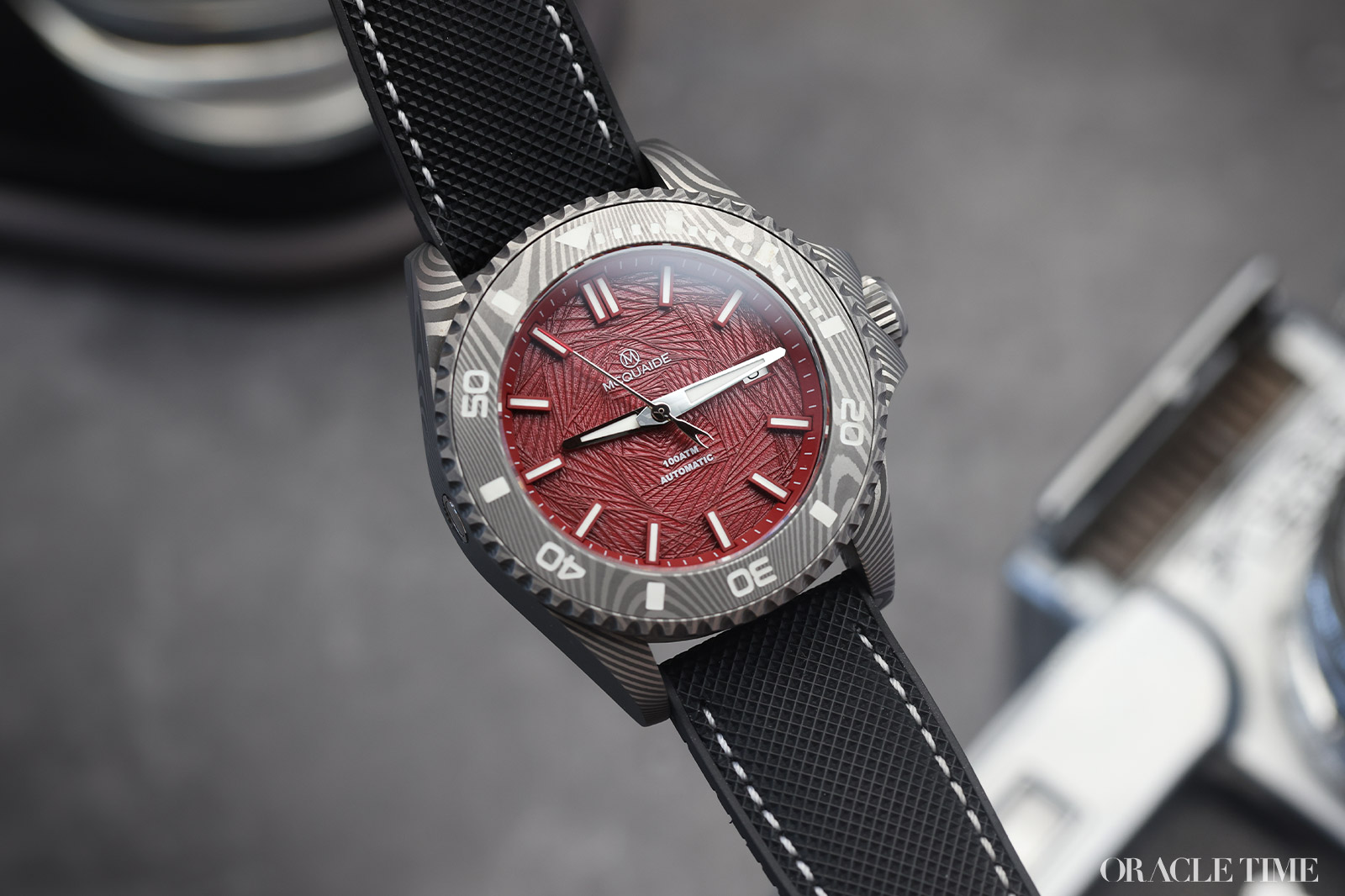
While it’s not a universal truth, you can certainly plot a graph between watch size and water resistance to see that in most cases larger watches have better water resistance ratings. At a fundamental level that’s because larger watches can have thicker walls, making them more resilient to high pressures. Plus allowing space for saturation diving elements like helium escape valves that are often redundant in more leisurely dives. That brings us to the McQuaide Q1, which achieves a water resistant rating of 1,000m. That’s impressive by any dive watch standard but for a debut watch it’s practically unheard of. Suddenly the bulk of the watch doesn’t feel like a negative so much as an attribute.
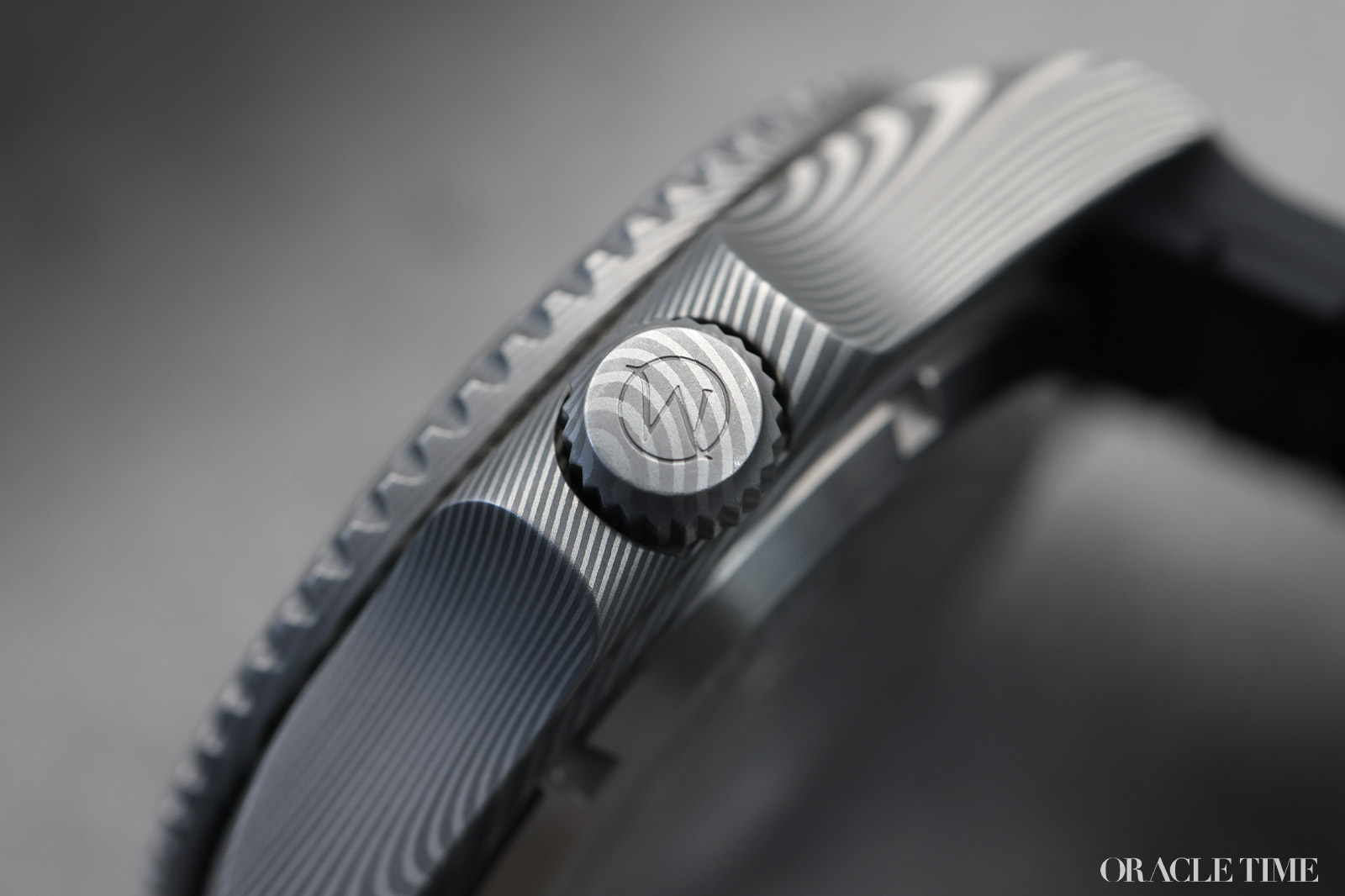
However, there’s still many more details on the case to dig into. For one, we haven’t got to the fact that it’s made from Damascus steel and that’s one of the core tenets of McQuaide’s reason for existing. We recently produced a full guide to Damascus watches so check that out to learn more about the techniques involved, but for now all you need to know is that it’s a method of producing tough steel with a distinctive layered appearance that is reminiscent of a contour map. No two cases share the same pattern, making them each a unique object. For the Q1 the material has been used for the case body, lugs, crown and bezel with a strong contrast between the light and dark layers.
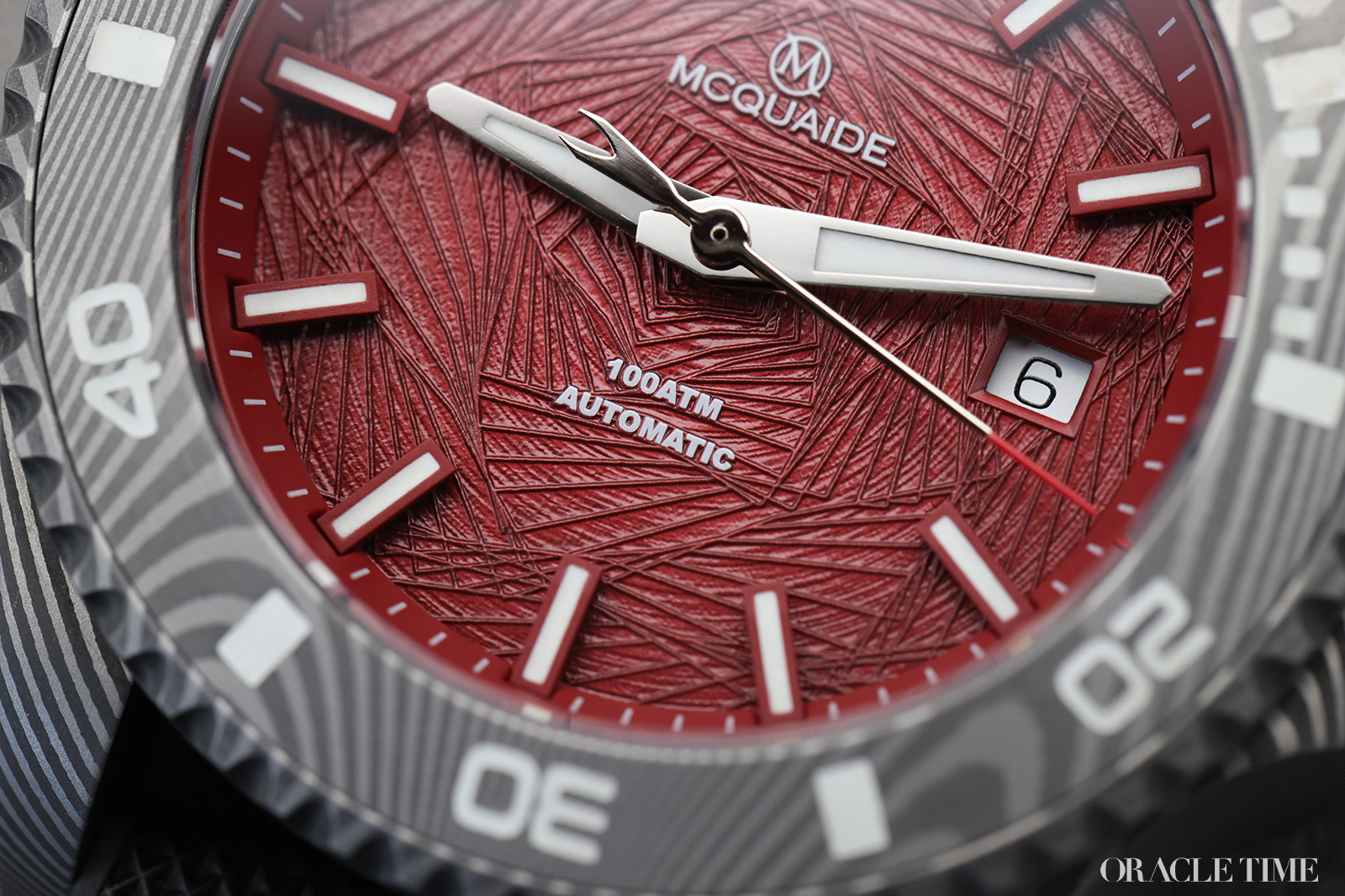
Mentioning the bezel, it’s a classic unidirectional dive timer. The pronounced grip makes it easy to rotate but it doesn’t feel loose at all like some cheaper dive watches can. Visually it serves as a bold porthole through which you view the dial, which is pretty dramatic too. It features an incredibly intricate guilloché style pattern that’s pretty difficult to describe – a sort of spiral of sectored lines that are made up of even smaller, finer lines. There’s also a slightly gloss finish to it, making it shine in direct sunlight. The edition I have here is the Q1 Crimson, it’s also available in Obsidian black and Abyss blue.
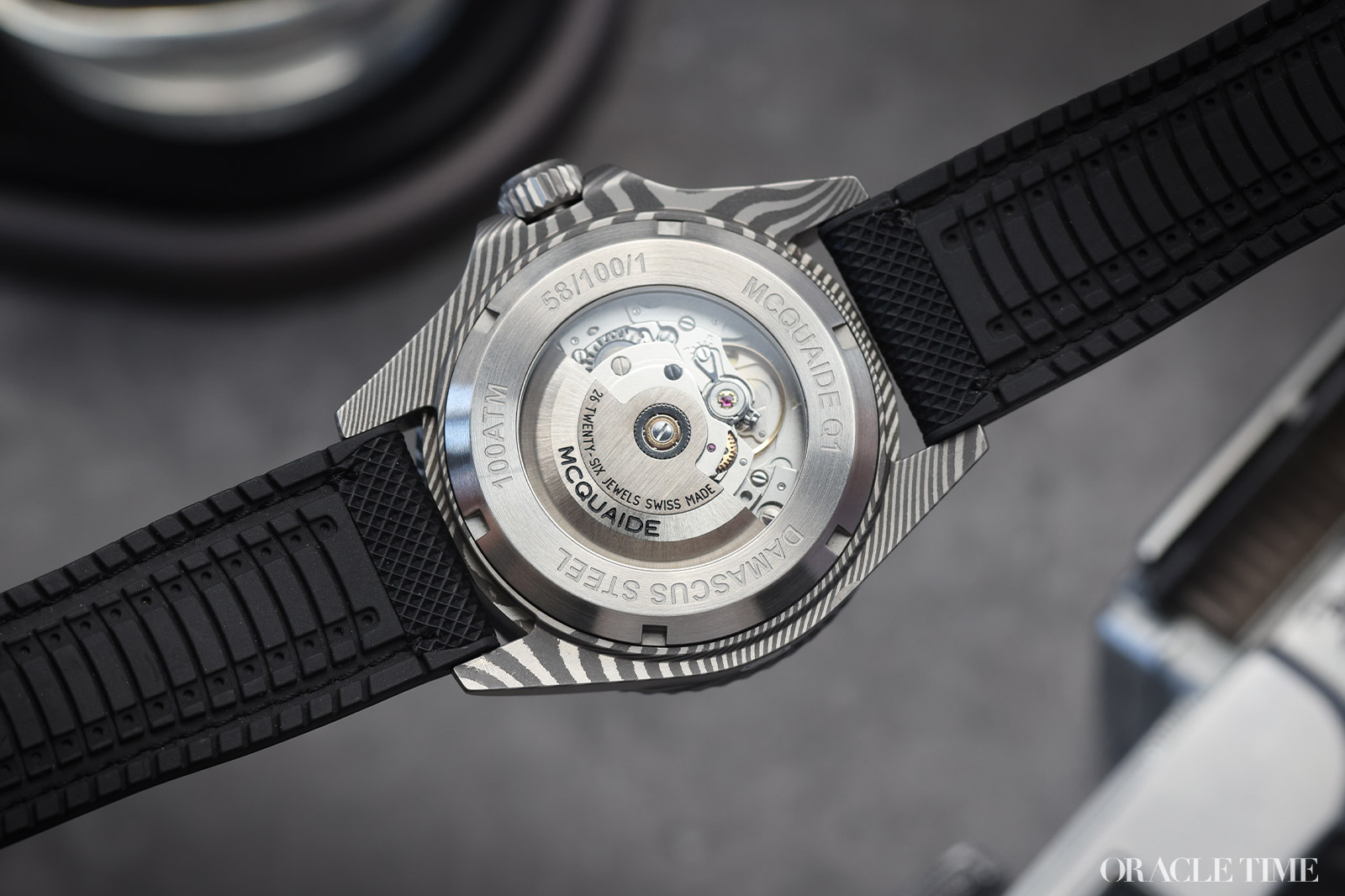
Inside and visible through the exhibition caseback is the Swiss-Made Sellita SW200-1 with 38-hour power reserve. Adding further credence to the saying ‘British Designed, Swiss-Made’. Though they are assembled in the UK too, at the Horologium workshop in Berkshire. Building on that British connection further, McQuaide are a member of the British Alliance of Watch and Clock Makers, the same group behind the popular British Watchmakers’ Day event.

At £750 it’s also very accessible, especially for a 1,000m diver. For a young brand I think this is a mature first collection with a defined design direction that puts them in good stead for future releases. On a constructive criticism level, I think the textured dial could perhaps be simplified a bit so that it’s a little less messy while having a clearer, more regular pattern that’s easier to appreciate at a glance. I could also mention the size but as I discussed earlier, since they are operating in the deep diver niche, that’s an excusable element – though I do think a Damascus steel skin diver could be interesting.
Price and Specs:
More details at McQuaide.