Jaeger-LeCoultre aren’t particularly known for making GADA (Go Anywhere, Do Anything) watches but of all their collections, the one that best fits the description is the Polaris. A sporty steel watch with oversize markings, 200m water resistance and options that include a suite of sport and travel complications such as chronographs and worldtimers. One unifying factor across those various complications and references is that the case measures 42mm in diameter. But not anymore. Jaeger-LeCoultre have introduced a new version of the Polaris Date at 40mm, downsizing the model for the first time.

42mm to 40mm is a great change for the Polaris because there is a large proportion of collectors who look at the number 42mm and immediately decide that it’s too big on the wrist to wear. That has been particularly true across the past 24 months when vintage proportion dress watches have been popular within the zeitgeist with people looking at 38mm, 37mm or even 36mm watches. A 40mm Polaris is going to be a much more attractive prospect to those collectors for both wrist comfort and style reasons.
Alongside the smaller diameter, the Polaris Date 40mm also reduces the thickness to 12.9mm down from 13.92mm. Thickness is a much more difficult dimension to visualise without seeing a watch in the metal because for the most part what defines an appropriate thickness is whether it’s proportional with the rest of the case as well as the wristwatch archetype. As a general rule of thumb, I would say 14mm+ is the figure where thickness starts to become egregious on anything other than a professional diver. For a 40mm sports watch, dropping to just below 13mm is a prudent design choice.

For the dial, they’ve retained the signature look of the Polaris line with its double fumé gradient layout featuring a central disk inside the minute scale surrounded by the hour scale ring. It also has the same internal rotating bezel operated by one of the twin crowns. The titular date window sits at 3 o’clock where it is balanced by the Arabic numerals at 12/6/9. While it is a sporty display, this is still Jaeger-LeCoultre, so it’s made from blue lacquer, still showing a high level of finesse and metiers skills.
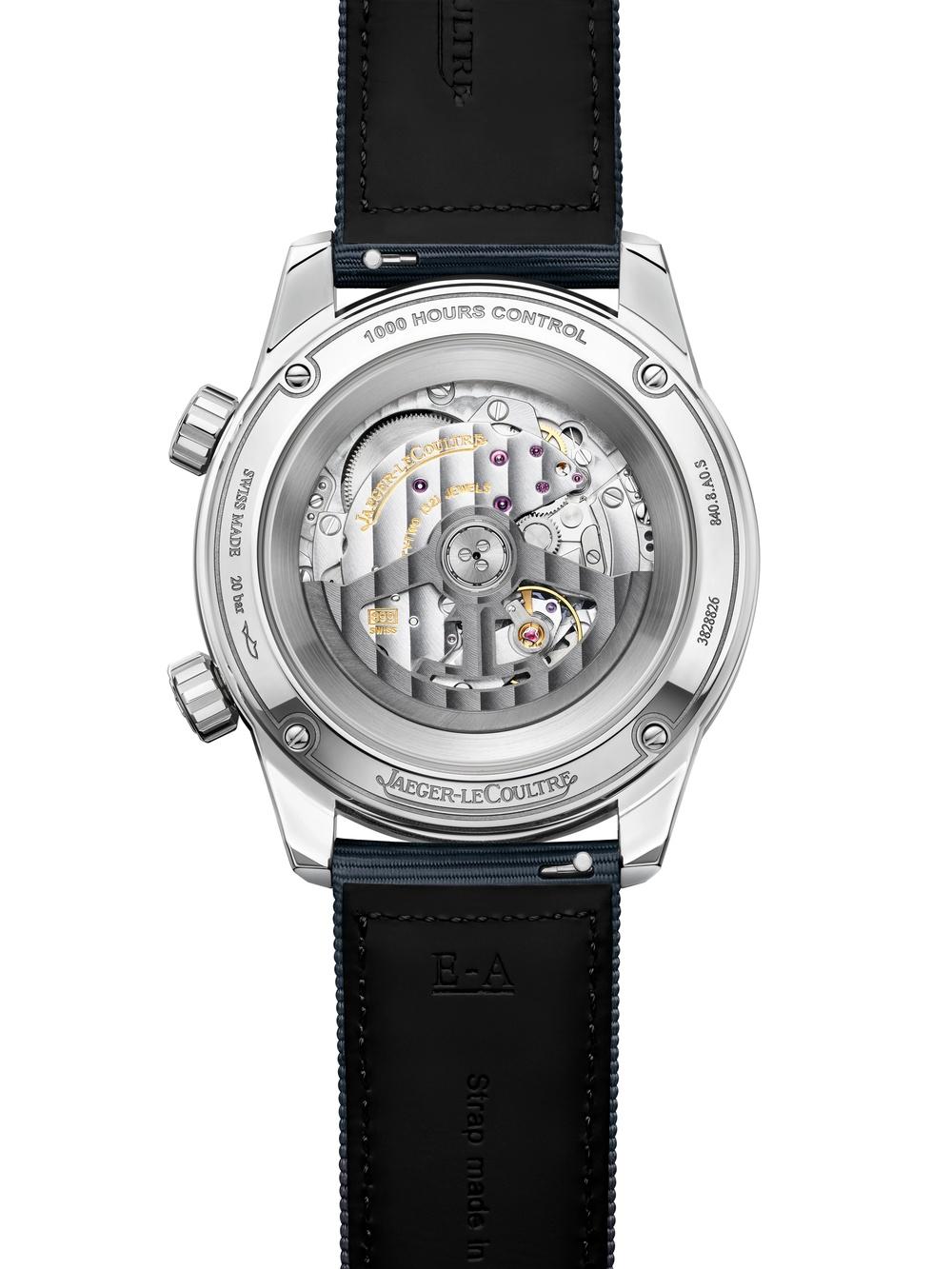
The Jaeger-LeCoultre Polaris Date 40mm also houses the same movement as its larger cousin, the calibre 899. It’s automatic with a 70-hour power reserve. It’s visible through the watch’s exhibition caseback, allowing you to admire the Côtes de Genève finishing across the plate and partially skeletonised rotor. A darker, anthracite coloured finish on the rotor also helps to make it stand out.

For pricing, Jaeger-LeCoultre have actually followed the rule of less watch = lower price. While the movement and design are largely unchanged, the Polaris Date 40mm is £9,250 instead of £11,200 – comparing it to the 42mm edition with the same fumé lacquer dial as seen on the 40mm. That’s a £2,000 difference all for the sake of 2mm. Part of that is likely due to the fact that the 40mm is presented on a canvas strap rather than the 42mm’s rubber, but generally the price difference between rubber and canvas isn’t as significant as say the difference between canvas and a metal bracelet. So really, I would just chalk it up to good value and say the Polaris just got even closer to embracing the true GADA spirit.
Price and Specs:
More details at Jaeger-LeCoultre.