A total lunar eclipse occurs when the sun, Earth and moon are all in alignment during their orbits. It means that any sunlight has to skim past the edge of Earth before hitting the lunar surface and being reflected back towards the planet so that we can see it. The effect of this is that as the light passes through the Earth’s atmosphere, the high-wavelength colours such as blue and ultraviolet are removed, causing the light that is returned to the Earth from the moon subsequently to appear red – resulting in total lunar eclipses also being known as blood moons. The next blood moon visible from Japan is on March 3rd, and Citizen is ready to celebrate the phenomenon with the new Attesa Shades of Red limited edition series.
Attesa Shades of Red Worldtimer CC4077-71Z

Starting with the Worldtimer, it’s based on Citizen’s flagship eco-drive satellite wave GPS design powered by the cal.F950. What that translates to in simple terms is that it’s a quartz watch powered by light with the time setting controlled by satellite connection based on your location in the world.
This makes for an incredibly accurate watch because it is always checking via satellite that it is displaying the correct time, down to the second. Even if it loses satellite connection it can maintain an accuracy of +/- 5 seconds per month. It features a multi-function subdial at 9 o’clock, a setting indicator at 3 and a 24-hour subdial at 6 o’clock that can be used in conjunction with the 24 cities bezel to allow you to read the time across every time zone in the world simultaneously. It’s also a 1/20th second chronograph to boot.


What makes this a limited edition is the updated style of the piece. As the name ‘Shades of Red’ indicates, it’s presented in a dark red colour inspired by the blood moon. That tone is used across the sapphire bezel and layered mother-of-pearl dial with moon-surface texture. There’s a tendency in the collector-sphere to dismiss quartz and satellite watches out of hand but it’s important to remember that as much artistry can go into the design and style here as a mechanical timepiece and the Attesa Shades of Red Worldtimer looks great.
Though you should be aware that it is something of a mammoth, with dimensions of 44.6mm diameter x 15.4mm in thickness. Fortunately, some of the size is offset by its lightweight construction in Super Titanium with Duratect DLC coating. It’s priced at £1,595 in a limited edition of 1,800 pieces.
Price and Specs:
Attesa Shades of Red Moonphase BY1005-73Z

Second in the Shades of Red series is the Attesa Moonphase. While it’s lower spec and more accessible than its Worldtimer counterpart, it’s actually more thematically appropriate for the Total Lunar Eclipse. That’s because at 6 o’clock it has a moonphase subdial that shows the phases of the moon depicted with a red, blood moon created through a layering process involving electrodeposition. It appears brighter than the dark red dial, which also has a raised moon texture that’s achieved through inkjet printing.
It’s the smaller of the two watches at 41.5mm diameter x 10.8mm thickness, produced in Super Titanium with Duratect DLC coating. The design feels a touch sportier as well with wide pushers for the chronograph function and more of a flowing shape overall through the lugs to the bracelet. Its bezel is smooth and bare rather than the sapphire insert on the Worldtimer.
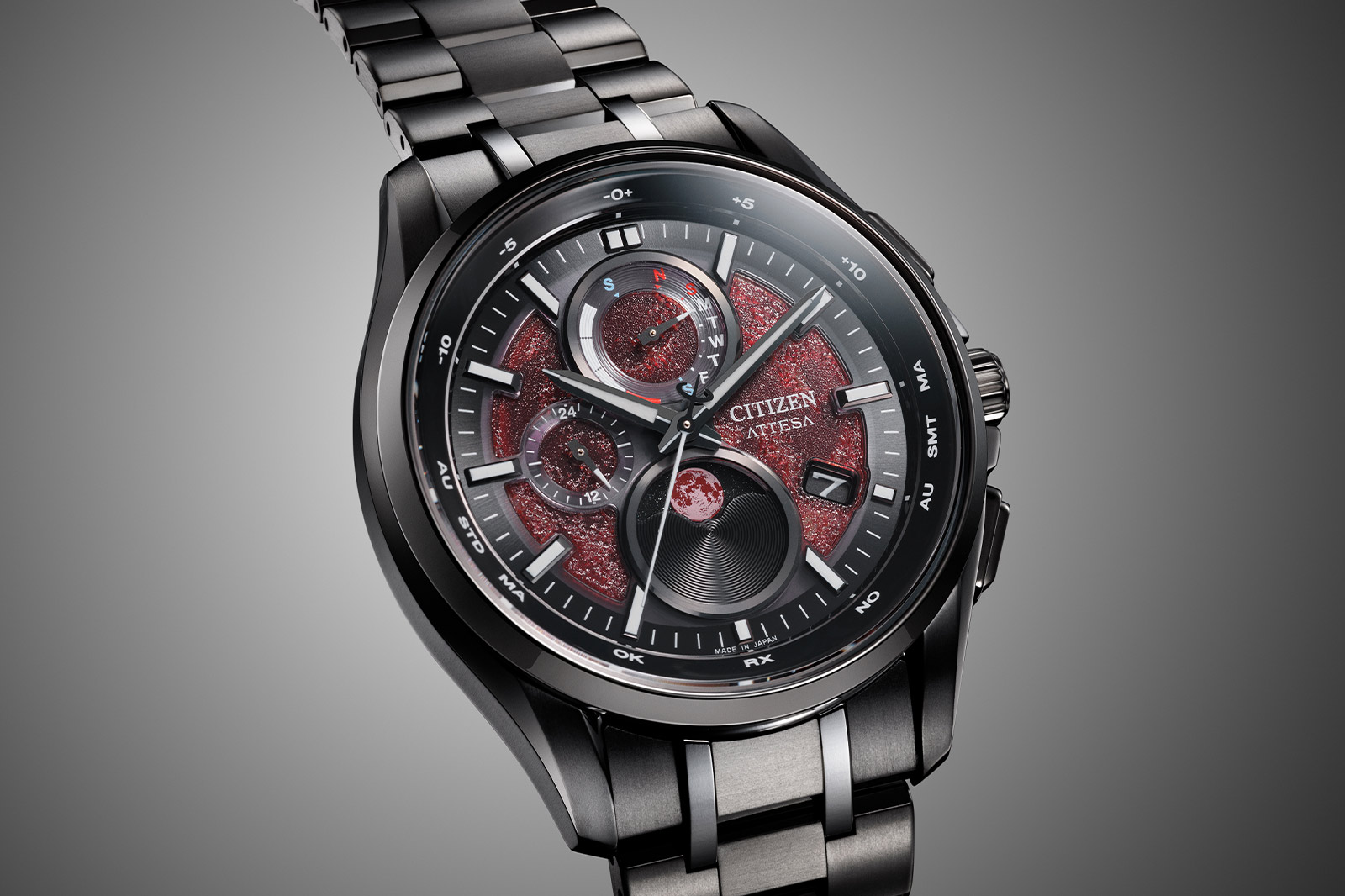
For the movement inside, it’s the cal.H874. It’s radio-controlled, so similar to the satellite connection of the other model, it’s constantly correcting the time itself. Though here the accuracy without correction is only +/- 15 seconds per month. Similarly, the total battery power reserve without charging is 2.5 years as opposed to 5 years on the Worldtimer (when in power save mode in both cases). Though in practical terms, specs like this are largely irrelevant unless you leave it in a drawer for literal years at a time.
The Citizen Attesa Shades of Red Moonphase is priced at £995 in a limited edition of 2,200 pieces. The total lunar eclipse that inspired this series will be visible on March 3rd from Japan at about 8pm JST. Unfortunately, it won’t be visible from the UK as it will be 11am at that time – our next total lunar eclipse isn’t expected until 2028, though we get a partial one in August later this year. But as we just discussed, both watches will be ready to go in two years’ time even without any charging.
Price and Specs:
More details at Citizen.