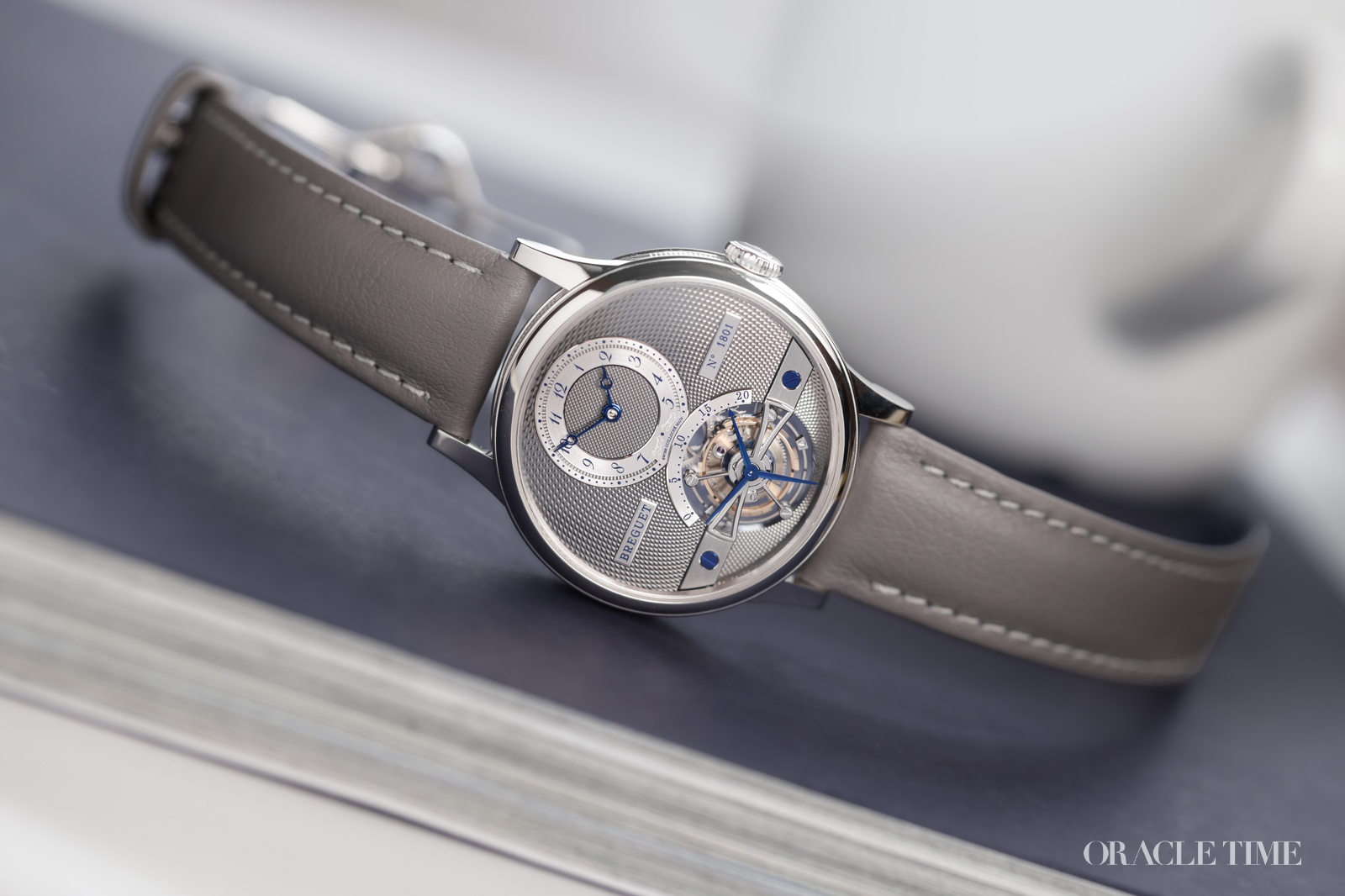
Ever since their much-needed refresh in 2025, Breguet have been on a roll. That might sound strange for the prestige watchmaker, but in the years leading up to Gregory Kissling’s takeover of the brand, they were lacking a strong identity. Over the past two years however they’ve not only produced some of their most technically advanced watches ever (like the magnetic-pinioned Expérimentale), but also their most beautiful – and the new Classique Tourbillon 7357 is up there with the best.
2026 is the year of the tourbillon for Breguet. 225 years ago, Abraham-Louis Breguet filed the patent for the first gravity-defying cage mechanism, and the modern watchmaker isn’t about to let us forget that. What we weren’t expecting however was a revamp of their famous modern tourbillon from the 1989, the Daniel Roth-designed ref. 3350.
With its open six o’clock tourbillon, the ref. 3350 was a clear predecessor to Daniel Roth’s own tourbillons to follow and was Breguet’s first tourbillon wristwatch. Yes, the historical watchmaker created the mechanism, but that was for pocket watches. But it was the ref. 3350 that set the tone for Breguet’s modern watchmaking for decades to come, guilloche dials and all.
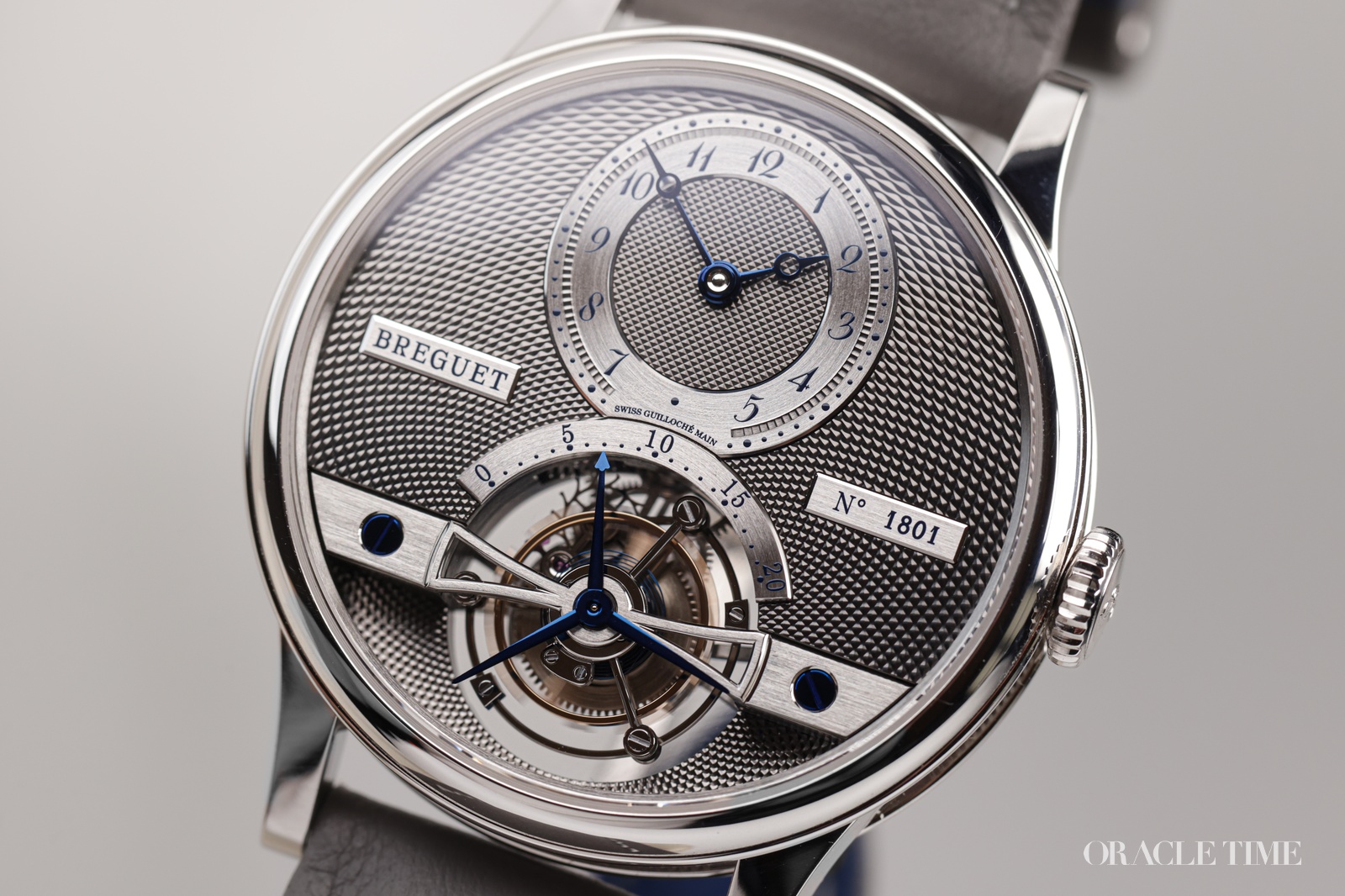
Measuring 36mm across by 9.1mm thick, it’s just as wearable today as it was in the late 1980s – proportions the new Classique Tourbillon 7357 gets just right, with a slight shift.
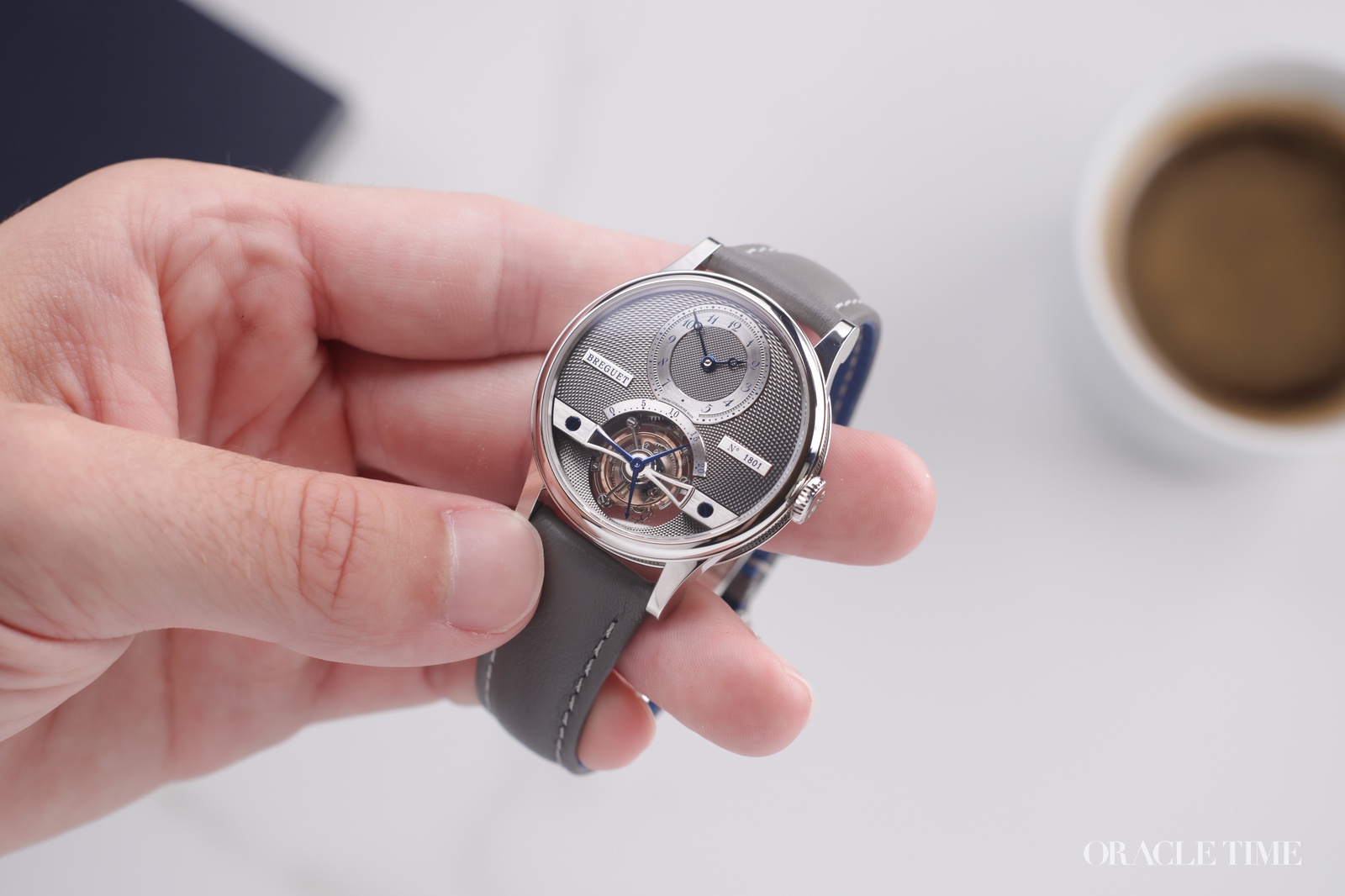
The new tourbillon’s platinum case measures 35mm wide by 9.2mm thick. That makes it slightly narrower but a touch thicker than the original, which even in the current climate of smaller watches feels decidedly vintage. Despite that sizing, the dial doesn’t feel cramped, partly thanks to the slim bezel, partly because the hours and minutes are on a smaller 12 o’clock subdial, with the 60-second tourbillon – doubling as a small seconds – at six o’clock. This is read using the 20-second scale at the centre of the dial.
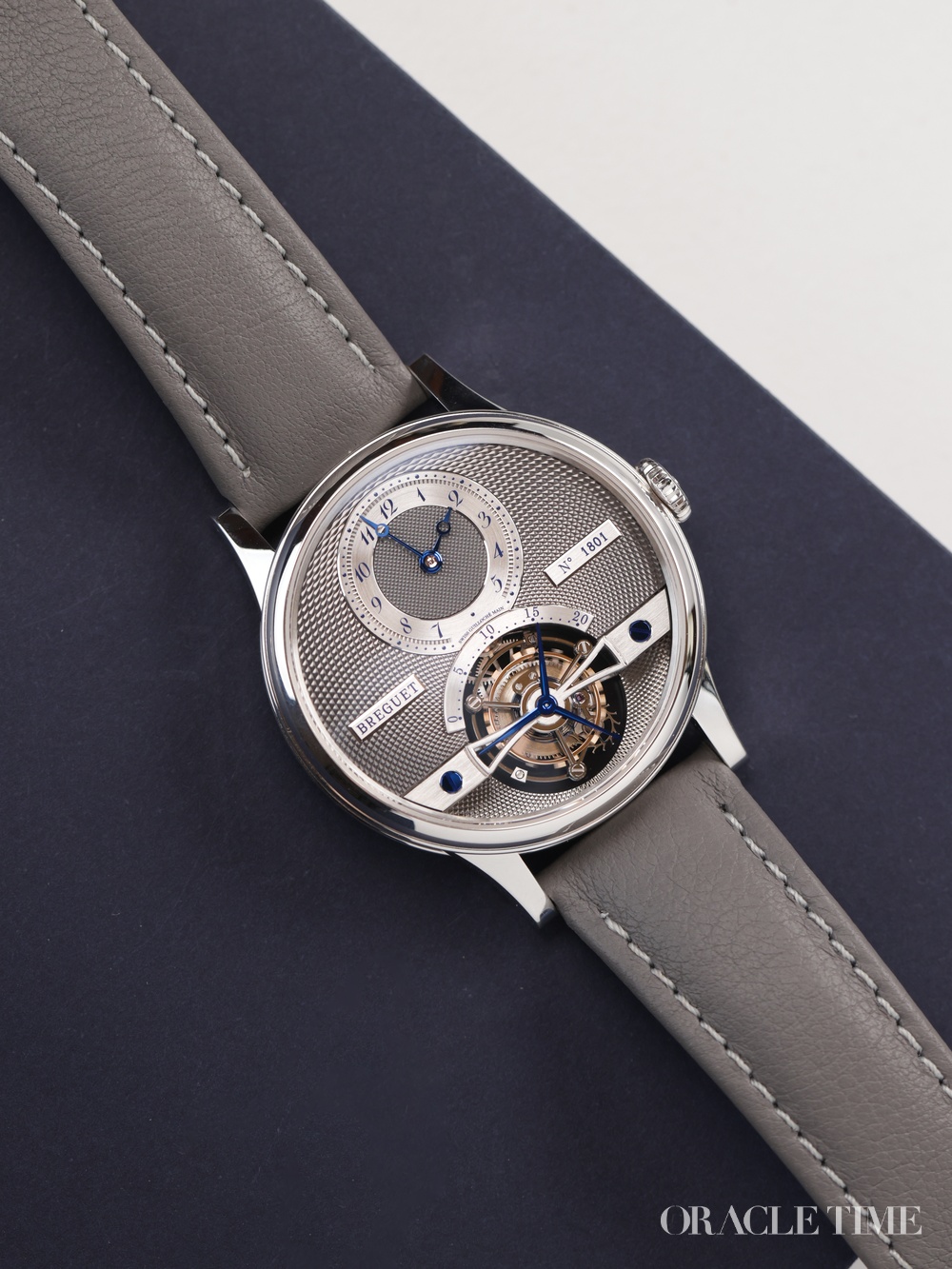
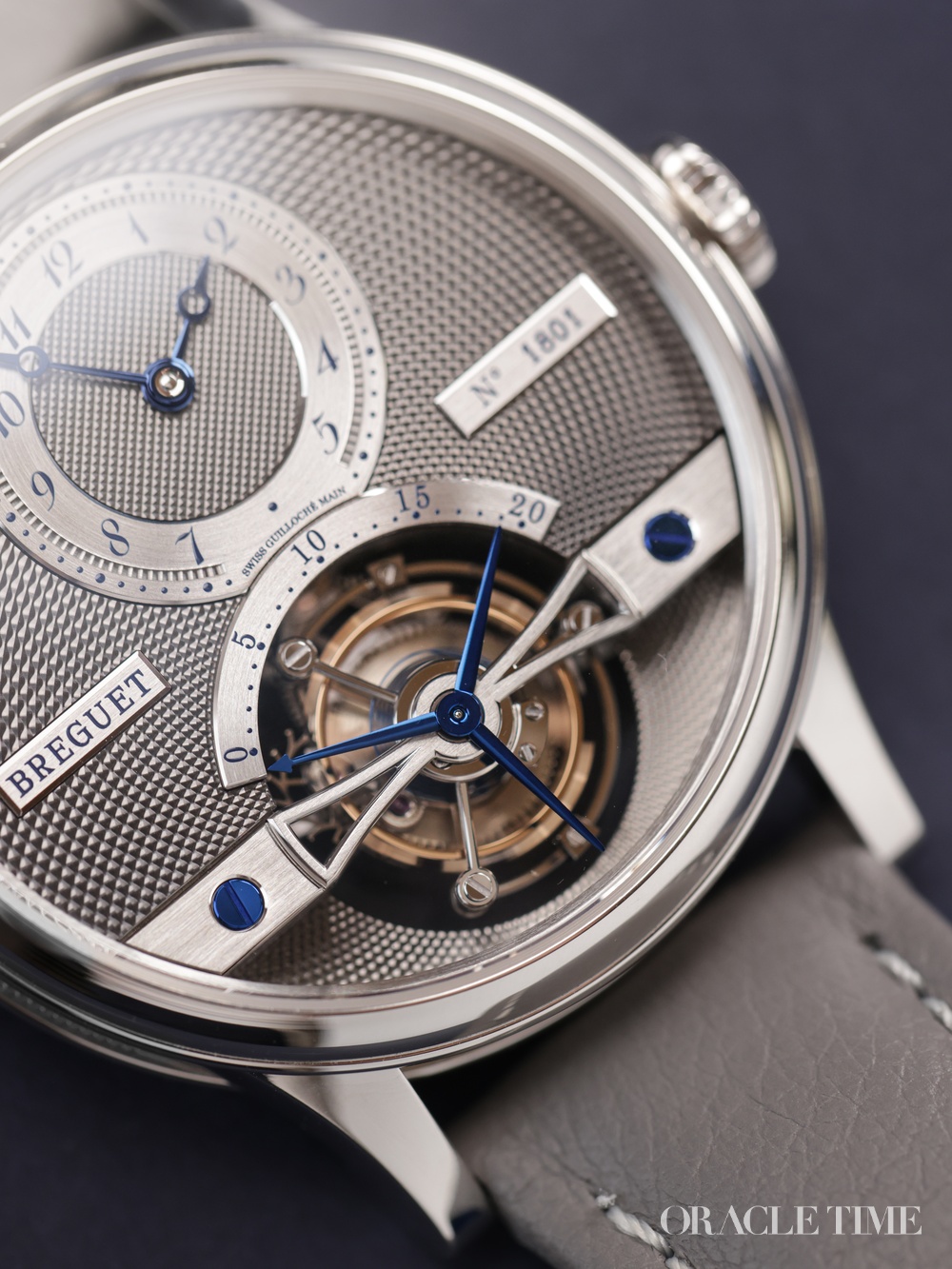
Rather than the orange baroque engraving that flanked the tourbillon in the 3350, Breguet have toned things down. There’s still a drop there, but it’s now been given the same barleycorn guilloche that covers the rest of the dial, perfectly following the same visual curve, separated by the brushed tourbillon bridge.
The guilloche itself is a fine sweep of barleycorn across the majority of the dial with the more geometric clous de Paris (or hobnail) pattern inside the chapter ring. It’s crisp, clean and mesmerising – especially in the modern anthracite version we have here. The Breguet gold version – leveraging the maison’s own, warm gold alloy – uses opaline white across the top two-thirds of the dial, with more Breguet gold below the tourbillon. It’s got that luxuriously antique look, but the modernised monochrome look of the platinum edition is, for me, the clear winner.
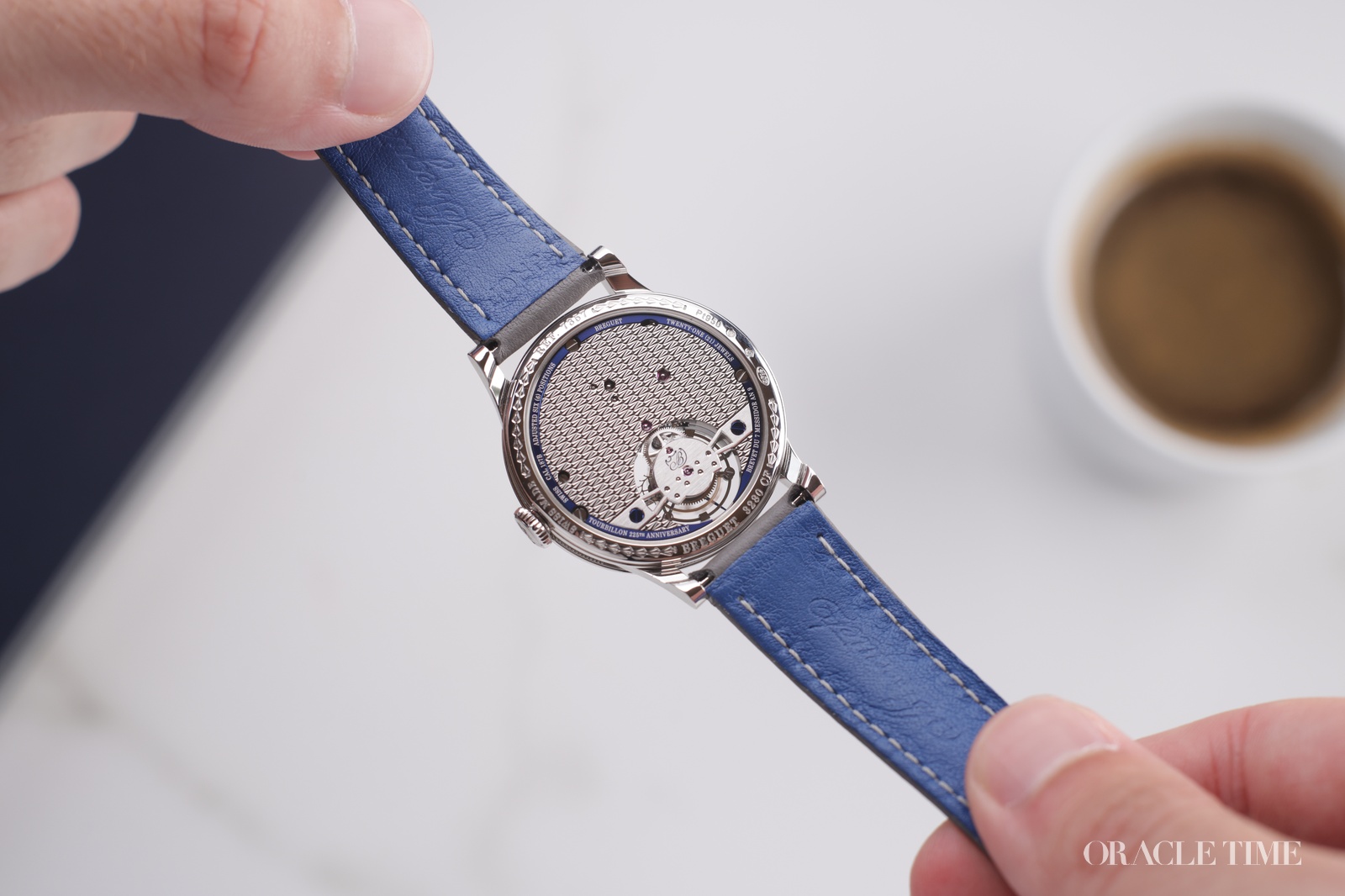
Almost as beautiful as the dial is the movement, which is almost uninterrupted, guilloche bridge. The unique pattern has been dubbed Dent de Vaulion in honour of the Vallée de Joux high-altitude valley overlooking Breguet’s manufacture. It’s not actually inspired by the peaks, but by the view of rippling water across the Lac de Joux. I can see why Breguet opted for the more expected barleycorn on the dial, but I’d love a full Dent de Vaulion dial at some point.
As it is, the reverse of the watch is interrupted only by a few watchmaking rubies and the six o’clock tourbillon. What you don’t see is that – according to Breguet that is – the movement is 41% new for this watch. That’s a substantial amount of new development and results in a 60-hour power reserve and greater antimagnetism thanks to the Nivachron balance spring and silicon pallet lever. Despite the striking percentage of new parts, the result is quality-of-life improvements rather than revolution, and it maintains Breguet’s usual 2.5hz frequency.
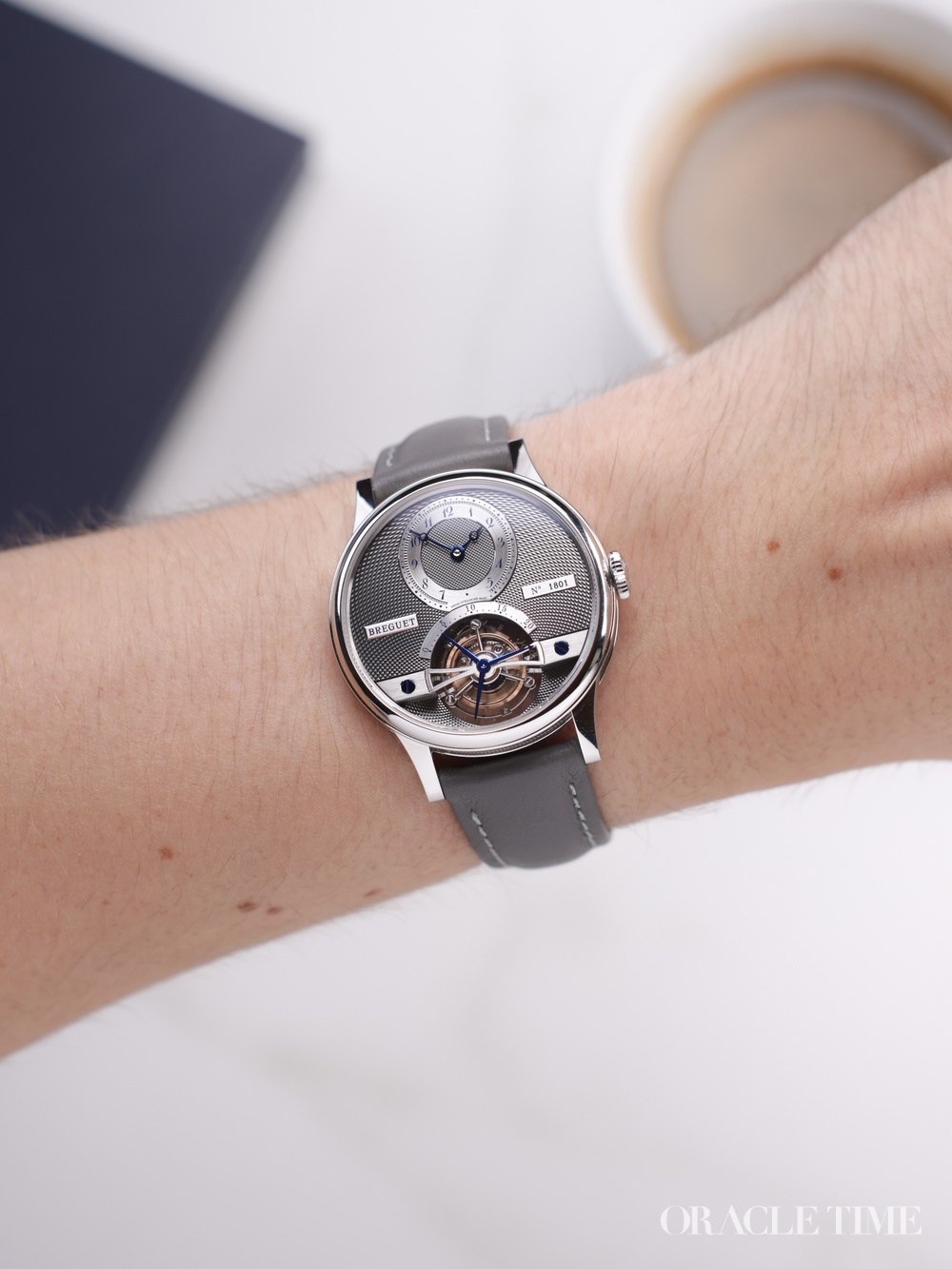
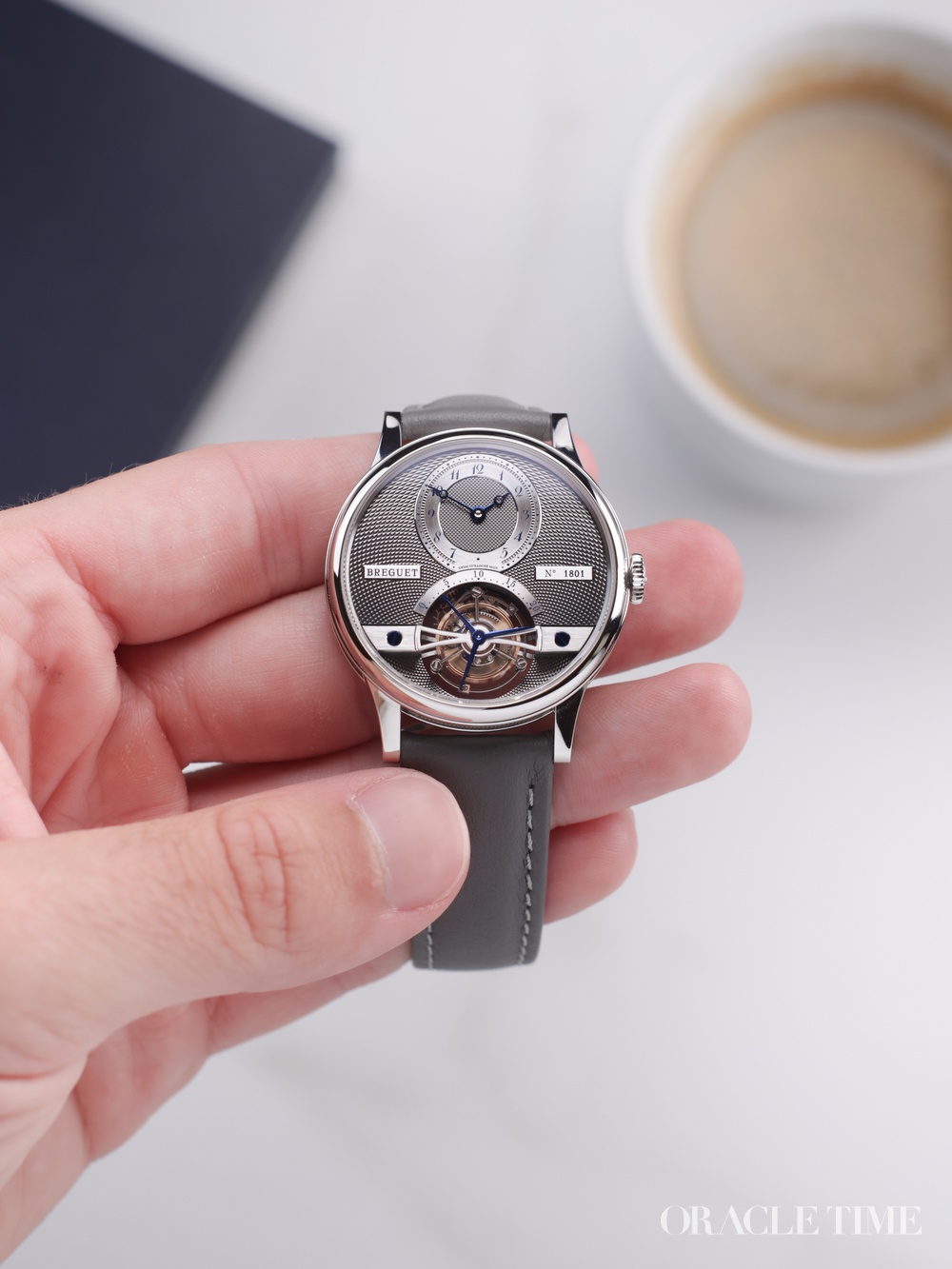
On the wrist, this might be the best-wearing Breguet yet. Older Breguets tend to have classical straight lugs and therefore sit quite flat on the wrist. That’s never really been an issue for me before, I just considered it a quirk of the watchmaker. Now that the 7357 has revamped those lugs into curving, ergonomic numbers, I’m not sure I can go back. It helps spread the weight of all that platinum, which you feel despite the modest case size. The lugs also work well with the grey calf leather strap, finished with a satisfyingly solid, visually ornate Breguet ‘B’ clasp.
Do the new lugs make the 7357 feel less Breguet? Definitely. But between the beautiful guilloche and the coin-edge mid-case, the 12 o’clock chapter ring and those gorgeous vintage Breguet numerals and hands, you don’t need the nine o’clock nameplate to understand intuitively who built this watch.
Really the only issue I have with the watch is the inclusion of those nameplates at nine o’clock and three o’clock; I’d much prefer uninterrupted guilloche. It would also give that 35mm sizing a bit more room to breathe. In the context of a watch like this, that’s a very small bugbear, but when you’re spending over £150,000 on a watch you want it to be perfect.
And yes, this is a watch that will set you back £156,100. That’s an extraordinary amount, even for a modern tourbillon. But the 7357 is a true modern grail. It takes the core elements that made the 3350 an icon of Breguet canon and modernises it for a cleaner, crisper and more wearable watch. A grail-worthy price tag makes sense. And don’t worry; as it’s not a limited edition, you have plenty of time to save up.
Price and Specs:
More details at Breguet.