
It’s only just February, but Audemars Piguet has already thrown down a serious marker for 2026 with the Neo Frame Jumping Hour. The idea is nicely judged: take the brand’s “pre-model 1271” watch from 1929, keep the guichet style display and modernise everything around it. Right down to a brand new movement, the calibre 7122.
The design brief is rooted in Streamline Moderne, also known as Pacquebot, or Ocean Liner style, a late offshoot of Art Deco that prized minimalism, elongated lines and aerodynamic curves. Here, that translates into a rectangular 18-carat pink gold case, defined by vertical gadroons, with eight on each flank, tapering into pointed lugs.

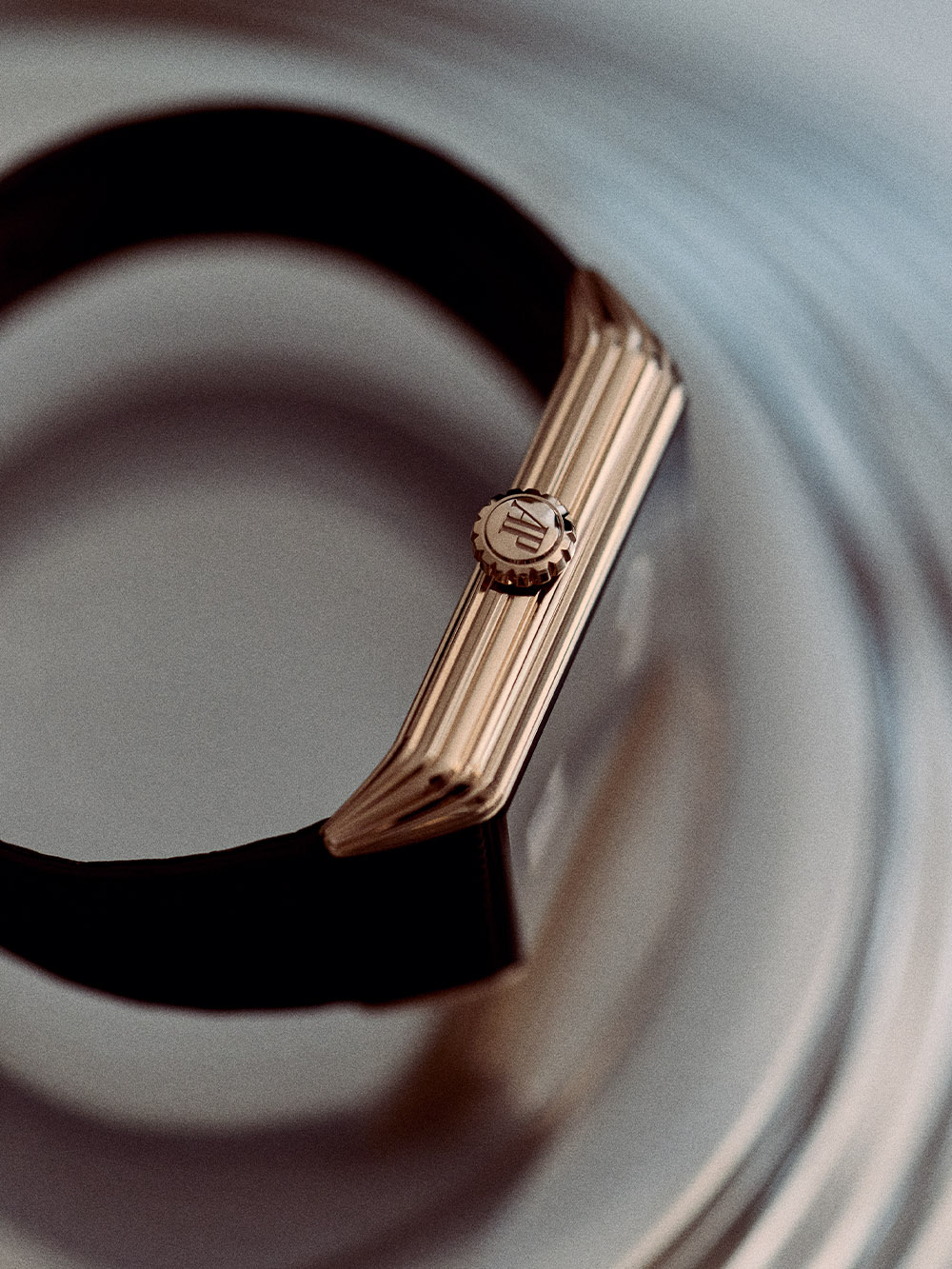
On paper, the proportions read compact: 32.6 mm by 34 mm and just 8.8 mm thick. In the metal, the rectangular footprint and those extended lugs should give it more presence than the numbers suggest, while the slim profile keeps it firmly in dress watch territory. Water resistance is a modest 20m.
Audemars Piguet introduce the two-tone idea by pairing the gold case with a black PVD treated sapphire crystal, which in guichets style functions also as the main display. Time is displayed through two gold framed apertures, with white numerals on black for the jumping hour and trailing minutes. The Audemars Piguet signature sits at six o’clock in pink gold tones.


Behind the clean front, the construction is the part worth talking about. Because the display is sapphire and the design leaves it exposed at 12 and 6 o’clock, Audemars Piguet says it could not rely on the usual approach of pressing a crystal into a bezel. Instead, the dial plate is bonded to the sapphire crystal and then screwed into the case, a solution developed specifically for this model.
Power comes from the brand new selfwinding Calibre 7122, developed in house and based on Calibre 7121 from the Royal Oak “Jumbo” models. It combines an instantaneous jumping hour with trailing minutes, backed by a 52-hour power reserve. Audemars Piguet also includes a patented shock-absorbing system designed to mechanically prevent unintended hour jumps in the event of impact. The hour disc is titanium to enhance shock resistance, while the minute disc is made from a copper alloy.

Flip the watch over and the movement is visible through a sapphire caseback, with finishing that includes Côtes de Genève and satin brushing, plus an oscillating weight that echoes the case’s fluting.
All of this sits within a longer Audemars Piguet story: the brand notes it sold 347 jumping hour wristwatches between 1924 and 1951, including 135 with dual apertures, and while the pre-model 1271 that inspired the Neo Frame was marketed in 1929 and 1930 with just 14 pieces made across four variants, including a unique platinum example now held by the Audemars Piguet Musée Atelier, AP hasn’t disclosed production numbers for the Neo Frame Jumping Hour, which is priced at £56,100.
Price and Specs:
More details at Audemars Piguet.


I have long been a fan of art deco styling and this watch just exudes this era in spades, the design is sublime.
Jump hour watches (which have been around for much longer than most people think), never appear to have taken off, unlike the more traditional watch format, but, the recent resurrection of this theme has seen quite a few releases, but this one breaks the mould in terms of wearability as it doesn’t follow the usual format of a metal frontispiece, which is prone to scratching etc.
Overall, a very nice watch with beautiful details, sadly, the price point is way outside of reach of the normal man in the street, and not even a “grail watch” except for the very few.
Not certain that I would have gone for the all black format, I would have probably leant towards a grey (possibly striped or pebbled enamel) main face under high impact crystal, or maybe even white.
I’m available for design consultant purposes lol.