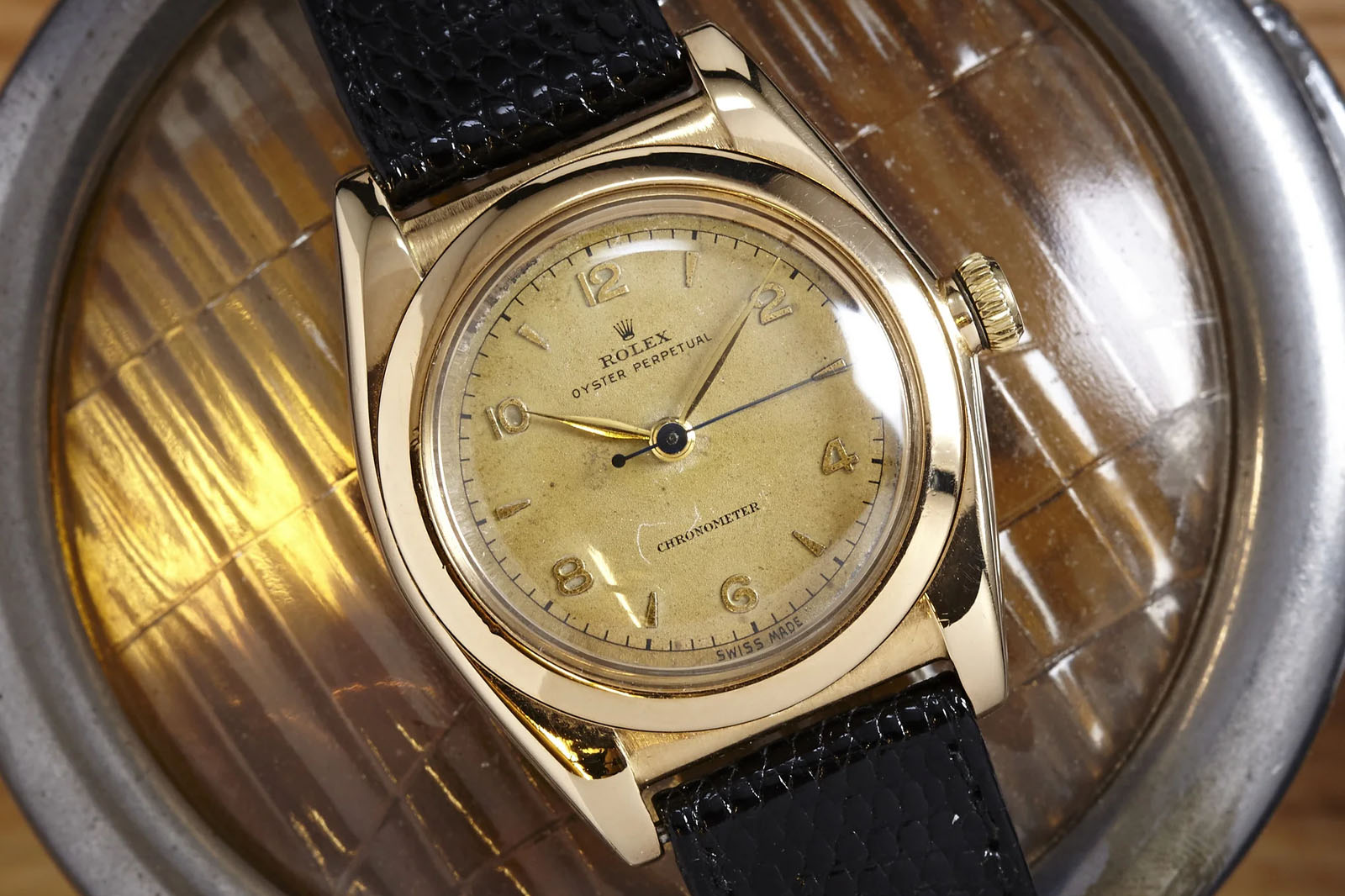
Rolex Bubbleback Pink Gold Ref. 3131, 32mm diameter, image credit: Analog:Shift
Look at any watch brand’s ad or press release, and you’ll see words like heritage and craftsmanship. But one word you’ll never find? Fashion. Yet, I’d argue fashion plays a far bigger role than those other two influences. I know that the readership of this fine publication will rise in arms and deny everything that I am about to say, but I beg you to carry on reading. Because contrary to popular belief, 36mm is the perfect watch size.
In my early collecting days – mid-’80s to early ’90s – the most coveted watches were the Rolex Bubbleback (32mm), Patek Calatrava Ref. 96 (32mm), and Rolex Prince (23mm wide). By today’s standards, those sizes look like women’s watches. But back then, we wore them without a second thought. Most of us also wore Datejusts, Day-Dates, and the occasional Explorer—all 36mm in diameter.
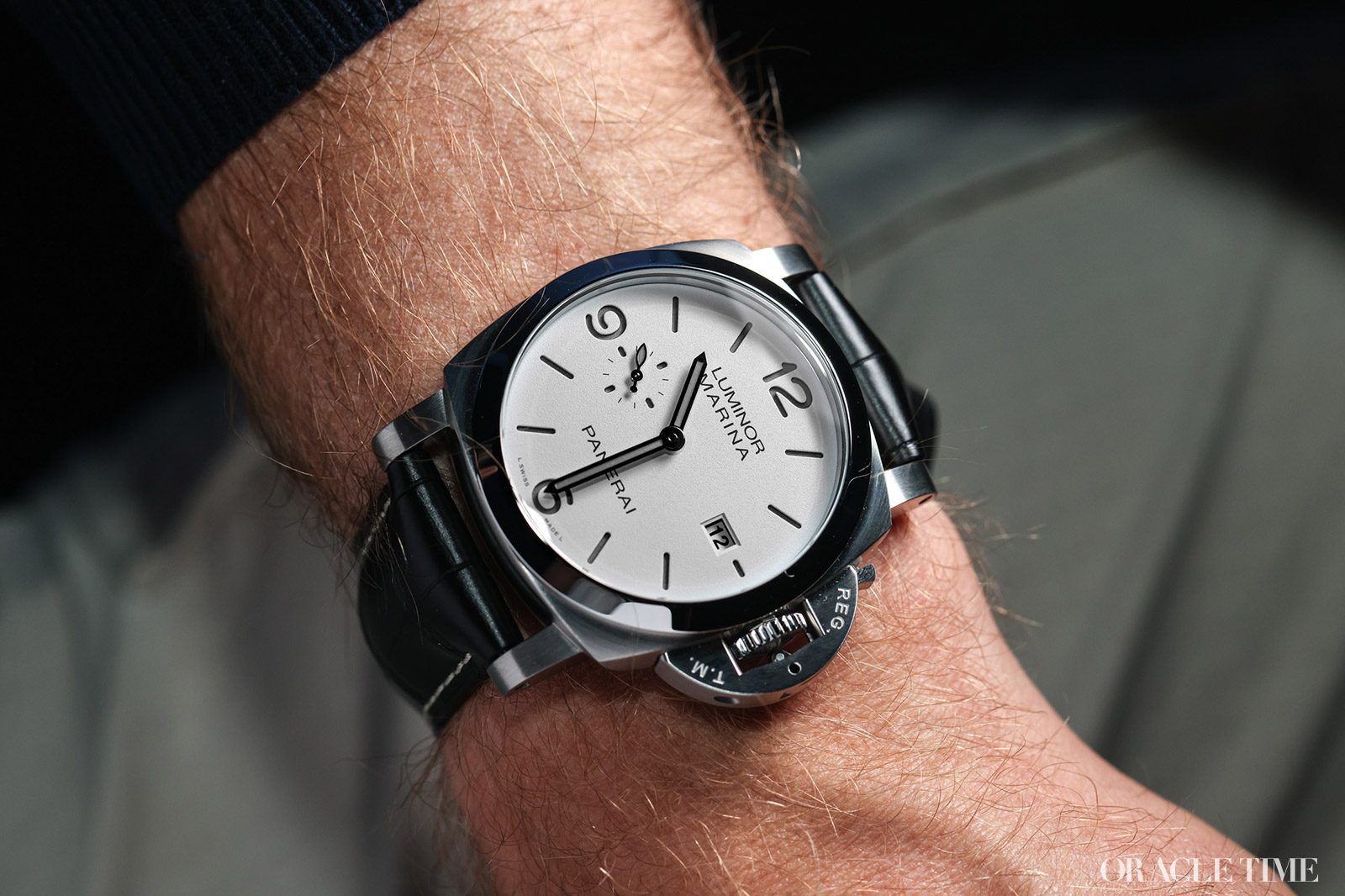
Panerai Luminor Marina Ref. PAM03314, 44mm diameter
Then two seismic shifts happened almost at once: Japan’s economic bubble burst, and the Soviet Union collapsed, leading to worldwide military budget cuts (including Italy’s Navy). There were two results. The Japanese watch market cratered, and Panerai – facing bankruptcy – turned to civilian sales of their only possible consumer product, their watches.
I first spotted Panerais in Italy in the mid-’90s, but not on hairy-chested Vespa-riding lotharios. They were on the wrists of slim, stylish women. I’d bet 95% of them had no clue about Panerai’s naval history, they just liked how they looked. Then Italian men followed, and the oversized watch craze began. Remember the 57.2mm Audemars Piguet Royal Oak Offshore T3? Exactly.

Rolex Perpetual Day-Date 40, 40mm diameter, Ref. 228239
Rolex, ever cautious, eventually joined the trend. By 2008, they rolled out the 41mm Day-Date II, their largest watch at the time. Soon came the 42mm Explorer II, the 44mm Yachtmaster II, and the Deepsea (also 44mm but nearly 18mm tall). I briefly owned a Deepsea but couldn’t wear it, it just felt wrong. The Day-Date II? The proportions looked off. The bezel was too wide, and the whole watch just felt clumsy. Rolex seemed to agree; it was axed after seven years in favour of the Day-Date 40, which, despite being just 1mm smaller, recaptured the classic 36mm’s proportions and elegance.

Rolex Oysterquartz Day-Date, 36mm diameter, Ref. 19019, image credit: Bonhams
Fashion, by nature, changes. Lately, watch sizes have swung back. First came the “war of the millimetres,” with Bulgari, Richard Mille, and Piaget racing for the “world’s thinnest” title. Then came the reintroductions; over the past couple of decades, brands have been reintroducing historic models, but there was usually an attempt to “modernise” them, which was code for making them bigger. But in the last few years, brands as diverse as Vacheron Constantin and Nivada have reintroduced models from their archives, retaining the original proportions, meaning a diameter of between 36 and 38mm. The past two Watches & Wonders fairs have been dominated by 36–38mm releases. It feels like sanity has returned.
In 1945, Rolex debuted the 36mm Datejust. Eighty years later, as I glance at the 36mm Oysterquartz Day-Date on my wrist, I still think it’s perfect. If you haven’t invested in a 36mm watch, you should.



As the old adage goes “size is not everything”, whatever this may have originally applied to, (which I don’t intend to be drawn on), it is the same for watches, and, as James points out, vintage watches are normally smaller than today’s output, and, in my opinion, vintage watches (normally dress watches) are far more elegant than many of today’s versions.
So, vintage watch sizes do vary considerably so sub 36mm is not at all uncommon. To elaborate on this, I personally have a 36mm diameter vintage Breitling dress watch, a 35mm Lecoultre, and a 34mm Longines, even smaller is my Bulova tank. All of these are in gold or rose gold, which again, was the norm in that period rather than SS.
I also agree with the statement that fashion is often at the forefront of watch selection, whether it be in the true definition of “fashion” which is current and short lived, or more classic, which rarely dates, but, everything comes back into the limelight at some point, this is adequately proven by the fact that the current “sweet-spot” is considered to be 39mm.
One thing does surprise me, and that is the fact that James states that back in the 80’s “all of us also wore Datejusts, Day-Dates, and the occasional Explorer—all 36mm in diameter”, well, judging by his photo, he must have been in his mid twenties at that point (as was I), but having the financial means at that age, to wear those watches, certainly was not the norm, the first proper watch that I purchased when I was in my mid twenties was a gold plate Jean Renet tank, and, I have to admit that I was very pleased with that watch (I couldn’t quite justify the outlay on a black dial Longines that I really wanted), so the Jean Renet was my second choice, (good old “Watches of Switzerland”). – I still have that Jean Renet!
So, fashion comes and goes, as does size, one thing never changes – class.
The photo you are looking at was taken 6 years ago when I was 75. So I was most definitely NOT in my twenties, then – in fact, I didn’t start messing about with watches until I was 40.
My first serious watch was a 60s Omega Seamaster gifted to me the summer before I started middle school, was perfect but I weighed 150 pounds was 11 years old, watch might have been 34mm. After university, my first green Amex charge card and marriage I bought a few 36mm Rolex watches, sold them to the son of the richest family we knew growing up, watch was too small compared to my first 38mm Breitling Chronomat.