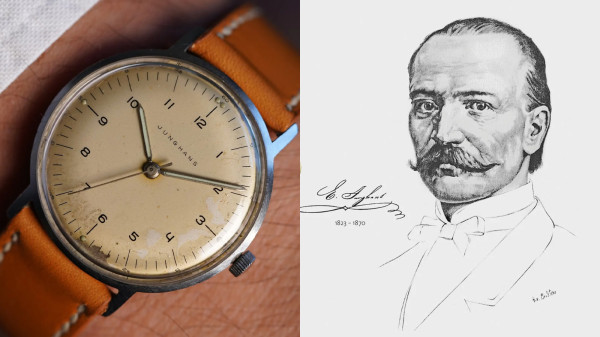
Glashütte is to all intents and purposes the spiritual home of German watchmaking. At least, a certain breed of it, more into three-quarter plates than fliegers. The little village in Saxony looms much larger than its footprint across the global horological landscape. Its legacy started way back in 1845, kickstarted by one Ferdinand Adolph Lange (yes, that Lange). But there’s one brand that’s arguably more important to the modern face of German watchmaking: Tutima.
The 1920s were not a good time for Germany. Inflation caused by the fallout of The Great War was putting company after company under. That included Glashütte’s Deutsche Präzisions-Uhrenfabrik, the huge manufacture designed to compete with the Swiss. It was a big beast with then cutting-edge machines. But with their pocket watches skyrocketing in price thousands of percent, the enterprise lasted only seven years. They were founded in 1918; they shuttered in 1925.

This was a blow for local watchmaking. But for Dr. Ernst Kurtz, it was an opportunity. Seeing the closing of DPU as a bit of a fire sale, the Hamburg-born entrepreneur bought up a chunk of these cutting-edge machines, splitting them between Uhren-Rohwerke-Fabrik Glashütte AG, or UROFA and Uhrenfabrik Glashütte AG, or UFAG. The former was to focus more on movements, the latter finished watches.
By the 1930s, the pair were producing watches that could equal the prestige Swiss models. To highlight that level of quality, Kurtz settled on a name: Tutima. This was a savvy bit of branding, derived from the Latin word tutus, or ‘safe’. And thus, the seeds of a brand were born.

Tutima Glashütte Pilots Chronograph, image credit: Uhren A. Hidding
Most of a century later and UROFA and UFAG are no more, but Tutima is still going strong, largely on the back of their rightly renowned pilots’ pieces. The original Tutima Glashütte pilot’s chronograph is a military classic for good reason. But more recently the brand has been emphasising what makes Glashutte watchmaking so special with the fittingly named Patria line.
In keeping with their Latin-derived brand name, Patria means ‘home’, in Latin and Saxon watchmaking is front and centre in the dress watch line. ‘Understated’ in watchmaking often means slightly less ostentatious than its neighbour but in the Patria line with its beautifully pared back dials and classical silhouette, it’s more than a word. There are complications here – the standard small seconds is joined by a dual time and a power reserve – but nothing showy. That is, until you look at the movement.

The manual-wind calibre 617 is an absolute stunner. This being Glashütte, it’s no surprise to see that large, three-quarter plate holding everything underneath, complete with its signature striping, interrupted only by a pair of steel winding wheels and an unobstructed view of the balance wheel. Bevelled edges, gold chatons around rubies, perfectly polished screws, this is not just German watchmaking at its finest, but horology as a craft.
And yet, while the Patria is an homage to the home of Saxon watchmaking, every home could use a refurb once in a while, and a platform as stripped back as this is ripe for a bit of new wallpaper. That’s why this year, Tutima has introduced the Patria not in its classic gold or accessible steel variants, but in the metal of the moment, titanium.

Lightweight, strong, titanium is a metal closely associated with sports watches, and from those brief traits alone it’s not hard to see why. But while weight certainly matters most when you’re flinging your wrist around, it also makes it much more comfortable – and there’s not a watch in the world that wouldn’t benefit from being more comfortable, be it a sports or dress watch.
Less shouted about (but in our opinion a big part of titanium’s appeal) is the unique mid-grey colour of the metal and that’s shown off incredibly well in Tutima’s new Patria triumvirate. First, it’s polished, which is unusual given how hard titanium can be to work with. More impactful though is that each of the three takes a slightly different angle on cool, modern monochrome. You have dark anthracite for more contrast, graphite for that distinctive, contemporary style and silver-white for a more classical bent. Lifted by a combination of hobnail-esque guilloche with a radial small seconds subdial, the colours leave the finishing to do all the talking.
It’s been a long time since Ernst Kurtz first used the Tutima name as shorthand for his Swiss-beating horological aspirations. But with the Patria line, be it the classical, white-dialled versions in gold or their new titanium beauties, modern Tutima is paying homage to not just their own heritage, but the best traditions of German watchmaking. Long may those traditions continue.
More details at Tutima.