Traditionally I associate Singer Reimagined with distinctive chronographs like the 1969 with its central chrono. However, for their latest release they’re moving away from the racetrack to unveil a brand-new movement, the Calibre-4, their first fully proprietary movement. It’s being presented in an equally new collection, the Caballero.
Let’s jump right to the new movement, Calibre-4. It looks amazing through the exhibition caseback and if you’re good with your horological identification skills, you’ll instantly be able to identify what makes it special. There’s a quartet of power barrels arranged in two parallel pairs with the balance wheel located at 9 o’clock between them. Most watches have a single power barrel, which is what contains the mainspring – the spring that you wind via the crown or swinging your wrist (depending on if it’s manual or automatic) in order to store energy to power the watch. Having four is practically unheard of.

There are a multitude of reasons to add additional power barrels. The simplest is to have a bigger energy storage capacity and therefore a longer power reserve. Another reason might be to produce a slimmer watch as mainsprings can be quite thick, thus having two smaller ones can let you downsize the watch without sacrificing performance. A third reason is chronometric performance because as the energy stored in mainspring is depleted, the total amount of energy in the movement is reduced which in turn can reduce torque and power, leading to the watch running slow. By having multiple barrels, as the energy in one spring runs out, another takes over, maintaining a balanced torque over a longer period of time. Essentially a barrel-based solution to the constant force problem.
In the case of Calibre-4 the intention is a combination of that first and third reason. Together the four barrels provide a 6-day power reserve, equivalent to 144-hours. That’s certainly a long power reserve though it’s actually a little lower than you might expect from four barrels considering there are quite a few watches out there with 7-day, 8-day, 10-day reserves or even more, with examples like the Panerai Otto Giorni. But the reason for that is they’ve prioritised the chronometric performance rather than longevity.

During testing they’ve managed to ensure that the Calibre-4 has a consistent and totally stable torque from first minute to last thanks to a continuous release of power. This enables the watch to achieve chronometer levels of accuracy, with a rate of -4/+6 seconds per day while operating at a 4hz frequency. As a note, since the Calibre-4 is manual winding, it does take 109 crown turns to wind it from empty to full so you might want to keep it topped up regularly if you don’t want to develop RSI.
You may have also noticed in the title of this article that the movement’s full name is actually Calibre-4 Solotempo. That’s because this is the time-only expression of the calibre, with only hours, minutes and seconds. It has been developed to be entirely modular meaning it can be equipped with a wide range of complication modules in future.


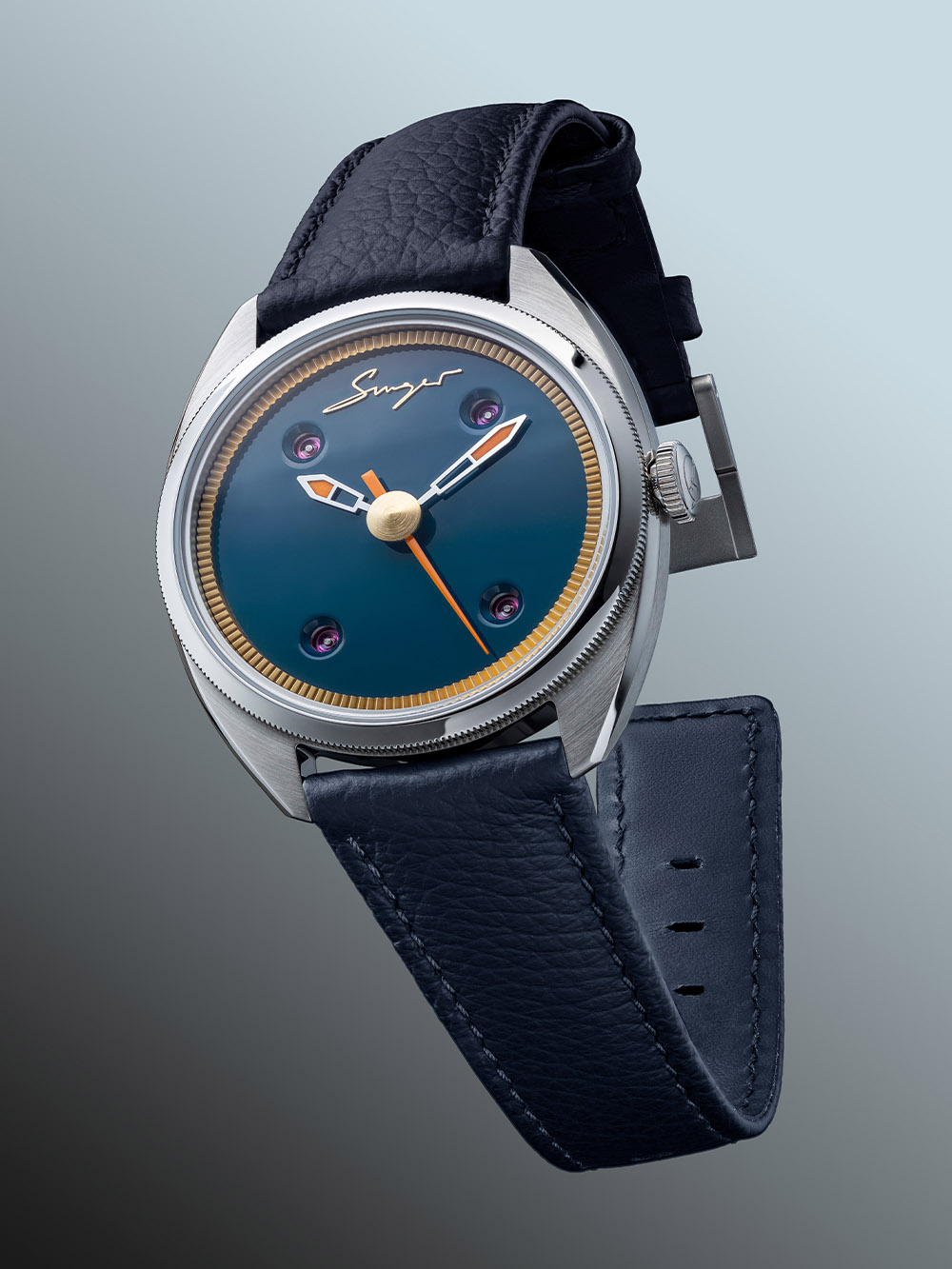
It’s also surprisingly svelte, fitting inside the 39mm x 10.5mm stainless steel case of the Caballero. The case itself is quite nice with alternating polished and brushed finishing with a round shape and sweeping, curved lugs. There’s also a coin-edge bezel that offers an interesting visual mirror to the golden, toothed flange (a Singer signature) around the outer edge of the dial.
The dial itself is presented in a choice of three colours: piano black, empire green or petrol blue, each produced in a fine lacquer. Though the standout element is the quartet of round apertures that reveal the rubies at the centre of each of the barrels below. A synthetic ruby, sometimes simply referred to as a jewel, is used to reduce friction around crucial pivot points in a movement, reducing wear and improving accuracy. It’s unusual to see them highlighted in such dramatic fashion but then the Calibre-4 is an unusual movement.

As for price, the Caballero is CHF 17,500 (approx. £16,200), which by Singer standards is practically entry level. It will definitely be interesting to see what other versions of the Caballero are in the works and if they retain the exposed jewel display.
Price and Specs:
More details at Singer.