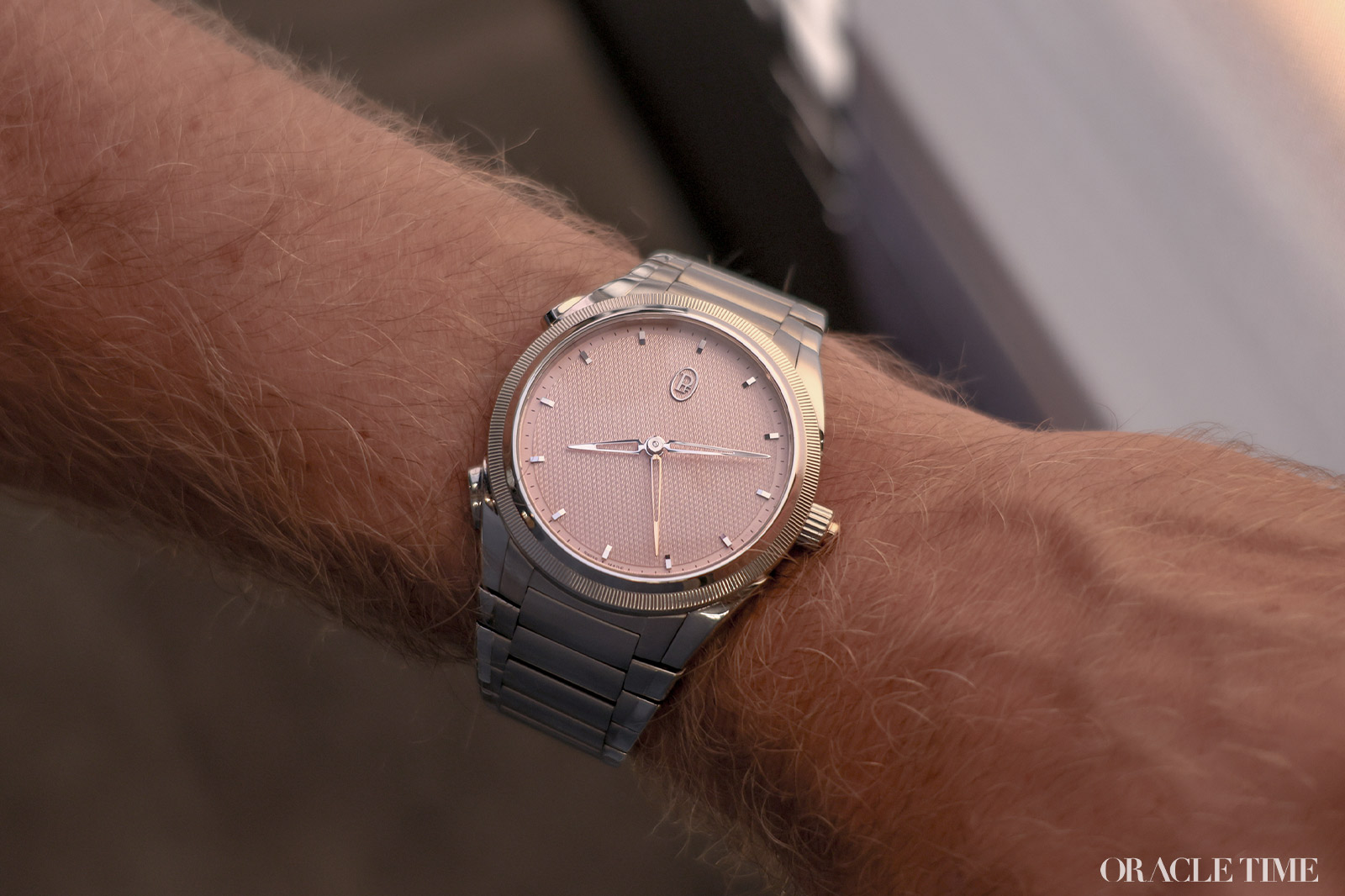
I interviewed Guido Terreni at Dubai Watch Week 2025, a year that has been measured rather than busy for Parmigiani Fleurier. Following the Toric Perpetual Calendar at Watches and Wonders, a beautifully minimalist take on the haute horology complication, Parmigiani arrived in Dubai with a single addition: the Tonda PF Minute Rattrapante in Arctic Rose. The rattrapante-minute function remains unique to the maison, offering a practical way to mark a segment of time on the main dial, and the Arctic Rose colourway fits neatly within the brand’s more understated palette. It felt like an appropriate moment to speak with Terreni about the foundations of Parmigiani’s philosophy and where the brand is heading next.
If a collector is discovering Parmigiani for the first time, where do you point them in the brand’s history? What’s the right introduction?
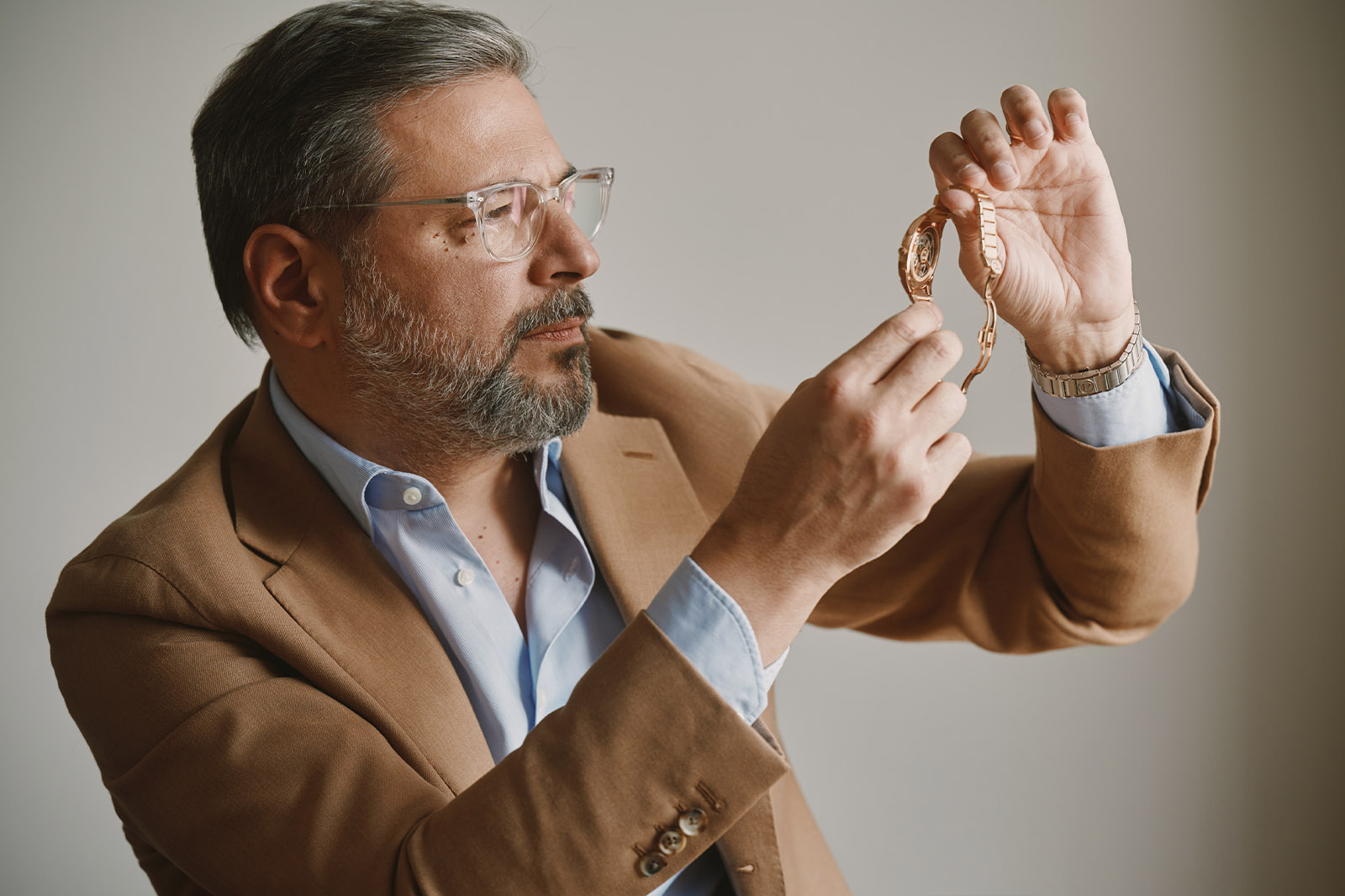
First of all, I speak about values, because everything starts there. Those values come from our founder, Michel Parmigiani. He’s a living legend of restoration and his knowledge of horology spans centuries because of that work.
When you restore, you’re not just understanding the craft of today, you’re mapping every tiny component from different eras. You develop an eye for finishing and a sensitivity to watchmaking that is incredibly broad. But it’s also completely understated. When you restore a piece, you’re working on someone else’s creation, giving it a second life for a client. You are not signing it.
That, for me, is the etymology of understatement at Parmigiani. The brand is very deep and very refined, but it’s aimed at people who are not ostentatious – collectors who have realised that “cool” is not what society tells you to buy, but what truly resonates with you. A collection should speak about the person, not the algorithm.
Historically, the key milestone is the creation of the brand itself on 29 May 1996. Next year is our 30th anniversary. Michel founded Parmigiani at the end of the quartz crisis to reaffirm what mechanical watchmaking is about: culture, craft, and innovation in the mechanism. The first model, the Toric, already expressed that – elegant, sophisticated, and mechanically interesting.
Another important chapter is the Bugatti watches in the early 2000s. We took the idea of a car engine and translated it into a transversal movement you could read like a driver, without turning your wrist. It was a very intelligent way of bringing mechanics into the real experience of the wearer.
Then in 2021 we relaunch the brand by going back to those roots: refined, understated, private luxury. That’s what we’re expressing today.
You’ve spoken a lot about one-off restoration pieces and special projects like La Rose Carrée and the mystery watches. How important are those to Parmigiani beyond simply showing off what you can do?
They serve two very concrete purposes.
The first is to perpetuate our restoration atelier. That atelier is the soul of the brand. To keep it alive, the watchmakers need work, not just from private restoration commissions but from internal projects that challenge and nurture their skills. These unique pieces do exactly that.
The second is to celebrate Michel’s legacy. Since 2021 we’ve created a tradition: every 2 December, which is International Watchmaking Day and also Michel’s birthday, we unveil a special piece outside the catalogue, usually a unique or extremely limited watch.
We take an antique movement – an “old heart” – restore it, and dress it in a new object, whether it becomes a pocket watch or a wristwatch depends on the character of the movement. So you have this beautiful idea of giving a second life to history, within a contemporary Parmigiani aesthetic.
The Tonda PF felt like an instant classic when it launched. Looking back, was it a lightning-in-a-bottle moment or a difficult birth?
It’s something we are very proud of, because it happened in the middle of the pandemic, which was not an easy time for anyone. When I joined, Parmigiani was in difficulty. The mission was to clarify the positioning and then develop it.
I had already studied the brand during the selection process, which took several months, so I arrived with a clear view of what needed to be done on the product side. But when I stepped in and saw the numbers and the existing collections, I felt the urgency even more.
We are fortunate to have enormous industrial power behind us thanks to the Sandoz Family Foundation: our own movements, our own cases, dial makers, everything. And Covid, paradoxically, gave us time. It was the only crisis after the Second World War that actually stopped Swiss production. Capacity was available, factories were quiet.
So we used that window to design and develop. In a very short timeframe, we created seven references that became the foundation of the Tonda PF relaunch. The challenge was simply: “get it right”, because there was no time for endless corrections. Yet the creativity was clear from the beginning. When you start going in circles in design, it usually means you haven’t nailed the idea. Here, we didn’t circle.
Collectors saw the watches in the metal, the reaction was immediate, and that gave confidence to everyone inside the company. After that, the next technical step was the GMT Rattrapante, which we introduced in 2022 – a module on our micro-rotor base calibre. Technically it was developed quickly, but it was essential. You can’t just refresh aesthetics; you need to push function as well.
Parmigiani is known among collectors for its finishing and its subtle details. Are there elements you think people still overlook?
Many. And that’s fine, because you’re meant to discover Parmigiani by wearing it, not scrolling past a render.
The whole philosophy is balance. No single element is allowed to scream louder than the others. There is no one “trick” that dominates the design.
Take the PF logo at twelve o’clock: when we launched Tonda PF, that medallion on the dial was a statement of privacy. It’s a quiet signal – “this is for you” – as opposed to a huge brand name across the dial for everyone else.
Or look at the guilloché. Historically, Parmigiani used a very present barleycorn pattern. On the new Tonda PF we kept the spirit but made it incredibly fine and shallow. From a distance it can look like a plain dial. On the wrist, it becomes a texture that plays with light and colour in a very subtle way.
Then there is comfort, which you cannot convey in a picture. The bracelet is designed as a second skin. You feel the softness of the edges, the way the chamfers run continuously from the case into the first links. We work the brushing to the point where you barely see the lines; it becomes almost silky, reflecting light more gently than a mirror polish.
Colours follow the same logic. They’re simple, easy to wear, but very specific. They don’t tire you after a season. These watches are meant to uplift you for years, not for one summer.
All of these ingredients play the same chord: something delicate, never intrusive, created for a collector who has moved past the phase of wearing what everyone tells them to buy.
You often talk about longevity of design. Beyond serviceability, what makes a design age well?
Balance and restraint.
When I criticise a watch design, it’s usually because the designer was too aggressive. It might be impressive on day one, but time is very cruel to excess.
If you look at the 1920s, at some of the great Art Deco pieces with shaped cases and beautiful numerals, they are absolutely anchored in a period and yet they still look fantastic today. Time has not ridiculed them.
There are designs that are truly timeless, and there are designs that are clearly of their moment but remain beautiful because they were done with integrity. The difference often has less to do with the original artist and more with what the brand does afterwards.
Think of any so-called “iconic” watch. Is it iconic because of one individual sketch, or because the brand managed it carefully for decades? If you over-exploit a design, if you flood the market with variations, you can kill its longevity. That’s not a design problem, it’s a management problem. You need discipline in how you evolve a style.

If you could revive or reinterpret a complication or craft that you’re not currently working with, where would you start?
We have plenty of ideas. But they take time.
For me, it’s less about reviving something for nostalgia and more about rethinking how a function is used in real life. The Tonda PF GMT Rattrapante is a good example. We took the rattrapante mechanism, patented in 1827 for split-seconds chronographs, and applied it to the hour hand instead.
The starting point was very simple: when you are at home, you don’t need your watch to shout that you are a traveller. When you travel, you need local time to move, cleanly and quickly. With our GMT, a pusher advances the local hour hand in one-hour jumps. When you want to go back home time, you press another button and the second hand “catches up” instantly via the rattrapante mechanism.
We used the same philosophy on the minute-rattrapante function we’re showing here: instead of measuring elapsed time on a sub-dial, you visually mark a slice of the hour on the main dial, so at a glance you know how many minutes you have left before a meeting ends or a gate closes. It’s still pure mechanics, but it gives you a more intuitive way of mastering your time.
The common thread is purity and intuition. Forms remain clean, information is clear, and the complication serves the wearer, not the spec sheet.
With ideas like that, who actually comes up with the complication? Is there one “mad scientist” or is it a committee?
This particular one came out of a conversation between myself and our head of development. I remember it very clearly.
It was the 29th of January, three days after I joined. We were discussing what Parmigiani needed to become and I said: let’s stop everything and think about a wardrobe of watches that gives a different experience. It has to be clean, pure, easy to wear.
Then I said something personal: I hate pulling out the crown to change the time when I travel. I don’t want to unscrew anything. A travel watch has to be as simple as pressing a button. And when I want to go back to home time, it should be even easier.
From that sentence, my head of development said: “What if we use a rattrapante?” That was the spark. From there, the whole idea of the GMT Rattrapante was born.
So no, it’s not one genius in a corner. It’s dialogue. But you need a clear vision of the brand to recognise when an idea truly belongs to you.
You’ve transformed Parmigiani’s design language quite clearly versus ten years ago. How much of that is your leadership, and how much is simply the brand finding itself again?
The brand had lost its way a little, which happens to brands the same way it happens to people. It lost contact with the audience it was originally speaking to. The world became less formal, tastes evolved, and Parmigiani tried to adapt very quickly, maybe too quickly.
At one point there was no CEO, there were too many changes in direction, and the original spirit of the ’90s was diluted.
What we’ve done is not to impose something new from the outside, but to go back to the soul of the brand – the restoration mindset, the understatement, the private luxury – and express that in a contemporary way with coherence.
Today, if you put one of our new Tonda PFs next to a Toric from the early days, you can clearly see they come from the same place. That, for me, is the real success.