2026 is apparently the year of space watches. Breitling recently stowed away on the Artemis II mission with their new meteorite-dialled Cosmonaut; Bremont are sending their new Supernova to the moon with Astrolab. And then we have the biggest space watch and, more importantly, the only one designed from the ground up with the vacuum of space in mind: the IWC Pilot’s Venturer Vertical Drive.
The idea for the Venturer Vertical Drive didn’t come from nowhere. Its launch coincides with IWC’s new role as official timekeeper for Vast, the company behind Haven-1, the first-ever commercial space station. The station is slated to open in early 2027, and construction on terra firma is well underway. Once the station itself is launched, the crew will follow on a later flight, with the new IWC on their wrists.
And so, there’s a very real chance the Venturer Vertical Drive will be strapped onto a spacesuit and ticking away in the void. Fortunately, that’s precisely what it’s been designed for.

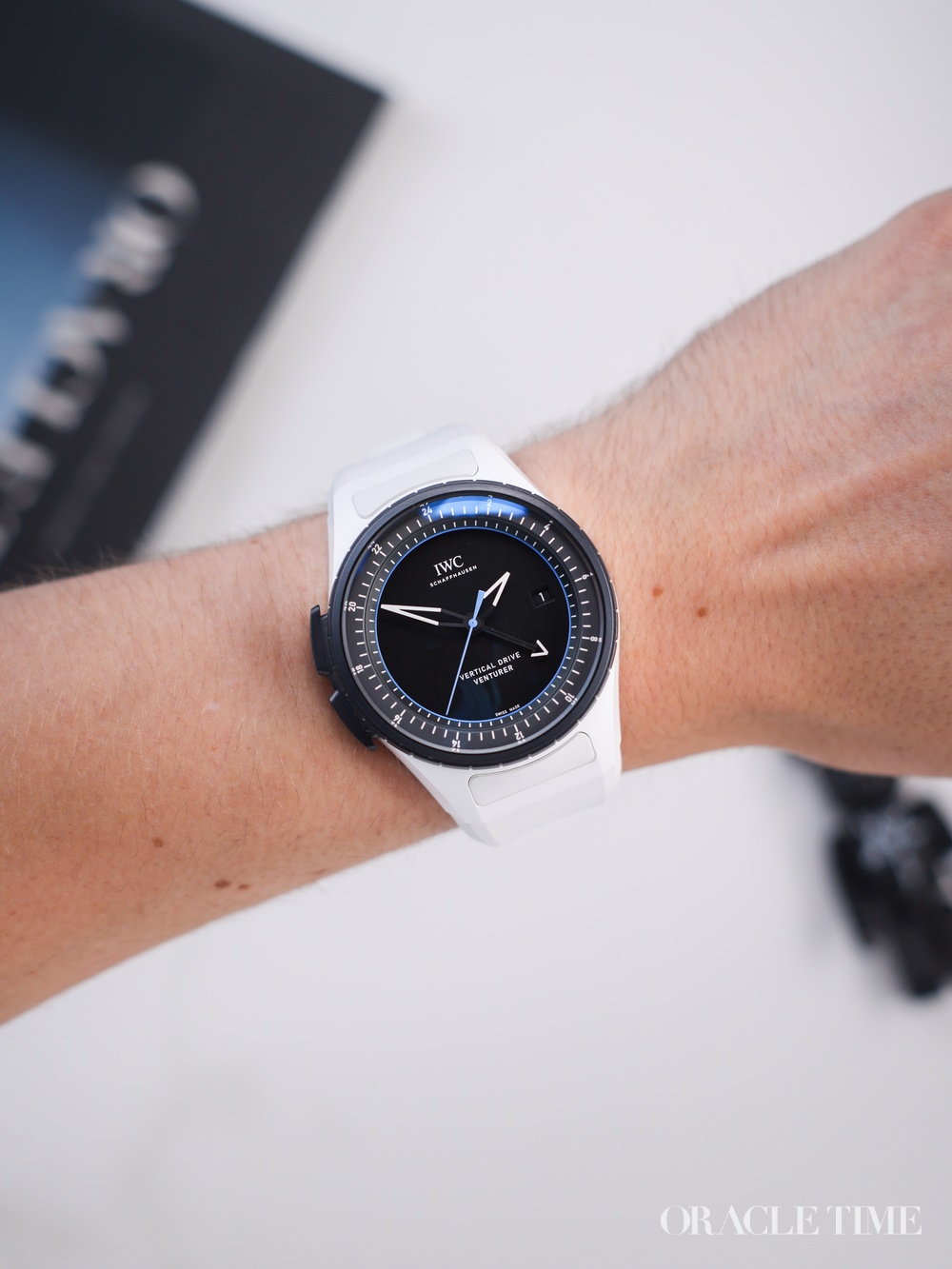
Firstly, this is a big watch. At 44.3mm across in white zirconium oxide ceramic, with a Ceratanium bezel and caseback, it’s a relatively daunting prospect for smaller wrists. The case tapers into the white rubber strap so abruptly that on my wrist the strap dropped almost vertically before curving to the clasp.
That doesn’t make it unwearable by any means, but it does make it less wearable than I’d like for a pricey pilot’s watch. At the same time, it’s something I can’t really knock because it makes sense. The size of both case and strap is because this thing is meant to go over a spacesuit and, like any watch designed for one specific task, it’s a necessary compromise.
That said, the most important feature of the Venturer Vertical Drive is one that can easily be enjoyed in the atmosphere: the bezel.
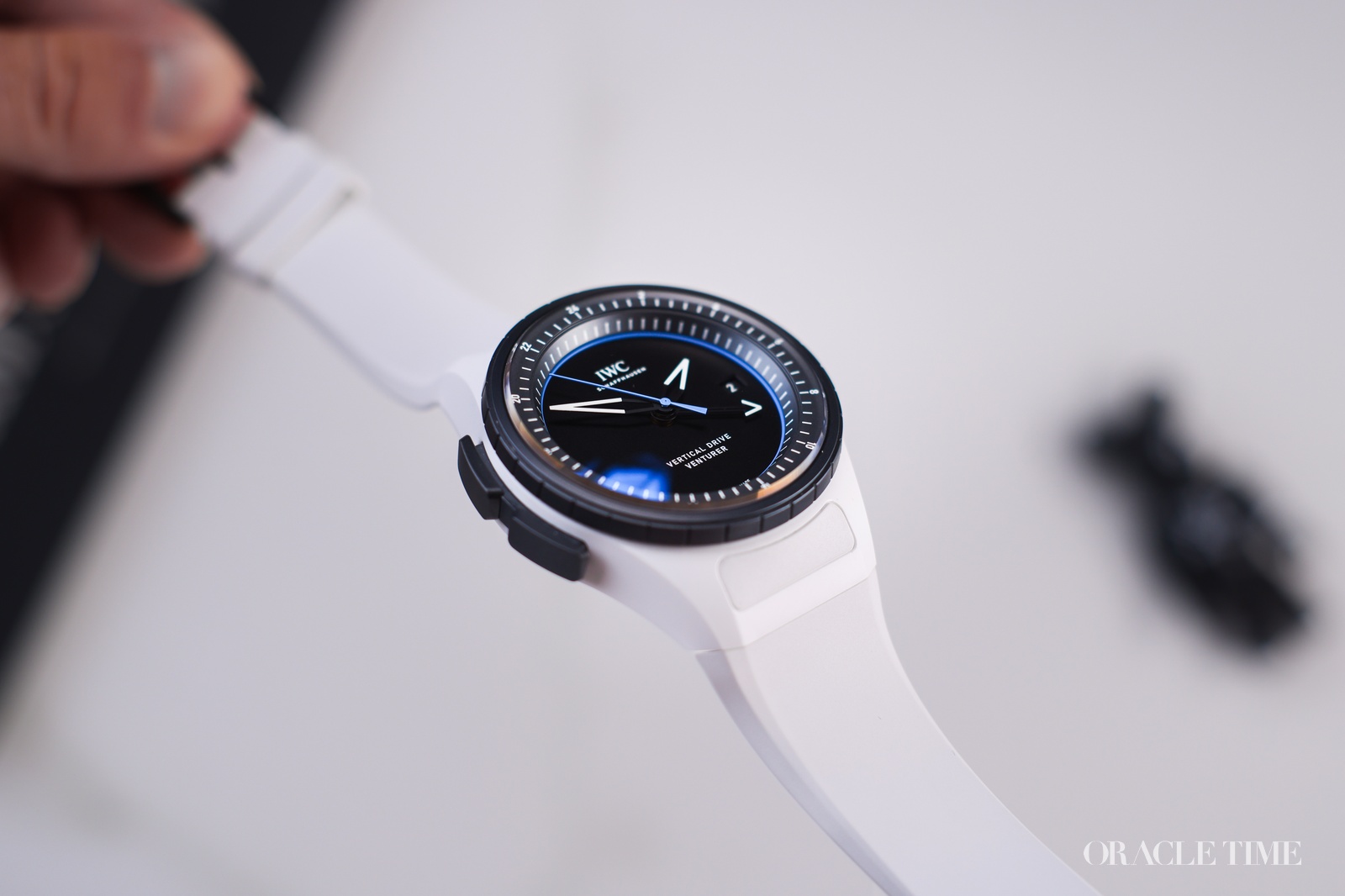
In order to be operated in thick gloves, IWC have taken away the setting crown entirely. In its place is a rotating bezel dubbed the ‘Vertical Drive’ that switches between winding and setting with a rocker switch on the side of the case. It’s an elegant solution but also an incredibly satisfying one. The switch has a nice, solid, mechanical feel to it and the bezel is incredibly smooth in its turning. There’s enough resistance that you’re not going to put too much force through the movement but not so much that it’s a pain to operate.
The elephant in the design studio is obviously that you probably shouldn’t be setting your watch in full gear; there’s a reason the Omega Speedmaster hasn’t dropped its crown or chronograph pushers. I can’t think of a single reason you’d need to set your watch once you’re geared up and many reasons to avoid it, but then I’m not an astronaut. Perhaps there is some fringe use case. And even if there isn’t, I can’t say it matters. When the bezel is this fun to use, who cares if there’s a genuine point to it?

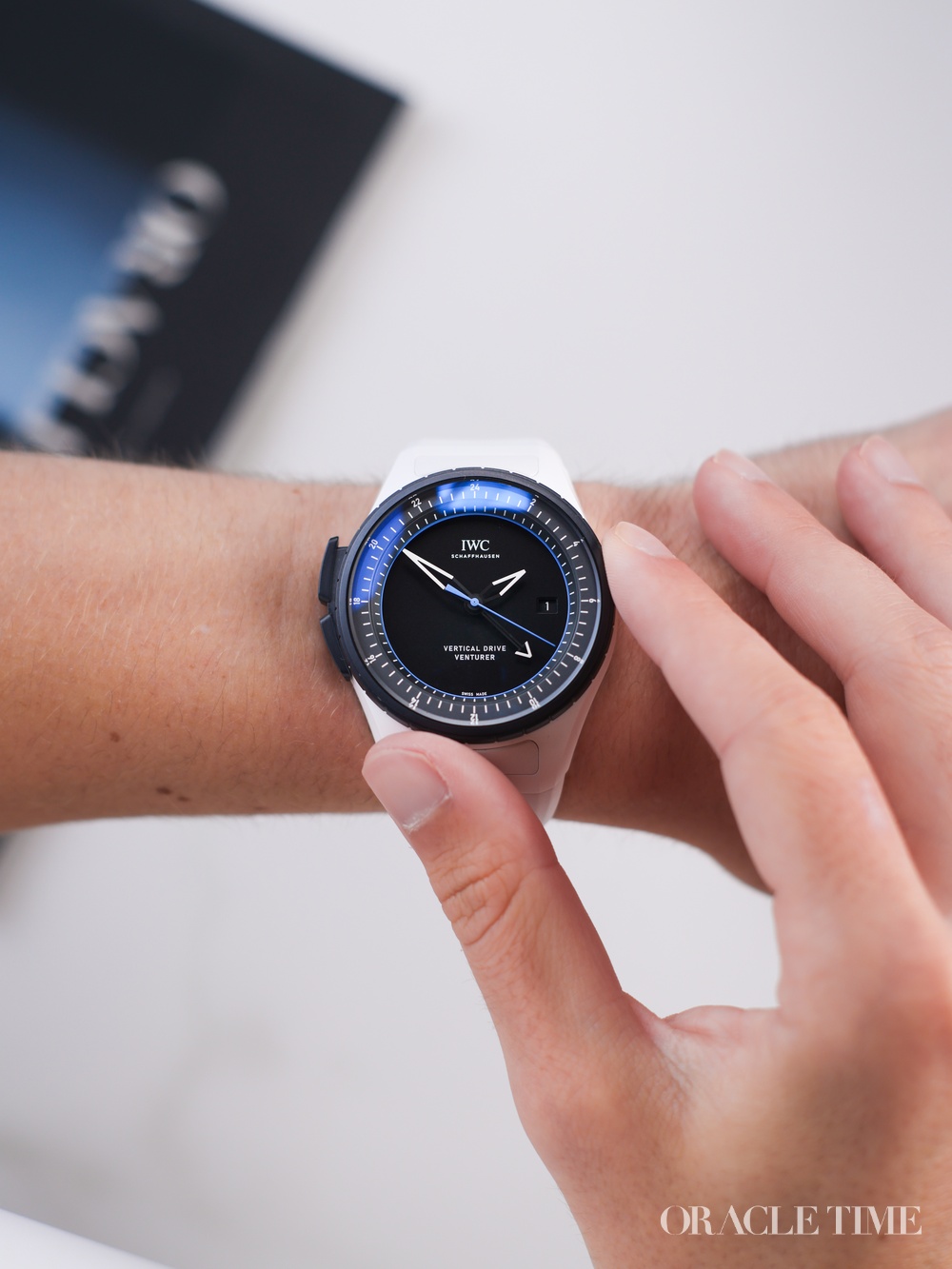
Because Haven-1 will see 16 sunrises a day, the Venturer Vertical Drive is a 24-hour watch, with two hands tracking the outer 24-hour scale: one shows reference time, the other can be set to a second time zone to avoid waking up the family for the longest of long-distance calls. The minutes and seconds move normally and the date window is nestled at three o’clock. It’s all neat and easily readable in the requisite white on black.
It’s not all black-and-white though. The futuristic look is hammered home with a bright blue ring around the dial and a matching blue seconds hand, both of which do some heavy aesthetic lifting. Without those little hints of colour, it might be a bit harsh; with them, it’s one of the best-looking IWCs in years.
What’s worth noting is that there is no chronograph here. From the Seiko Pogue to the Speedmaster, space watches have historically had chronographs for mission-critical timing, famously used to time the 14-second course-correction burn that set up Apollo 13’s re-entry. IWC also have a penchant for the humble stopwatch function, so its absence here is conspicuous.
It’s an acknowledgement that there are much better, more precise tools for the task; at the same time, that acknowledgement makes me wonder quite why the Venturer Vertical Drive needs any space-specific functionality at all.
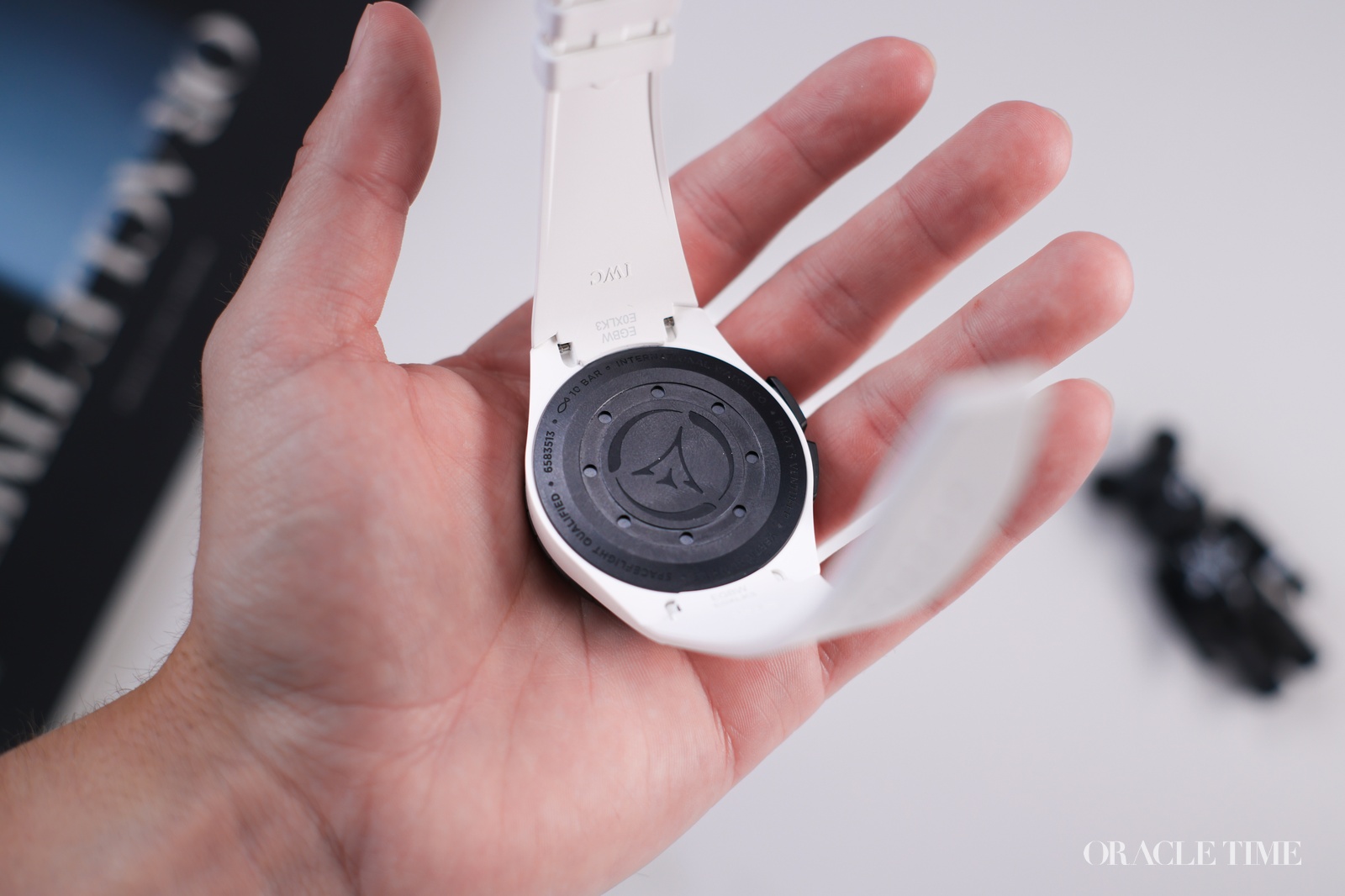
Inside is the 32722 automatic movement, with a substantial 120-hour power reserve. In this instance, that reserve is more important than usual given that a rotor’s not going to do its job in zero gravity, though the bezel-winding system provides a useful manual backstop. I have to assume it’s as nicely finished as other IWC movements as the Venturer Vertical Drive has a solid caseback. The watch is built to withstand depressurisation, so the solid caseback is expected; if anything, it reinforces the tool-watch intent.
Priced at £22,600, the IWC Pilot’s Venturer Vertical Drive is a lot of money for a GMT watch. But for a gloriously overengineered bit of space-faring equipment, it’ll definitely find its way onto a few collectors’ wrists — big wrists, at that.
Price and Specs:
More details at IWC.