Across their over 150 years of existence, IWC has had plenty of designers both for their cases and movements. Most of them, let’s be honest, have gone pretty much forgotten except amongst sects of serious military watch collectors. But there are two that remain important not just to IWC but watchmaking in general. In terms of design, it’s Gerald Genta; in terms of chronometry, it’s Kurt Klaus.
Genta doesn’t need much of an introduction. The 1976 revamp of the Ingenieur was one of a long list of iconic pieces he created. Kurt Klaus, simply because movements are less sexy, isn’t known quite as well but should be as the maker of the crown-operated Perpetual Calendar. It was an invention he put first into IWC’s Da Vinci in 1985. Now, IWC is bringing those two Schaffhausen watchmaking milestones into one watch: the IWC Ingenieur Perpetual Calendar 41.

Now, while IWC are saying this is the first time these two elements – the Ingenieur case and the perpetual calendar – have come together, they do so with one painful caveat: in stainless steel. There was indeed an older Ingenieur Perpetual Calendar as recently as 2019, but in titanium. Sure, the Ingenieurs of the 2010s looks completely different, but even before then there were precious metal perpetual calendars in the collection.
Still, without the hyperbole, steel does actually make a big difference. Just look at last issue’s cover star and the difference swapping from precious to practical made for Vacheron Constantin’s 222. And like the 222, they’ve embraced that classic colourway of steel and blue.
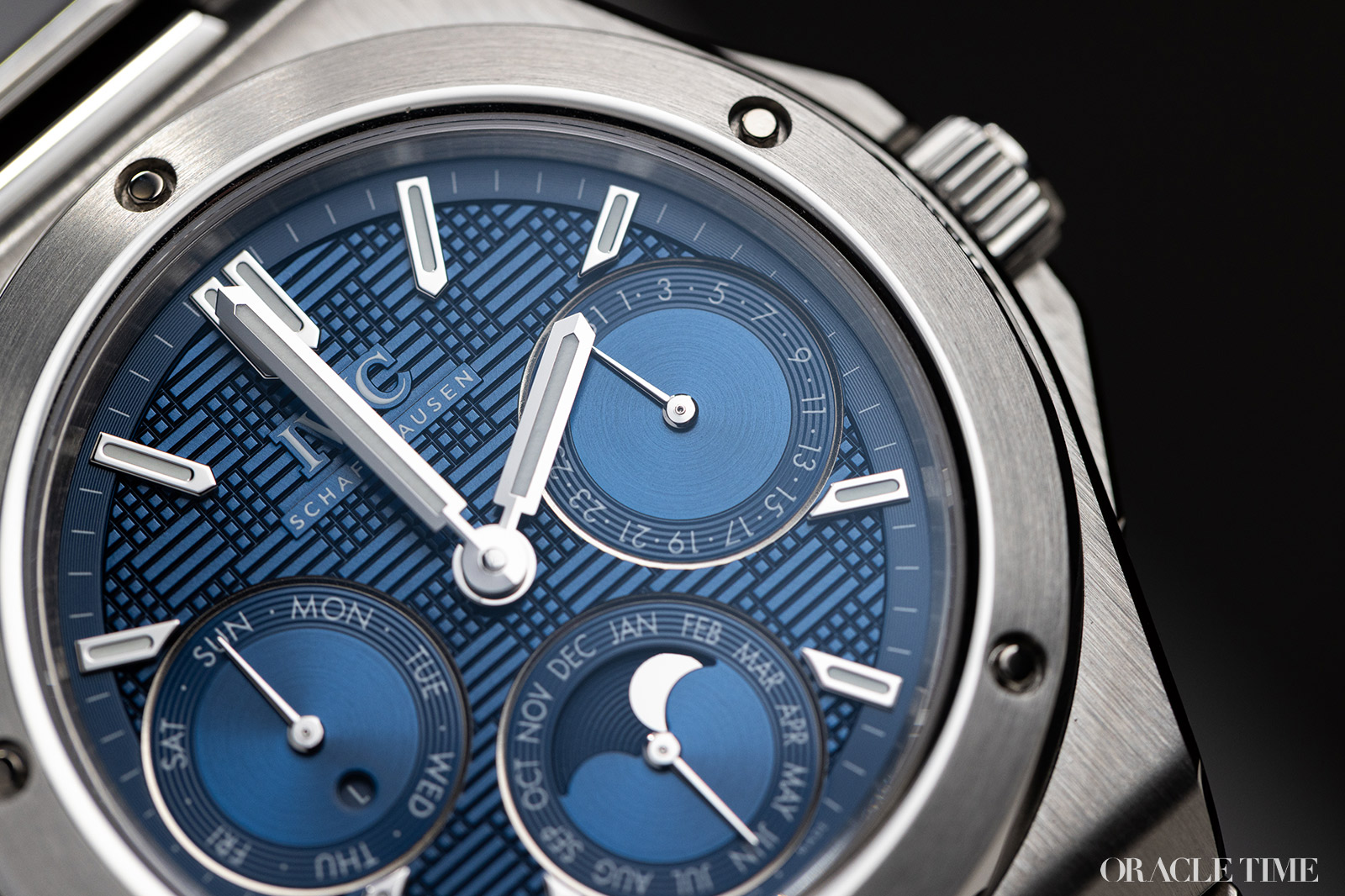
Avoiding the pitfalls (and comparisons) that come with Tapisserie, instead IWC have opted for a kind of staggered grid, with vertical lines in sets of four creating squares across the horizontal. On paper it doesn’t sound like much, but I genuinely love it. It’s familiar but distinctive, a usually impossible line to tread. It doesn’t feel too busy but has enough going on to be interesting after the first few glances and, perhaps most importantly, it looks absolutely killer in shimmering blue metal.
The large, lumed indexes would take over an automatic, but here the perpetual calendar subdials actually cut them off so that only those at 11 – 1 remain whole. This leaves the subdials enough room to actually show the various calendar entries, with days at 9 o’clock, date at 3 o’clock and month / moon phase at 6 o’clock. It’s a layout we’re more used to seeing with chronographs, meaning that IWC have seemingly disguised the high complication as something more mundane and, let’s be honest, more thematically suited to the steel case of sports watch.

That case is an absolute beauty. The flat planes are all brushed for that industrial look, but the edges are polished, outlining the entire Ingenieur and emphasising its distinctive shape. At this price point, you’d hope for details like that but it’s still nice to see, right down to the polished central links of the bracelet. I do think they could have done something more inventive with that bracelet given its competition, but it’s true to the original and does the job.

Despite the innate size of a high complication movement, you don’t notice it on the wrist. The 41mm case is about as small as you could have for a perpetual calendar and expect to read the thing. And while it isn’t exactly ultra-thin at 13.4mm, it’s not nearly as chunky as this many indicators and a moon phase accurate for 577.7 years might lead you to assume. That all said, you can still quite easily tell the difference on the wrist compared to the automatic version.

The IWC 82600 is a solid calibre even outside of the calendar. With its 4hz frequency and 60-hour power reserve it’ll keep accurately ticking over a weekend, even if you don’t wear it at all. If you do, the Pellaton winding system’ll have it powered up in no time. Sure, it’s not some insane calendar that will only go out of sync when the sun dies, but it’s fantastic, nonetheless and is, of course, superbly finished through the exhibition caseback.
Given a crown-operable perpetual calendar was Kurt Klaus’ baby, it’s worth a brief mention. All the indicators are synced together and can’t go out, so all you need to do is turn the crown to move everything together at once. If you don’t wear it for a few months that means it’s going to take some turning to get back to now, but it’s also incredible satisfying to watch everything more in tandem. He’s might not be as well known as Genta, but Klaus was a mad genius.
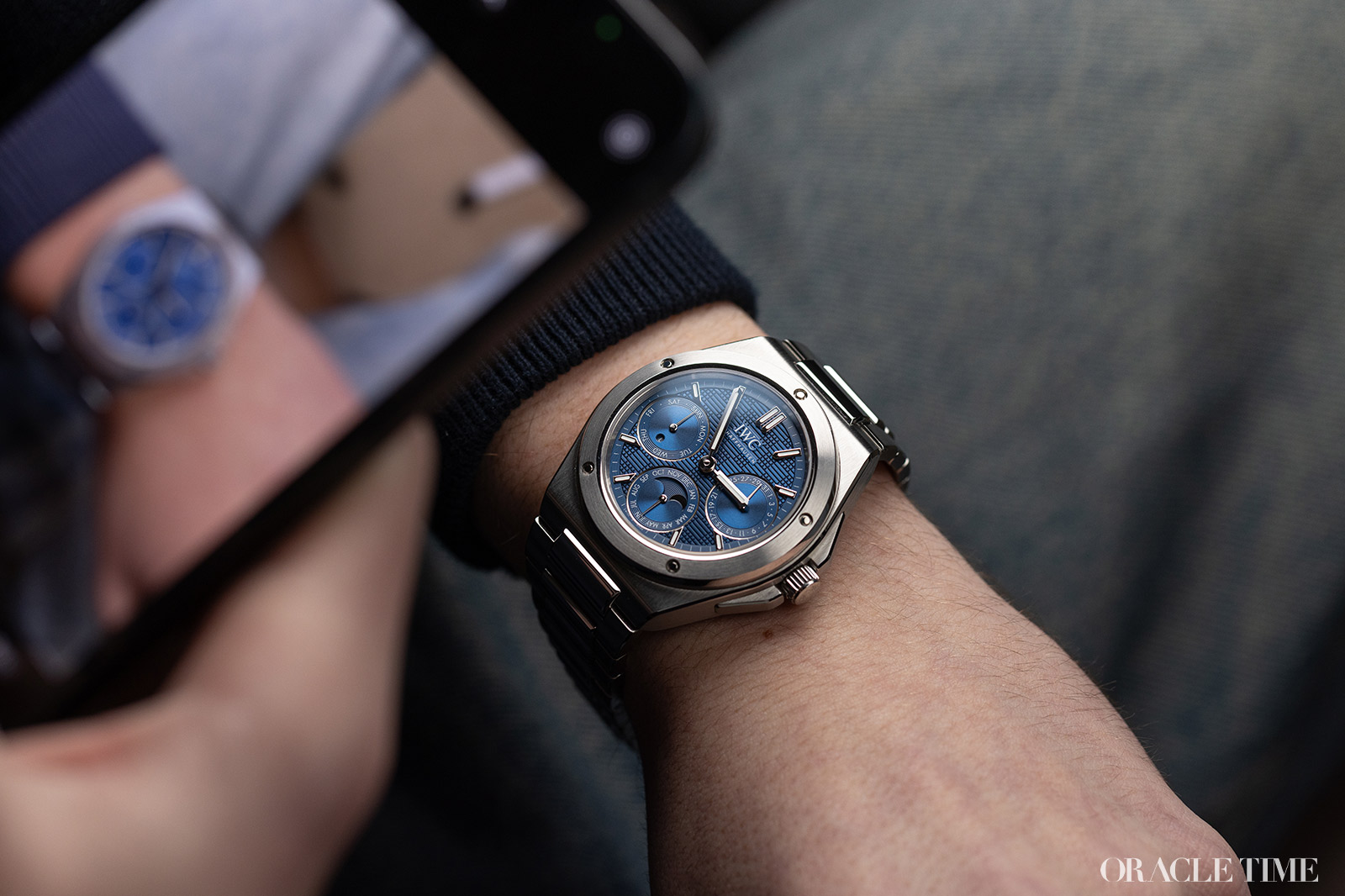
There’s a lot to love here. The Ingenieur Perpetual Calendar 41mm needed to nail the brand’s first highly complicated model in the new collection and in my opinion they did so. It’s streamlined, solid and sexy. The dial elevates it aesthetically above the rest of the collection and the necessary alterations to case size work well.
IWC shouldn’t be finding some granular ‘first’ to be trying to get attention here. The IWC Ingenieur Perpetual Calendar 41mm doesn’t need the help.
Price and Specs:
More details at IWC.