

When does the story of the British military watch begin? Is it in World War I when the ‘trench watch’ is widely used by officers? Or perhaps British military specification wristwatches such as the legendary pilot’s IWC Mark 11 from 1948 designed for the RAF? I’d say earlier. Because it’s less about the specific watches built for war, but looking back at one of the first major moments timekeeping played a serious part in battle.
The date is 21 October 1805. On this day the Battle of Trafalgar will be fought and won by the Royal Navy in the Atlantic Ocean off the Cape of Trafalgar, Spain. The famous architect of the triumph Vice Admiral Lord Viscount Nelson (1758-1805) aboard his flagship HMS Victory has with him one of the finest chronometer pocket watches of the time by the eminent watchmaker Josiah Emery (1725-1794), complete with a lever escapement. It was this watch that Nelson was likely to have consulted during the sea battle against Napoleon Bonaparte’s French warships and the Spanish navy, a battle that would ultimately cost him his life. Nelson is recorded as having asked a number of his officers onboard HMS Victory to set their timepieces to his watch before the battle. Synchronising watches is standard military practice; there’s a good chance here is where it began.

This is a fitting start point for British military timekeeping as there was another important development that made it possible. As the Royal Navy from the 18th century set about ruling the sea ships needed to navigate far more precisely. To achieve this an accurate timekeeper was required that would work onboard a ship along with a nautical almanac to establish longitude. The British Government established the Board of Longitude in 1714 to offer prizes to find such a timepiece. Rising to the challenge, John Harrison, John Arnold, Thomas Earnshaw, and Thomas Mudge all contributed to the first marine chronometer. Their innovations, along with Abraham-Louis Breguet and Josiah Emery, resulted in dramatic improvements in terms of accuracy and reliability for the watch – improvements that made these first, truly accurate timekeepers fit for the battlefield.
For historians and collectors alike, December 2025 offered a special treat with the chance to obtain at auction Nelson’s Emery watch, along with the pocket watches of Captain Thomas Hardy and Rear Admiral Cuthbert Collingwood. Spink auctions in London sold the three as an historic set, titled ‘The Watches Which Won the Battle of Trafalgar’ for £765,625, including buyer’s premium.
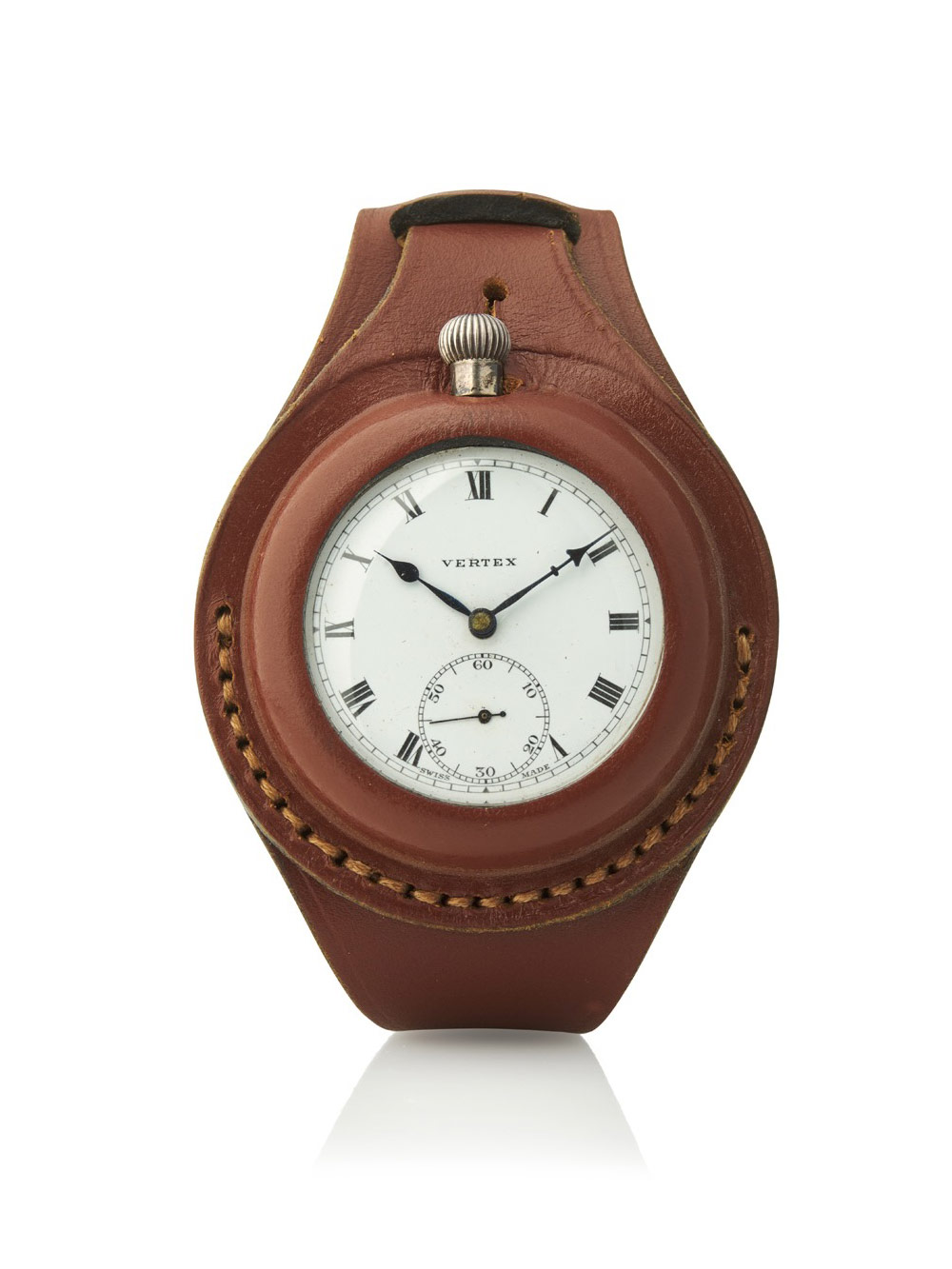
By the start of WWI in 1914, it was increasingly recognised that the pocket watch was outdated for military purposes. It wasn’t that the mechanical movement was at issue. Instead, blundering around the battlefield fumbling for a pocket watch wasn’t a good look (or particularly safe) for an officer. The British army had in fact begun to experiment in the late 19th century with the so called ‘wristlet’ wristwatch, for example during the South African (or Boer, if you prefer) War. These early military application wristlet watches often enclosed a small pocket watch within a leather strap with the dial visible kind of like a bund strap. An excellent example made by Vertex during WWI is pictured above. Wristlet watch design also progressed, (for both civilian and military use), to add wire lugs to the case to allow for mounting a thin leather wrist strap. Watch movements were therefore adapted by makers to allow for a winding crown at three o’clock as is standard with most modern wristwatches.
It was these wristlet watches that were largely adopted by British officers at the beginning of the war. As the war descended into vast muddy battlefields on land, brutal sea warfare, and the newly invented airplane created a new theatre of warfare, the wristlet evolved to become the ‘trench watch’, now regarded as the epitome of utilitarian military timekeeping in WWI. Functionality was everything, no elaborate dials just simple black or white enamel with large format numerals and a seconds subdial. No gold of course, but some silver was used along with base metals.
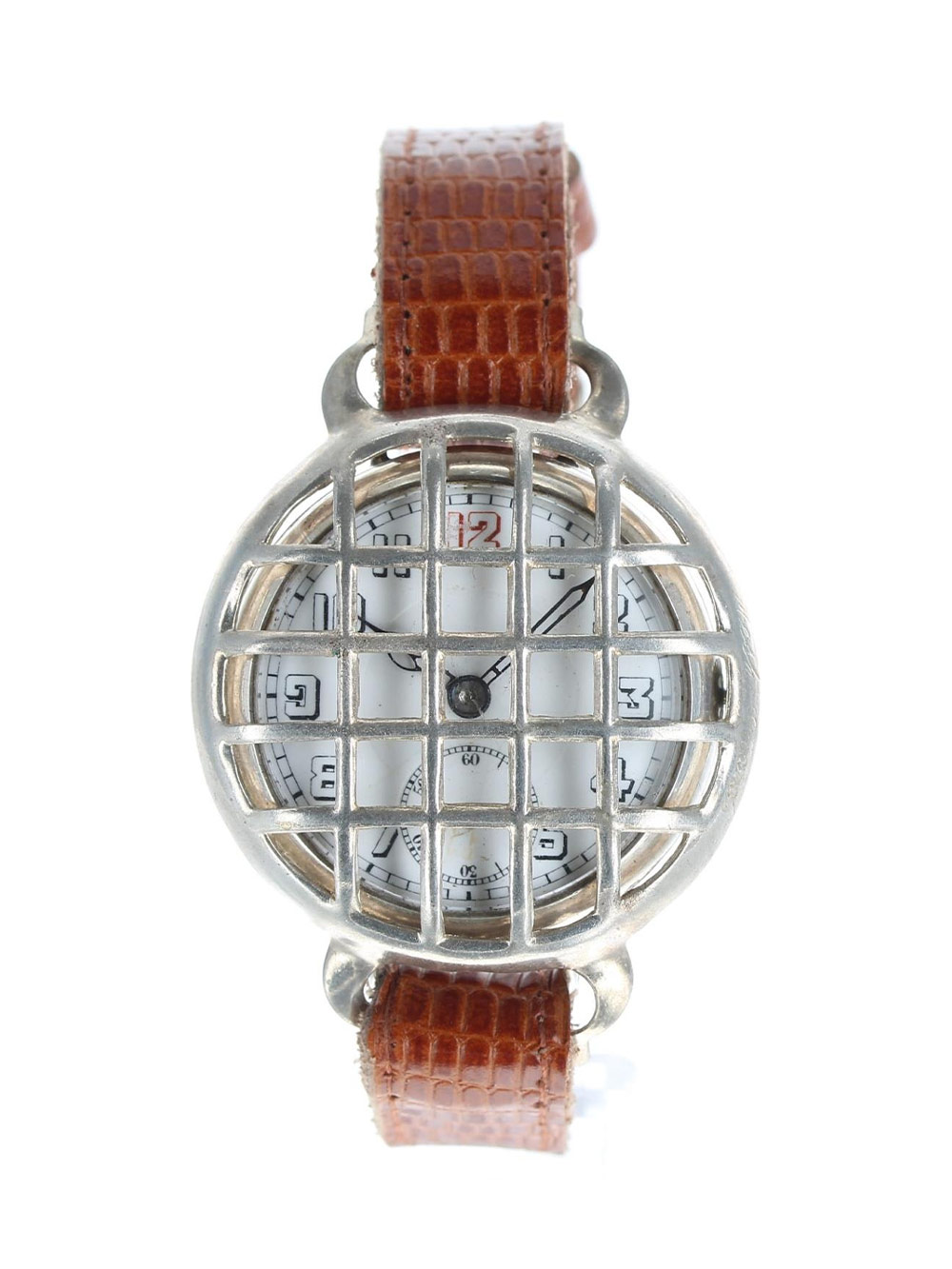

As the war progressed the trench watch took on some new innovations, most notable of which was the application of the recently invented radium luminescence. It must have seemed like a brilliant idea before we knew about radiation. Even today radium dials need to be treated with great care, as the radioactive compound will still be active. Other, less poisonous improvements to the trench watch included tougher materials for the glass cover and improved dirt and water protection. Perhaps most distinctly, some trench watches sported so called ‘shrapnel guards’ to protect the watch face. A good example was auctioned by Gardiner Houlgate, a 33mm silver cased WWI period wire-lug trench watch with import hallmarks for London 1916, fitted with shrapnel mesh guard.
The trench watch design was produced by many manufacturers including English, Swiss and American. Unlike WWII, the Great War did not see the mass issuing of watches by the Army, Royal Navy or the new Royal Flying Corps. However, some military issue pocket watches and trench watches were given out to NCOs and other ranks whose duties required accurate timekeeping. These watches were marked with the famed British military property ‘broad arrow’ symbol also referred to as the ‘crow’s foot’ plus stamped military reference numbers. The mention of NCOs and other ranks brings us to another point. The vast number of troops required drew in more and more volunteers, then conscription took over in Britain from January 1916. Some of these servicemen purchased their own watches. A poignant example can be found in the public online archives of the Imperial War Museum, which documents a Swiss pocket watch complete with a moon phase that was struck by a German bullet. As the museum records, the pocket watch likely saved the life of its owner, Acting Sergeant Smith. Tragically he was killed on the battlefield shortly thereafter in 1915.
Finally, a quick note should be made about other timing devices employed by the British Army in WWI. These included military issued split second chronograph stop watches to artillery units. The terrible science of accurate artillery shelling had advanced rapidly in the war leading to unprecedented bombardments including the use of creeping or rolling barrages. These devastating artillery applications required precise timing to be effective.


During the interwar years of the 1920s and ‘30s the wristwatch became the desired timepiece for men in civilian life. It would be inaccurate, however, to state that the trench watch alone created the modern wristwatch. This would be to ignore one of most definitive wristwatch designs that helped define the template for men’s wristwatches – the Cartier Santos wristwatch designed for Brazilian pioneer aviator Alberto Santos-Dumont in 1904. Followed shortly by the Cartier Tonneau and Tank wristwatches, both created during WWI – the latter famously inspired by a Renault military vehicle. What can be said is the popularity of the trench watch as worn on the wrist carried over into civilian life.

The interwar years also spurred new wristwatch developments that had immediate military application when WWII broke out in 1939. US Naval Officer Philip Van Horn Weems developed a long-range celestial navigation system for flight in the late 1920s using in part a radio time signal and a wristwatch that could be manually set to the radio signal. Swiss watchmaker Longines built the watch for Weems, the now renowned ‘Weems second-setting watch’. Variations of the Weems watch were used by the U.S Army Air Corps. Central to our story however is that the British also specified a Weems watch for RAF pilots and navigators. This was an official issue watch from the British Air Ministry and a true piece of military kit. Along with Longines, the watch was supplied by makers like Omega and Jaeger-LeCoultre. Today this rare watch is regarded as highly collectable, and Watches of Knightsbridge recently offered a Longines version of the Weems Air Ministry RAF wristwatch issued in circa 1940 from the Battle of Britain period. It made an above estimate hammer price of £5,200 at their December 2025 watch sale. Making a nice direct comparison, Gardiner Houlgate had a rare Jaeger-LeCoultre version, which fetched £5,000 at their October 2025 watch sale, a steal for something with this much history.

The use of British military specification wristwatches was much more widespread in WWII. By and large, NCOs (Non-Commissioned Officers), and personnel of all ranks needed to know the time and within the RAF the pinnacle wristwatches were those issued to pilots and navigators. The best known of these is the stainless steel IWC Mark XI. Introduced in 1948 after WWII and at the start of the ‘Cold War’, following a tender procurement process by the Air Ministry the watch is powered by the accurate IWC manual-wind calibre 89. One of the most significant features of the watch is the use of a soft iron Faraday cage to shield the movement from magnetic fields. Jaeger-LeCoultre was also commissioned to produce its own version of the Mark XI RAF pilots’ wristwatch to the same specification.
The other defining British military specification wristwatch from the WWII era is of course the British Army’s so called Dirty Dozen watches. Issued by the British military at the end of WWII, the War Office commissioned 12 watch companies to supply these watches including Buren, Eterna, Grana, Longines, Vertex, Lemania, Record, IWC, Jaeger-LeCoultre, Omega, Cyma, and Timor. From a collector perspective, the rarest watch in the group is the Grana, of which a scant 1,000 to 1,500 were ever built.
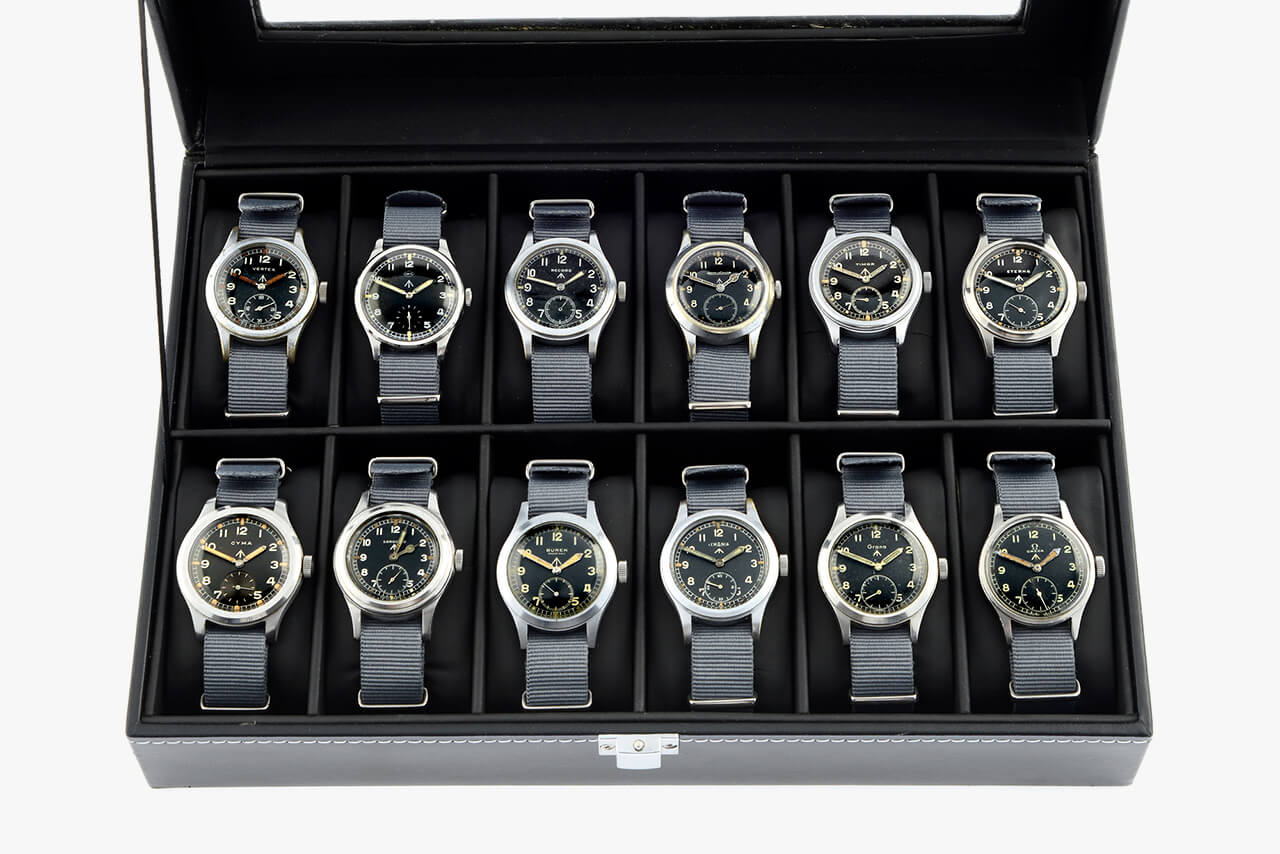
All 12 watch models follow the same British military designated requirements including the stamped designation W.W.W for ‘Watch. Wrist. Waterproof’. The watches have high legibility numeral dial, a sub-dial for seconds, screw down case back, fixed bars, and a hacking seconds, (stop seconds), function to enable watch synchronisation. As the only British maker on the 12-brand commissioning list, Vertex’s version is emblematic, with its stamped broad arrow and manual-wind calibre 59 movement.
Of course, you can’t talk about military watches without the iconic Rolex Submariner reference 5513 & 5517, known as the ‘MilSub’. This watch has established itself as one of the most sought-after collector pieces for vintage military wristwatches. Specified by the Ministry of Defence (MoD) for the Royal Navy and commissioned between 1972 and 1979, it was specced for a stainless steel case, a bezel calibrated for 60 minutes, 200m or 660ft of water resistance, tritium luminescence, a hacking seconds feature, fixed lugs and sword-shaped hands. Compared to the Dirty Dozen, MilSubs are incredibly hard to get hold of; a prime example was sold by Bonhams in December 2025 for £108,350.

The MoD also commissioned rivals Omega to produce a diver’s watch. Using their already well established Seamaster as a base model, Omega applied the MoD military specification to the watch in the mid-1960s for Royal Navy divers. Similar to the Rolex ‘Milsub’ this included solid fixed bars between the lugs, a full 60-minute calibrated bezel, tritium luminescence with the circled ‘T’ on the dial, oversize sword hands and a hacking seconds feature. Like the Rolex, it too became incredibly collectible, just at a slightly lower premium; Bonhams also sold one of these in 2024 for £23,040.
Of course, true, dyed-in-the-wool fans of military timekeepers are likely screaming about a conspicuous absence from the story so far: CWC. The British Cabot Watch Company, established by Ray Mellor in early ‘70s, was awarded MoD contracts to supply British armed forces with both wristwatches and timing devices. CWC is still trading today and increasingly getting more attention. As military watch historian and collector Jonathan Hughes notes about CWC:
“The most sought-after CWCs have to be the early Royal Navy divers, (mechanical in 1980 and 1981, and quartz in 1983, 1985 and 1986), plus the early SBS divers from the 1990s, (and the first issued year from 1988, although those are so rare as to be virtually unobtainable)”.
You can take Jonathan at his word, given he runs the highly informative website CWC ADDICT, arguably the best resource about the brand in existence. In addition to the CWC content the website also hosts a range of other resources for military watch collectors.
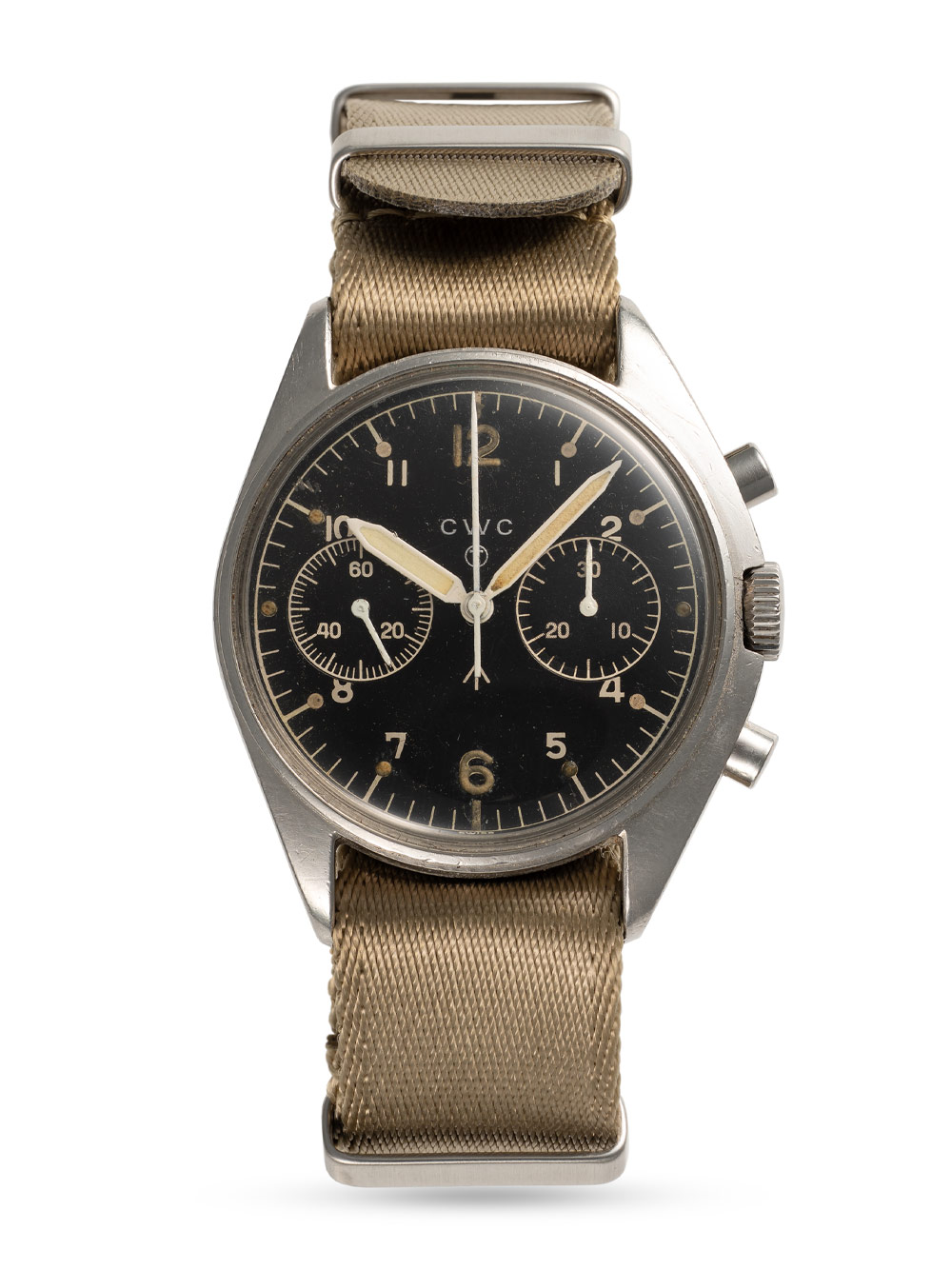
A good example of a CWC military wristwatch was auctioned by Watches of Knightsbridge in December 2025. The piece was a British military issued CWC Quartz powered Royal Navy divers’ wristwatch dated 1997. The watch has a ‘Big Triangle’, 60 minute rotating bezel, tritium dial, fixed bars, and sword hands. The move by the MoD to Quartz powered wristwatches was a sign of the times but also the relative lower cost versus increasingly expensive Swiss automatic mechanical watches. The watch is sized at 42mm with a screw back and stamped with military issue markings on a military NATO style strap. The watch sold for a hammer price of £1,500.
So, what of the future for the British military watch? Well, there’s no danger of smartwatches taking over. Or perhaps, there’s too much danger there, as they can be hacked and have been banned in sensitive areas and for military activity. While it might seem archaic for any quartermaster to issue a wristwatch, maybe the age of the simple reliable military wristwatch is not over quite yet. And with vintage military watches becoming ever more collectible (even outside of Rolex and Omega), now might be a good time to flex that stiff upper lip and invest in a bit of military history. It won’t make you Vice Admiral Nelson, but it will at the very least get you a beater to end all beaters.


Many thanks for your kind feedback on my article. The history of military watches is a fascinating topic to write about and very extensive.
Thank you also for sharing the details of the A.T.P military watches and the 1915 Brook & Son SUBMARINE. This watch sounds incredibly rare. If you do ever find a photo of the watch I would like to see this. Talking of submarines researching the article I found a very nice example of a Royal Navy Seiko Nuclear Submarine military issue quartz chronograph wristwatch from 1993. The watch was sold by Fellows Auctioneers in February 2024.
One of the hardest choices with the article was in deciding which watches to include as the article is a brief history of British Military watches as well as highlighting some of the innovations in horology that had military application. Other notable British military watches include those by Lemania and Smiths.
With regard the Cartier Santos Dumont story let me see if I can find you some research resources. Did you have a chance to attend last year’s superb V&A museum Cartier exhibition? The exhibition had a very early Santos Dumont wristwatch from the Cartier Collection which was incredible to see. One very good reference book for watch history is by Alexander Barter, titled ‘The Watch: A Twentieth-Century Style History’.
Oracle Time have also suggested viewing the following link to an article they wrote in 2018 by Sam Kessler, Editor: https://oracleoftime.com/historys-toughest-exploration-watches-from-ocean-depths-to-outer-space/
You might also enjoy this informative article by Phillips in Association with Bacs & Russo about the case shapes used by Cartier.
https://www.phillips.com/article/157029294/the-different-shapes-of-cartier
As noted if I can provide any additional resources I will let you know. Best regards Richard.
Thanks for the suggestions Richard, I’ll have a read of those.
With regards to the submarine, I’m more than happy to take some pictures if you let me know where to send them (can’t see a way to add them in the comments unless I’m missing something?)
I’d also recommend a read of the research David Boettcher has done on these almost forgotten watches.
Many thanks – I hope these resources help.
To send a photo to me of the WWI submarine watch please e-mail to Oracle Time: editorial@opulentmedia.co.uk. I am sure they will pass the photo on to me.
Thank you also for the recommendation. David Boettcher has an incredible technical knowledge of watch making and of watch history.
As mentioned I hope to provide some more resources regarding the Cartier Santos Dumont story but meantime some additional thoughts are as follows:
On a general note the Antiquarian Horological Society (AHS) is an excellent society dedicated to the history of horology. You may already know about the society or be a member. Specifically to your interest in the Cartier Santos Dumont story the AHS has a Wristwatch Group with members who have great knowledge about the story of watchmaking. Well worth finding out about. I am a member and highly recommend the society. https://www.ahsoc.org/groups/wristwatch-group/
Another source of information is of course Cartier itself. You could approach Cartier and ask for their help with your research and see how you go. They list three relevant publications on their website as follows:
(1) ‘LE TEMPS DE CARTIER’ – Jader BARRACA, Giampiero NEGRETTI, Franco NENCINI. Publi Prom S.R.L, 1993.
(2) ‘THE CARTIER TANK WATCH’ – Franco COLOGNI. Flammarion, Paris, 2023.
(3) ‘THE CARTIER COLLECTION: TIMEPIECES’. Franco Cologni, François Chaille. Flammarion, Paris, 2006.
https://www.cartier.com/en-gb/maison/the-story/living-heritage/bibliography/monographic-publications
Best regards, Richard.
Great article thank you, I’d like to add two more watches for anyone interested in this subject.
A.T.P. or army trade pattern watches, introduced in 1939 they saw service through the war, and set much of the template for the later dirty dozen watches.
The other is the 1915 Brook & Son SUBMARINE, although not issued by the admiralty they made at the request of a couple of WW1 submarine commanders for use at sea. It was years ahead of it’s time being one of the earliest water-resistant and anti-magnetic wristwatches.
On a side note, can the Oracle team or any of the readers point me towards a historical record for the Cartier Santos Dumont story?
I’ve recently been trying to research the subject but the earliest account of the story I’ve been able to find in the archives only dates to 1978 when Cartier was launching what we now know as the Santos.