H. Moser & Cie are no strangers to perpetual calendar functions, the Perpetual 1 from 2005 became one of their flagship timepieces and they’ve been consistently revisiting the complication since, as recently as this year with the Heritage Perpetual Calendar. However, they’ve always stayed in that ‘heritage’ bracket and there hasn’t really been too much innovation or modern design, until now. Enter the Streamliner Perpetual Calendar, an addition to the Streamliner collection introduced in 2020.
The case on the new calendar follows the basic principles of its parent collection. Meaning that like the other Streamliners it has a 42.3mm diameter cushion shaped case in stainless steel with contrasting brushed and polished surfaces, although the bezel here has been given a sunray brushed finish. Similar to the Streamliner Flyback Chronograph version, the crown on the Perpetual Calendar is offset at 4 o’clock. Completing the case is the signature integrated bracelet, which with its scalloped links is actually a highlight feature of the collection. If you’ve worn one, you’ll know how comfortable it is.
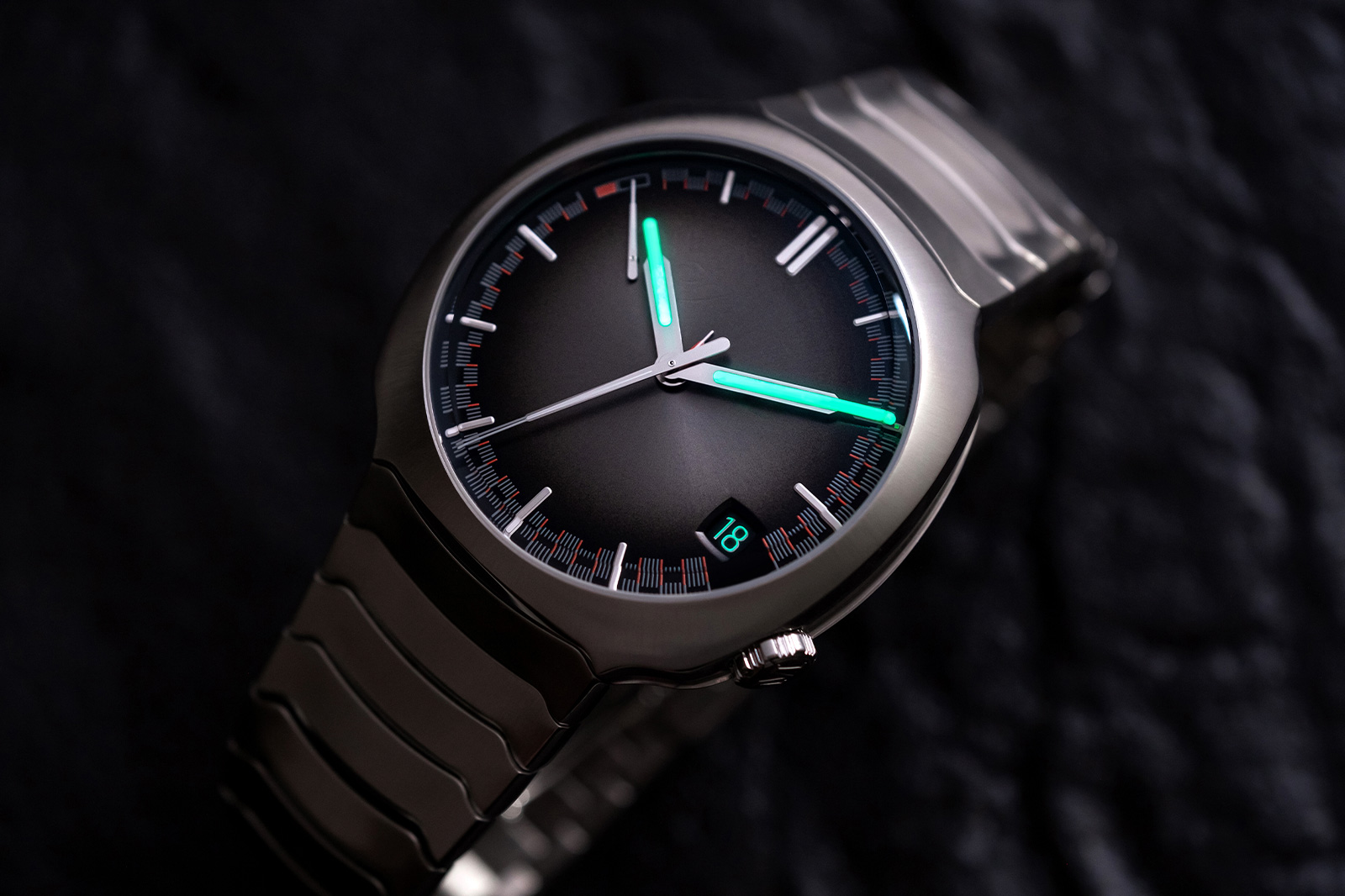
Yes, the case hasn’t been changed or updated that much for the new version but that’s not a bad thing. It’s the case and silhouette of the Streamliner collection that gives it a quirky, quasi-industrial charm, with references to 1920s-30s trains, which is what made them a hit in the first place. The dial on the other hand has seen a fair bit of change.
First of all, the central hand stack includes four hands. That might not sound like the craziest innovation but until now H. Moser’s perpetual calendars have always used a small seconds subdial (if they include seconds at all). Personally, I’ve never thought it was an issue, however on reflection the small seconds does occupy a large portion of the dial and obscures the fumé designs that they’re so good at. By moving the seconds back onto the hand stack, the dial is immediately cleaner and refined, showing off that signature grey fumé.



The hand stack consists of your classic hours, minutes and seconds with an additional red and white months hand that uses the baton hour markers to show how far through the year we are. They also include Globolight® inserts, a type of ceramic material that has lume built into it. Rounding out the dial is a power reserve indicator at 10 and a new date window at 4. There’s also a leap year indicator but that’s tucked away on the back of the movement, visible through the open caseback.

As you would expect, this change in format and layout for this perpetual calendar requires a new calibre. The HMC 812 is a manual-wind perpetual calendar movement with a superb power reserve of 168-hours and plenty of quality of life features such as a ‘flash’ instant change date that allows you to adjust the date and time at any time of day.
Setting out to write this article, I wasn’t the biggest fan of the Streamliner Perpetual Calendar. It’s not as conventional as the Heritage Perpetual Calendar I mentioned earlier and I expected to conclude that the heritage version is overall classier and my favourite. However, in the relatively short time I’ve spent looking at it and writing about it, it’s completely won me over. There’s something about the case and its quirky personality that fuses so well with one of watchmaking’s most prestigious complications. Moser have done it again – on screen their watches aren’t anything special but the further you dig, the more you understand the method to their madness.
Price & Specs:
Model: H. Moser & Cie Streamliner Perpetual Calendar
Reference: 6812-1200
Case/Dial: 42.3mm diameter x 11mm height, stainless steel case, black or fumé dial with sunburst pattern
Water resistance: 120m (12 bar)
Movement: In-house calibre HMC 812, manual winding, 33 jewels
Frequency: 18,000 vph (2 Hz)
Power reserve: 168h
Functions: Hours, minutes, direct-drive central seconds, big date at 4 o’clock, month indicator, power reserve indicator, leap year cycle indicator
Strap: Integrated stainless steel bracelet
Price/availability: CHF 49,900 (approx. £39,250)
More details at H. Moser & Cie.