Arnold & Son’s DSTB was built to show the exact second. Now, for the first time, you can set it to one. The new DSTB Stop-Seconds combines the collection’s signature true-beat, aka. deadbeat-seconds, complication with a stop-seconds function. Two new 42mm limited editions carry it with two new dial colours: red gold with Cliff Grey and platinum with Kingsand.
The easiest way to understand what deadbeat-seconds are, is to compare them with a quartz movement. A quartz watch’s second hand moves in little jumps, once a second, nudged forward by a tiny motor. However, a mechanical watch’s second hand normally moves in quick, tiny steps, several times a second, so it reads as a smooth sweep rather than a tick. Deadbeat-seconds deliberately makes a mechanical watch tick like the quartz one. Inside, a lever and notched wheel sit between the balance and the seconds hand so that as the balance keeps swinging at its usual fast rate, the lever locks the wheel in place and releases it only once a second. Making the seconds hand move in a single sharp jump, causing the ‘tick’.
Arnold & Son calls its version of this the DSTB, short for Dial-Side True Beat, since the mechanism doing all this sits visibly on the dial rather than hidden underneath. The DSTB collection has been expanded and built on since 2014.

But why would you make a mechanical watch look like quartz at a glance, especially when it takes considerably more engineering? The point isn’t accuracy, the balance runs exactly as it would in any other watch, it’s readability. A ticking hand lands precisely on a marker once a second; a sweeping hand is always somewhere in between, so you’re estimating rather than reading. That matters when the whole point of a chronometer is to check the time as precisely as possible for purposes of timekeeping and navigation.
This latest version solves a slightly ironic problem. A deadbeat-seconds watch exists to show you the exact second, but until now, you couldn’t easily set a DSTB watch to the exact second you wanted. Pull the crown on an ordinary watch and the seconds hand usually freezes, a feature known as a stop-seconds mechanism, letting you line it up with a reference clock before pushing the crown back in and picking up time from that precise second. However, pull out the crown of a DSTB and it keeps ticking. That’s because a deadbeat mechanism and a stop-seconds mechanism are not natural partners. The former is constantly storing and releasing energy to produce that once-a-second tick, so stopping it isn’t as simple as stopping the balance.
Arnold & Son’s fix is to introduce a dedicated stop lever. Activated by pulling out the crown, the lever halts the seconds hand and all that stored tension cleanly, then restarts it instantly the moment the crown goes back in. The effect is the same routine sailors once followed with their own chronometers: set the hands in advance, wait for a time signal, then release at the precise second. At sea, that second mattered – by Arnold & Son’s figure, a one-second error put a ship’s position out by 463.8 metres. The stop lever itself is invisible – you won’t see it from the dial or through the sapphire caseback. That makes it the kind of complication that rewards knowing it’s there rather than seeing it.
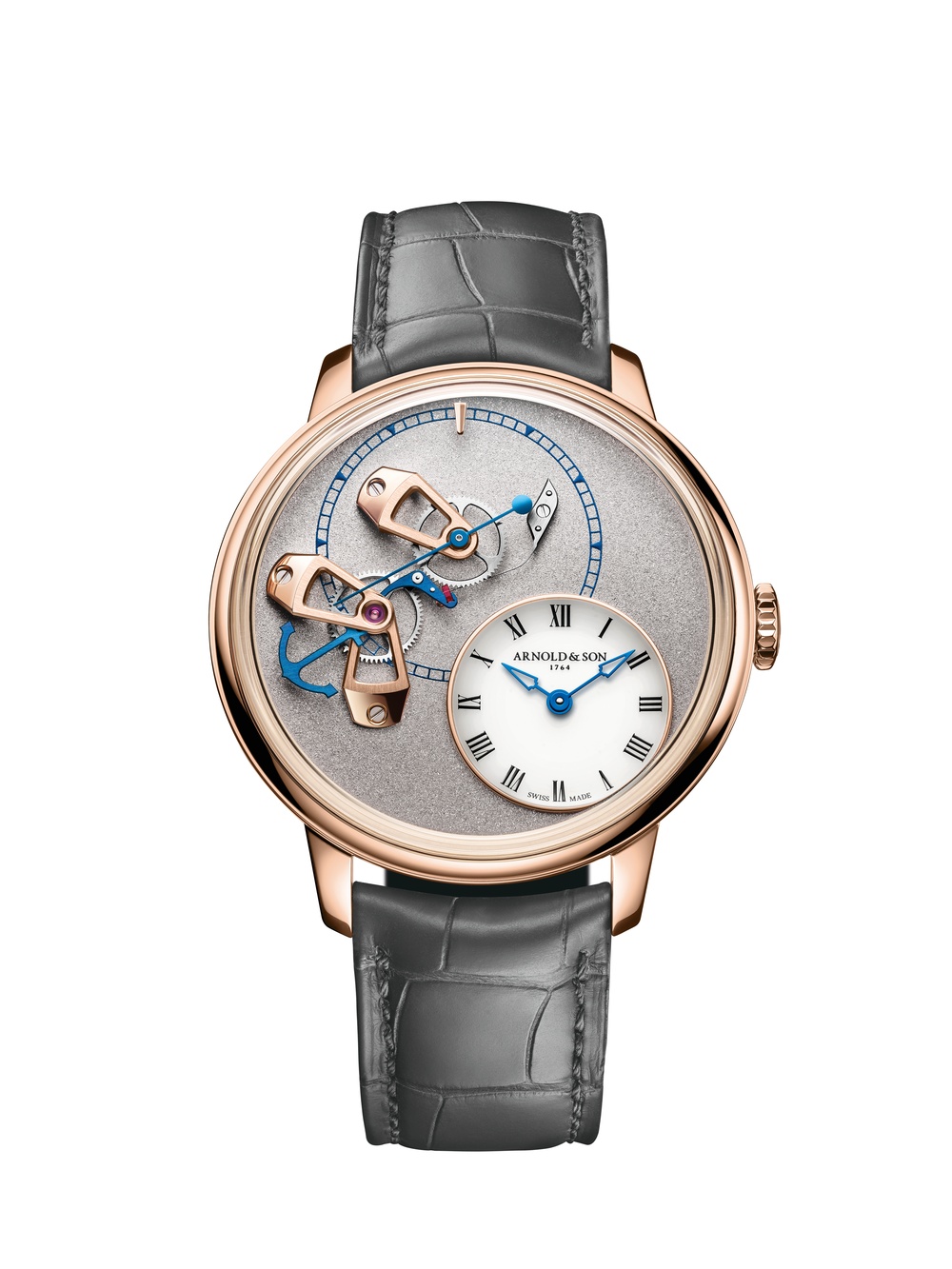
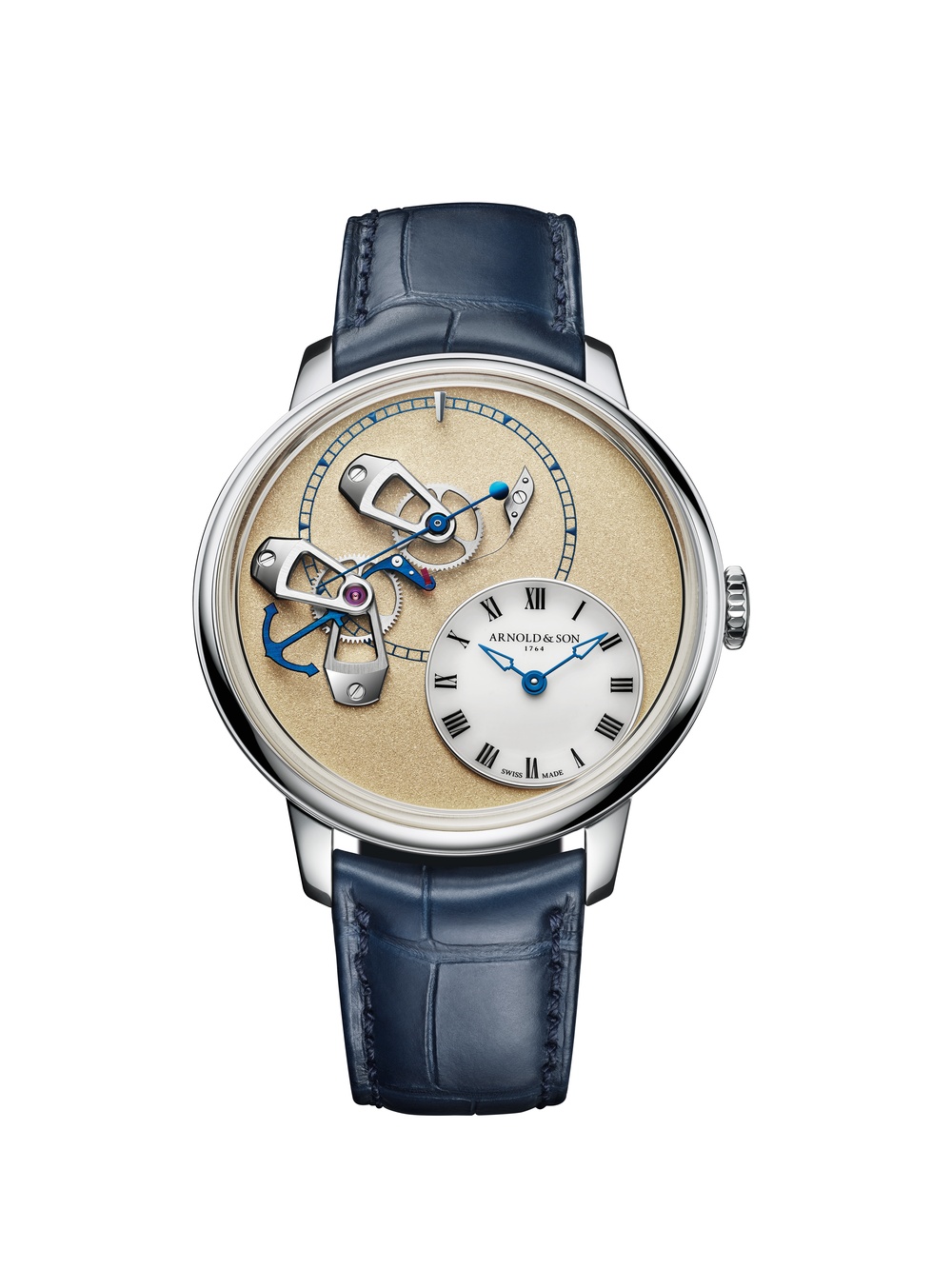
Two new dial colours have joined the collection, Cliff Grey and Kingsand, and each is set against its case metal rather than matched to it. The red gold watch gets the cooler grey, while the platinum one gets the warmer, gold-toned Kingsand. They’re also calmer than past examples of the DSTB. Previously dials have leaned brighter – think mint green and Ascot blue – so this feels like a deliberate step back toward the brand’s own history. Cliff Grey nods to the cliffs of John Arnold’s native Cornwall, and Kingsand to the gilded brass mainplates in his original movements.
Beyond the colours, the rest of the dial stays true to the standard DSTB layout. The true-seconds mechanism sits openly at the top, its gold bridges and fire-blued steel anchor tracking the seconds hand as it jumps around the blue outer track. The hours and minutes are read from a white opal sub-dial lower down, with Roman numerals on a subtly concave surface. Those sub-dials are framed in the same metal as the case, red gold for the Cliff Grey, platinum for the Kingsand.
Both references are 42mm across and 12.95mm thick, with a domed sapphire crystal (anti-reflective on both sides), a flat sapphire caseback and water resistance to 30m. Both come on a hand-stitched alligator leather strap, warm grey for the red gold Cliff Grey and ink blue for the platinum Kingsand, each closing on a pin buckle in the same metal as the case.
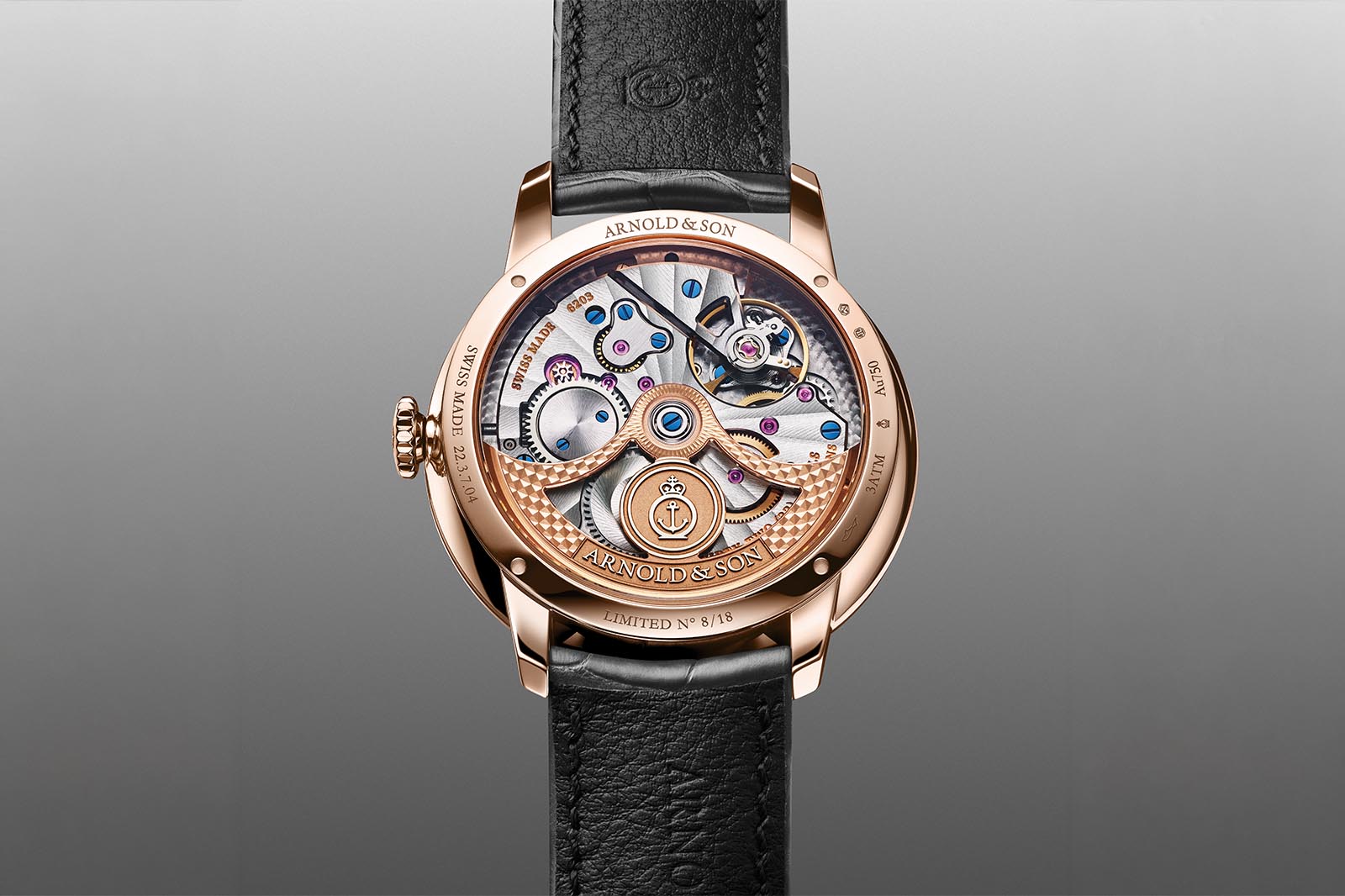
The movement is the in-house automatic A&S6303, with a 55-hour power reserve and a 4Hz (28,800vph) beat. It’s the next generation of the A&S6203 in the existing DSTB 42 as it carries the all-important stop-seconds lever, hidden from both the dial and the caseback.
As for pricing, the red gold version is £48,300 and the platinum £59,600, across a combined limited edition of 36 pieces, 18 in each colourway. That’s just £1,200 and £1,100 more than the current red gold and platinum DSTB 42s (£47,100 and £58,500).
I think that’s a fair price. Arnold & Son could easily have charged a bigger premium for a new movement and a limited run, and it hasn’t. That restraint suits the function, because stop-seconds doesn’t make the watch any more accurate day to day, or change much about how you wear it. What it does is let you finally set the DSTB with the same precision it was always meant to display, closing a gap the collection has always had. It’s also, by design, not a watch that shouts about any of this. The stop lever is hidden, so nobody’s clocking it across a dinner table. But if you’re the kind of person who’d know it’s there, and care that it is, the increase is comparatively a small price to pay.
Price and Specs:
More details at Arnold & Son.