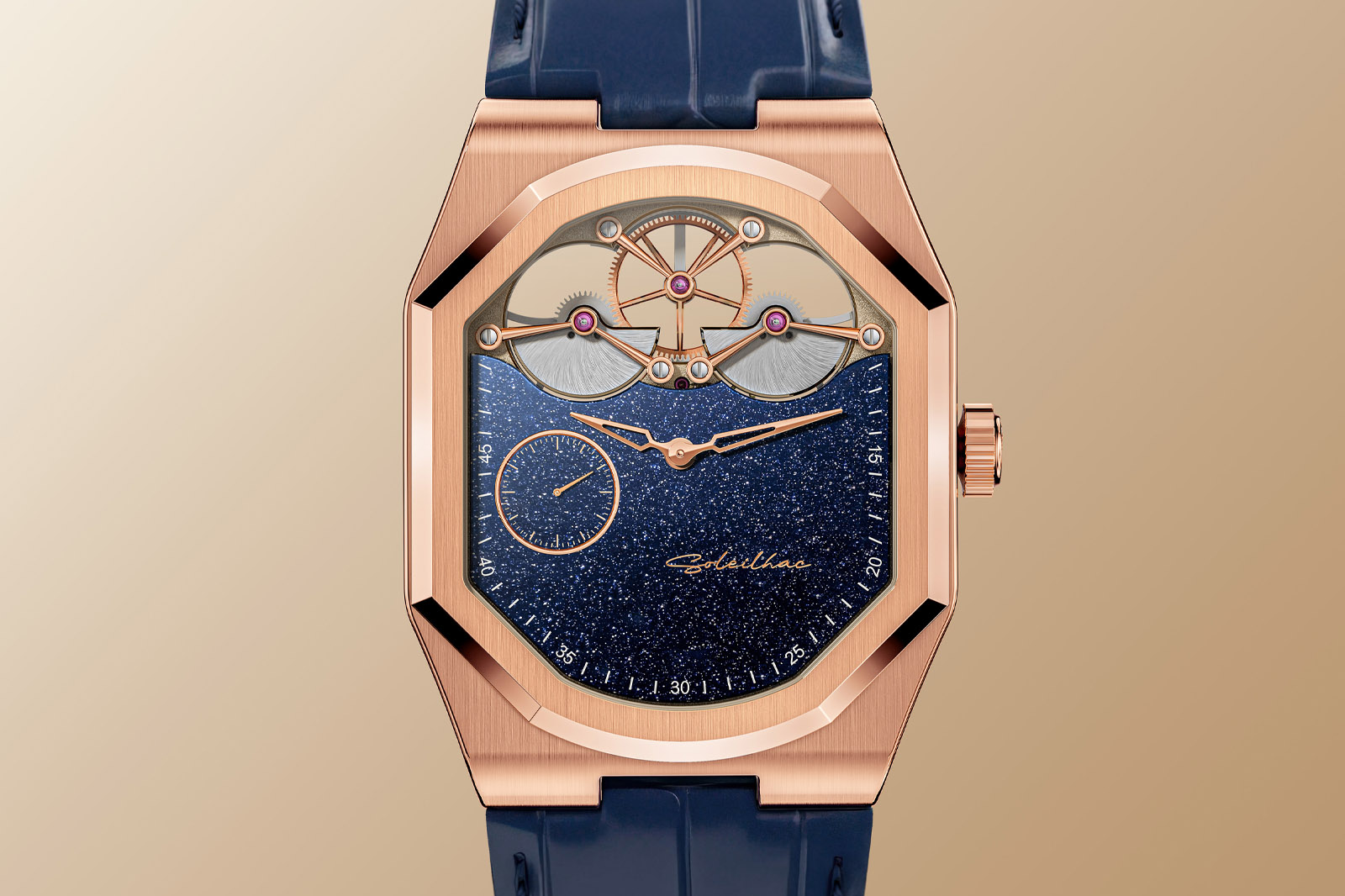
There are a lot of routes to becoming an independent watch designer. The most traditional would be a career at one of the top watchmaking maisons before striking out on your own – the Philippe Dufour method. Or you could become the apprentice to a master watchmaker and take over their craft after their passing – the Roger W. Smith method. Or you could do as Samuel Soleilhac has done and pick up a book and teach yourself watch design. Now, after years of development, his debut timepiece is nearing completion, the Soleilhac Harmonie.
The most striking aspect of the Harmonie’s design is its bi-rotor winding mechanism, which takes pride of place at the top of the watch towards 12 o’clock. Visually it’s very impressive with its twin micro-rotors that oscillate in unison with each other, connecting to a floating central wheel that transmits power to the barrel for storage. Bi-rotors are a niche mechanism in watchmaking because mechanically they offer the same utility as a standard rotor, but the visual impact is far more impressive. Here they provide the watch a 50-hour power reserve when fully wound.
Conceptually, the Harmonie didn’t start life as a bi-rotor design. Samuel’s original project was called the Pendule which was even more ambitious in that it aimed to solve the mechanics of creating a pendulum wristwatch. Which Samuel ultimately concluded was mechanically impossible and so the Harmonie was the natural follow up to his research into winding mechanisms.
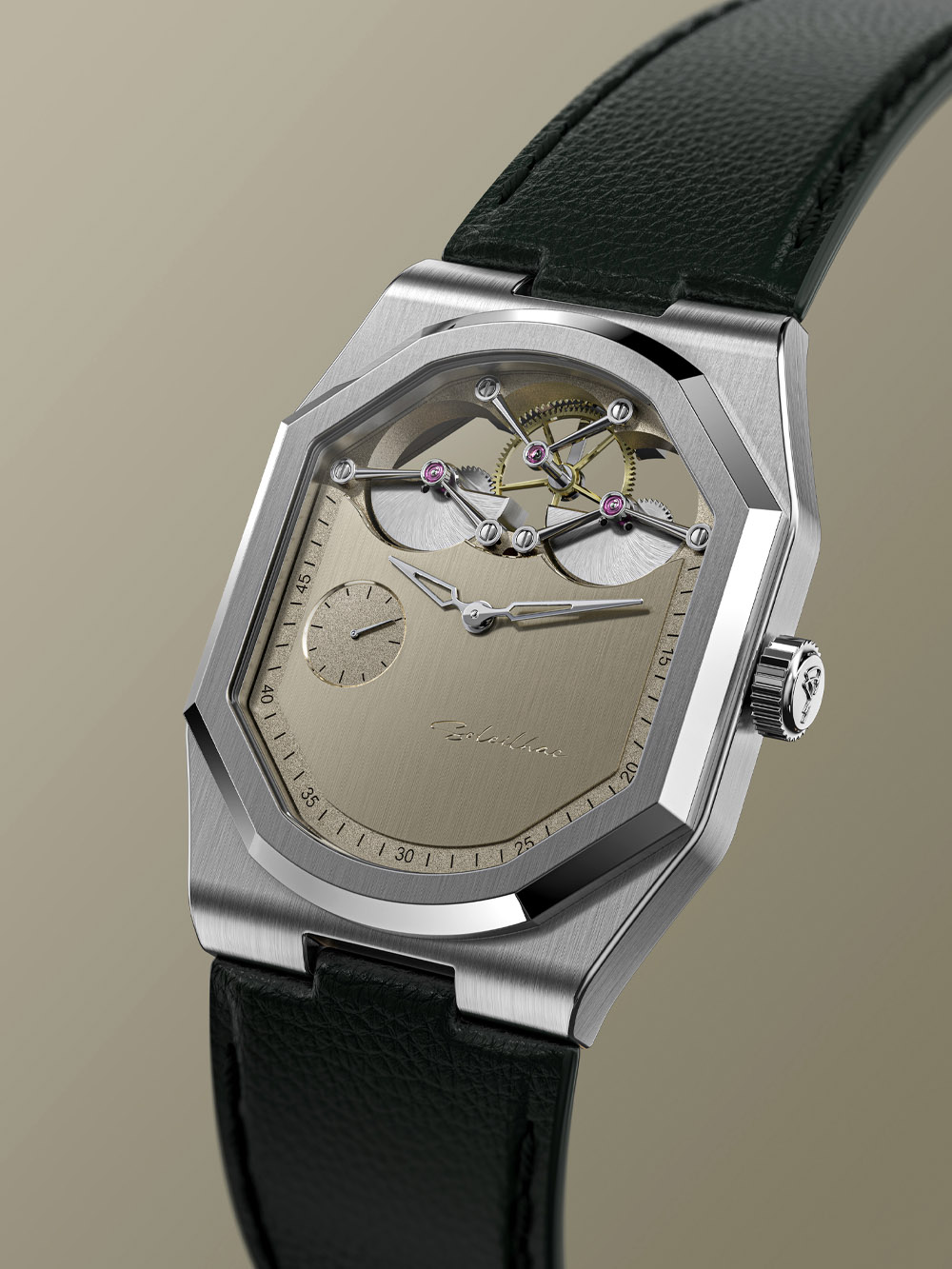
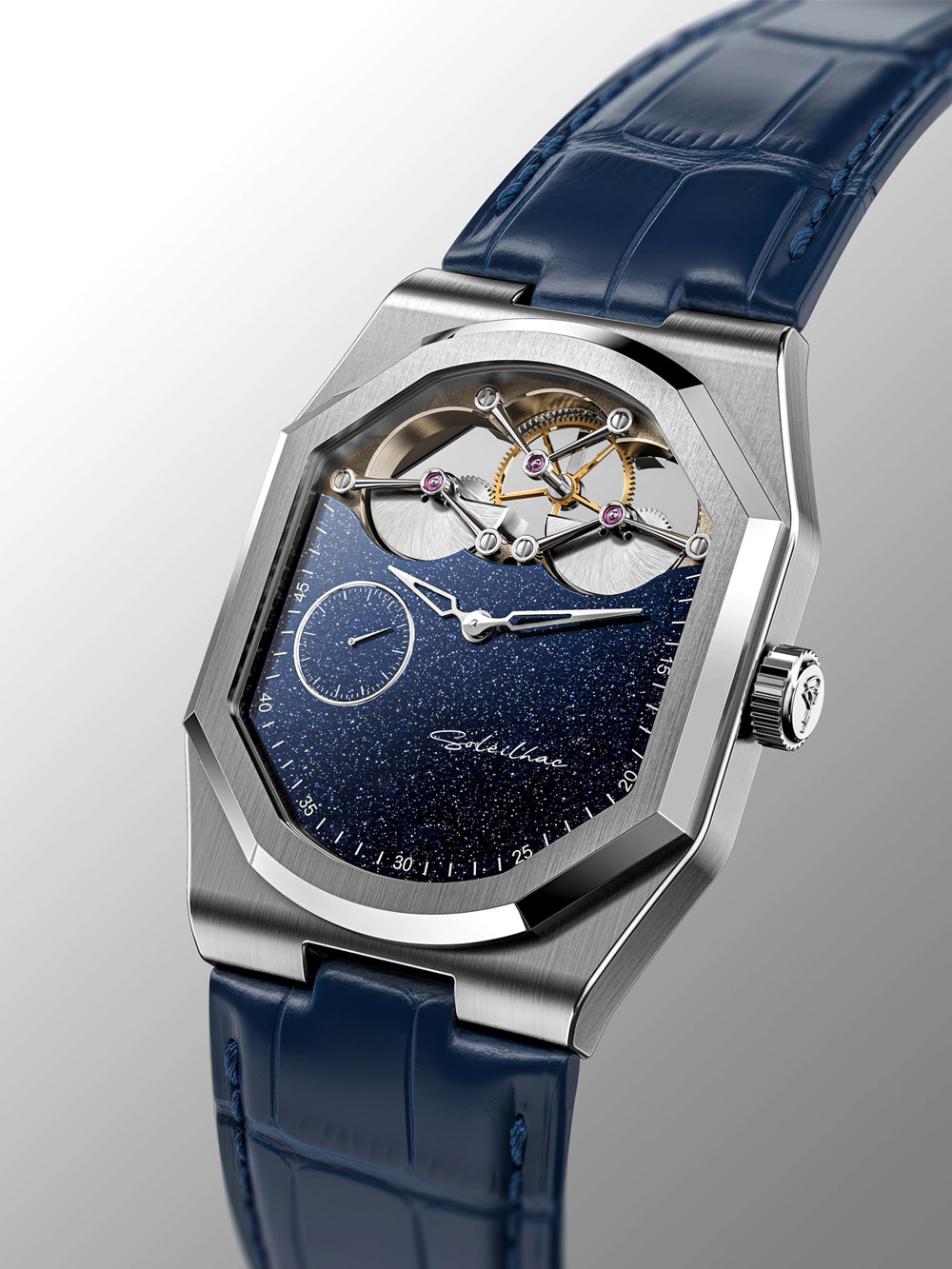
Once the Harmonie’s movement was designed using CAD and mathematically everything was working as intended, the question then turned to case and dial design. With this aspect of the watch, Samuel was more willing to outsource ideas regarding materials and dial finishing to the customers because the brand is using the soucription purchase method – also known as subscription this means customers provide a deposit to fund the creation of the watch before its manufacture. In turn this means they can follow the creation process and provide feedback if the watchmaker allows them. As such, when early customers expressed interest in gold cases and aventurine dials, Soleilhac was happy to provide. Alongside the titanium case and sand dial he had already developed.
Structurally the case takes its design cues from several prominent designers in the watch industry. The overall shape is inspired by the elliptical form of Daniel Roth’s watches but rather than a one-to-one imitation, Soleilhac reinterpreted it through the lens of a 1980s sports watch. Adding straight lines, sharp angles and the characteristic flat-top bezel seen on work from designers like Gerald Genta.
While its lineage can be traced through the history of watchmaking, the care and attention paid to each bevelled edge makes it feel fresh and exciting, never derivative. For the dimensions, the case measures 40mm x 35mm x 9.3mm, with the lugs pushing the total length to 45mm. Those lugs lead into either a blue leather strap for the aventurine models or black for the sand-tone dial.
The dials themselves have central hour and minute hands in an open-worked Alpha shape showing a bit of the dial through their middles. A small seconds subdial completes the timekeeping elements offset towards 8 o’clock. I personally prefer the aventurine option as it makes the watch feel a bit grander and more special, which is what you want from a watch that’s already pretty Avante Garde in its construction.
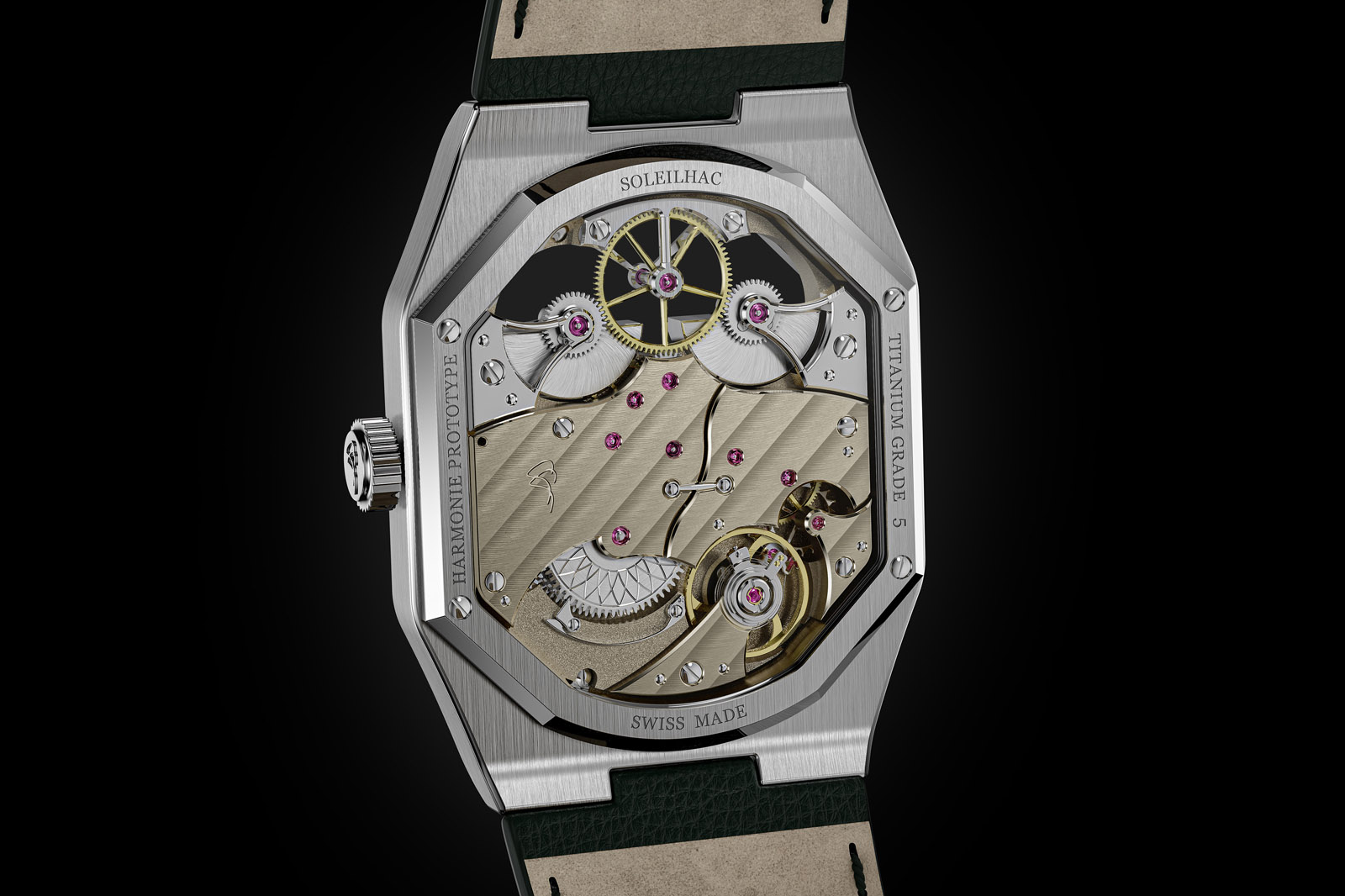
On the reverse side of the watch is an exhibition caseback revealing more details of the movement. It’s finished in painstaking detail with Côtes de Genève across its plate as well as plenty of anglage, polishing and frosting. Two focal points are the engraved cover on the barrel and snailing on the platinum micro-rotors, emphasising the Harmonie’s distinctive bi-rotor mechanism.

For pricing, the Harmonie Titanium Sand is CHF 49,000 (approx. £46,860), the Titanium Aventurine is CHF 52,000 (approx. £49,750) and the Gold Aventurine is CHF 59,000 (approx. £56,400). The initial subscription models are limited to just 18 pieces, available via personal inquiry – there are very few spaces left. The first pieces are expected to be delivered in late 2026. Moving forward from 2026, Soleilhac hope to achieve an annual production of 20 pieces to a maximum of 100 watches.
Price and Specs:
More details at Soleilhac.