
It’s strange to think that until around 2016, the world assumed that the first ever chronograph was built by Nicholas Rieussec in 1822. You’d assume that by now the history books would have pinned down everything there is to know, but no. Instead, we know now that while Riussec may have coined the term ‘chronograph’, it was Louis Moinet that made it a mechanical reality in 1816, nearly a decade earlier. And now the modern brand is paying tribute to that original timekeeper in the new 1916 chronograph.
It has to be said that the Moinet chronograph didn’t come out of nowhere. There were references to the watchmaker’s masterpiece in various documents, but as it was a one-off pocket watch made for the watchmaker’s own gratification, the so-called compteur de tierces didn’t make the splash it should have. And when it ended up in a private collection rather than a museum, there was a good chance it would have remained in obscurity. It took the watch heading to auction for us to be enlightened, for the horological history books to be rewritten. But for the modern Louis Moinet brand, that was a godsend.
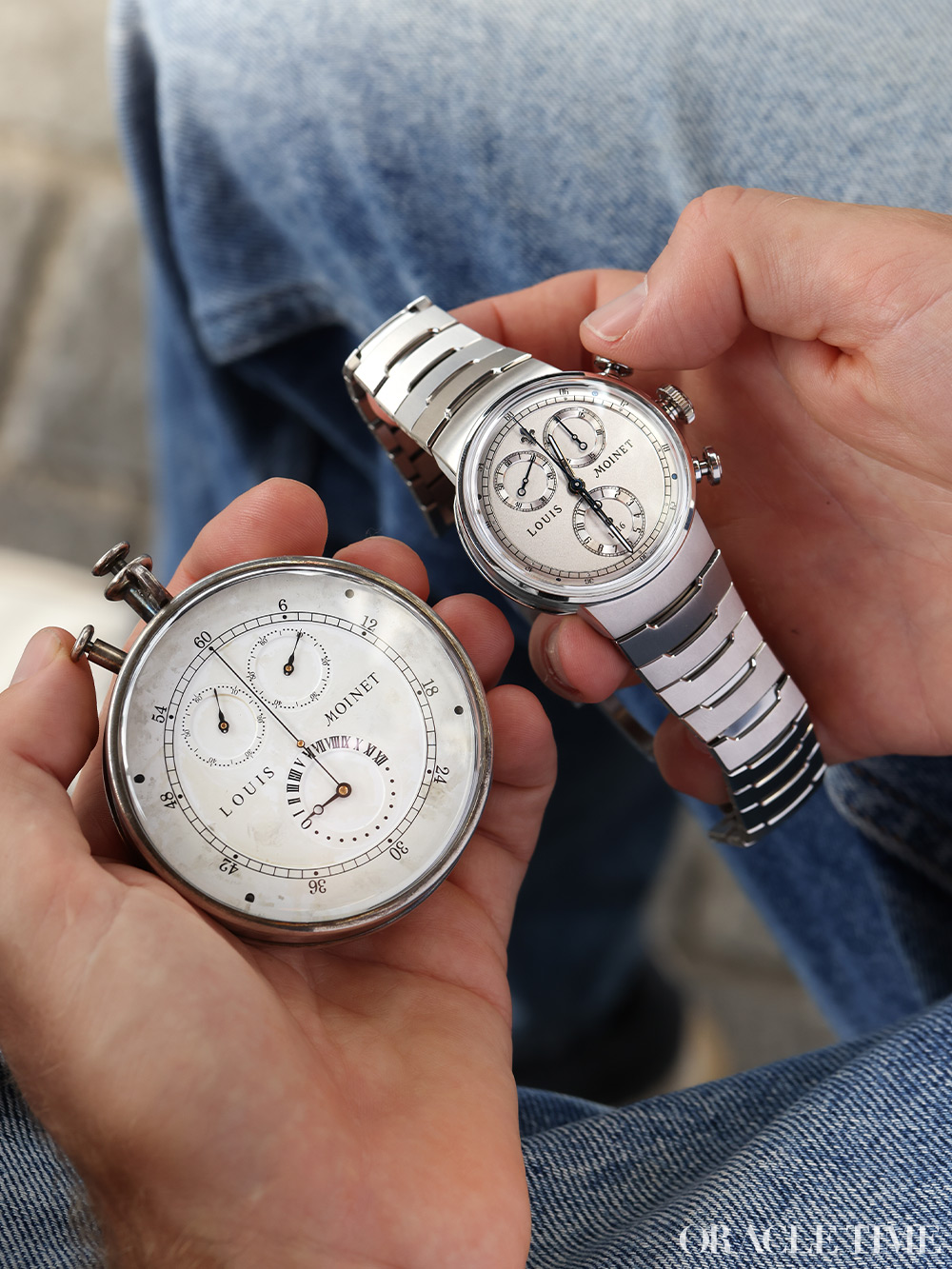

Despite the heritage name, Louis Moinet as a modern brand was actually launched back in 2008 by Jean-Marie Schaller. I first came across them at Baselworld back in the day (I’m getting on a bit) where they were showing off some intense, planetary metiers d’art pieces. They were incredibly made, complicated and finished to eye-watering perfection. But they didn’t really have a story behind them other than ‘here are some gorgeous watches’. That’s normally enough, to be honest, I’m not someone that needs a story behind everything. But when your name is pulled from history, it felt like they were missing something. Not so with the new 1816 Chronograph.
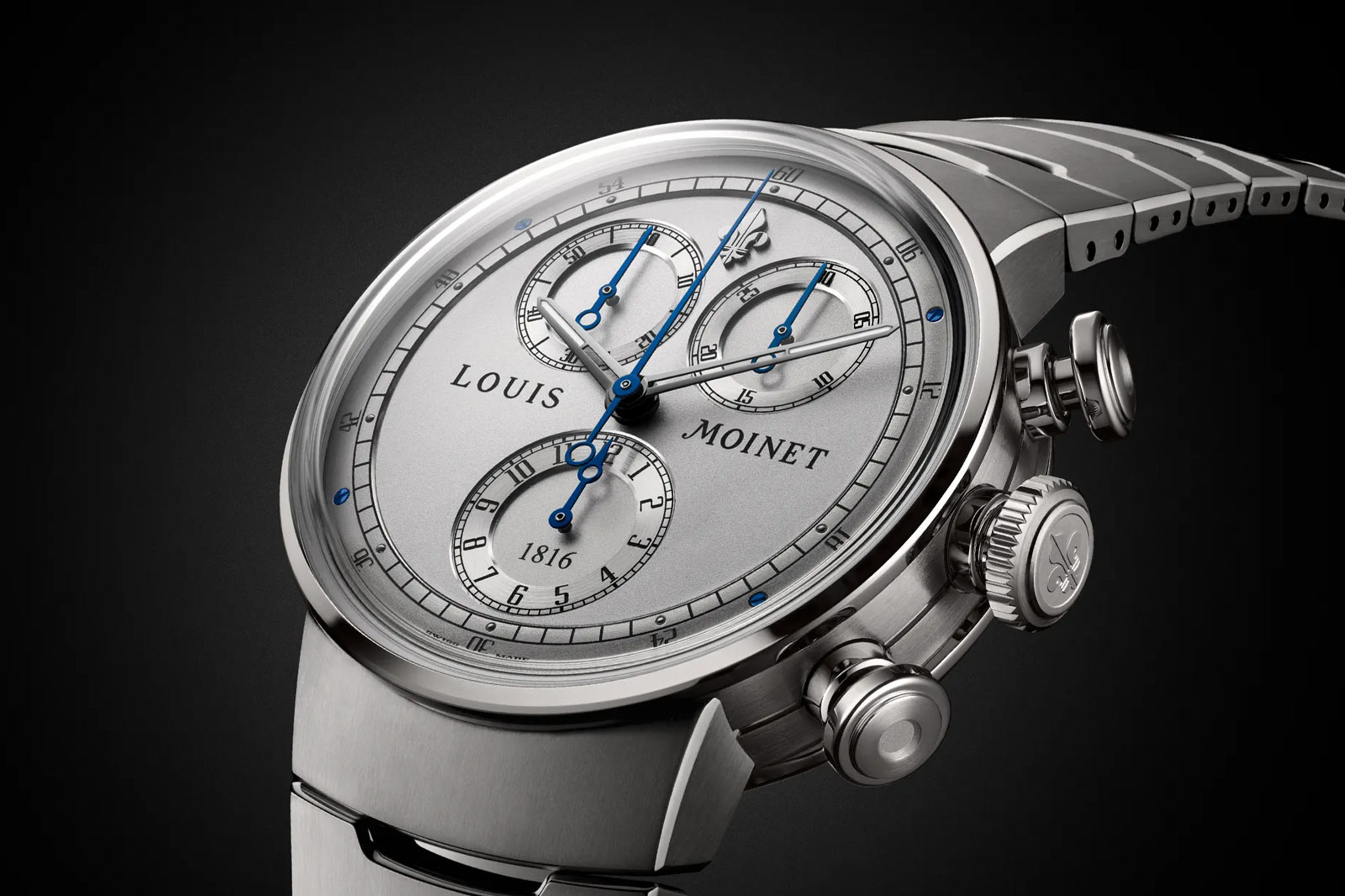
Louis Moinet have translated the aesthetic details of the original pocket watch chronograph into a wristwatch and done so in a way that feels authentic, a modern update with a red thread tying it all the way back to the 19th century. The silver dial, a mix of grained with brushed subdial rings, imitates the layout of the compteur de tierces, with small seconds and chronograph minutes close together at 10:30 and 1:30 respectively, the chronograph’s 12-hour counter at six o’clock. The central minute and hour hands are a bit more modern, especially with a dollop of lume at the end, but the blued steel Breguet-adjacent (with the circle on the counterweight instead of the hand tip) are classically beautiful.

The case on the other hand is a bit of an odd duck. At 40.6mm across, it feels nicely compact and with a streamlined approach to the chronograph, there’s plenty of room to let it all breathe. But it’s also 14.7mm high. That’s… tall, tall enough that it feels a touch top-heavy. It doesn’t look bad per se, but it does seem a bit out of proportion and you won’t be fitting it under the nicely tailored shirtsleeve it otherwise demands. On the plus side, it doesn’t feel any worse on the wrist for that height; in fact, thanks to the lightweight titanium construction and the bracelet, it feels incredible.
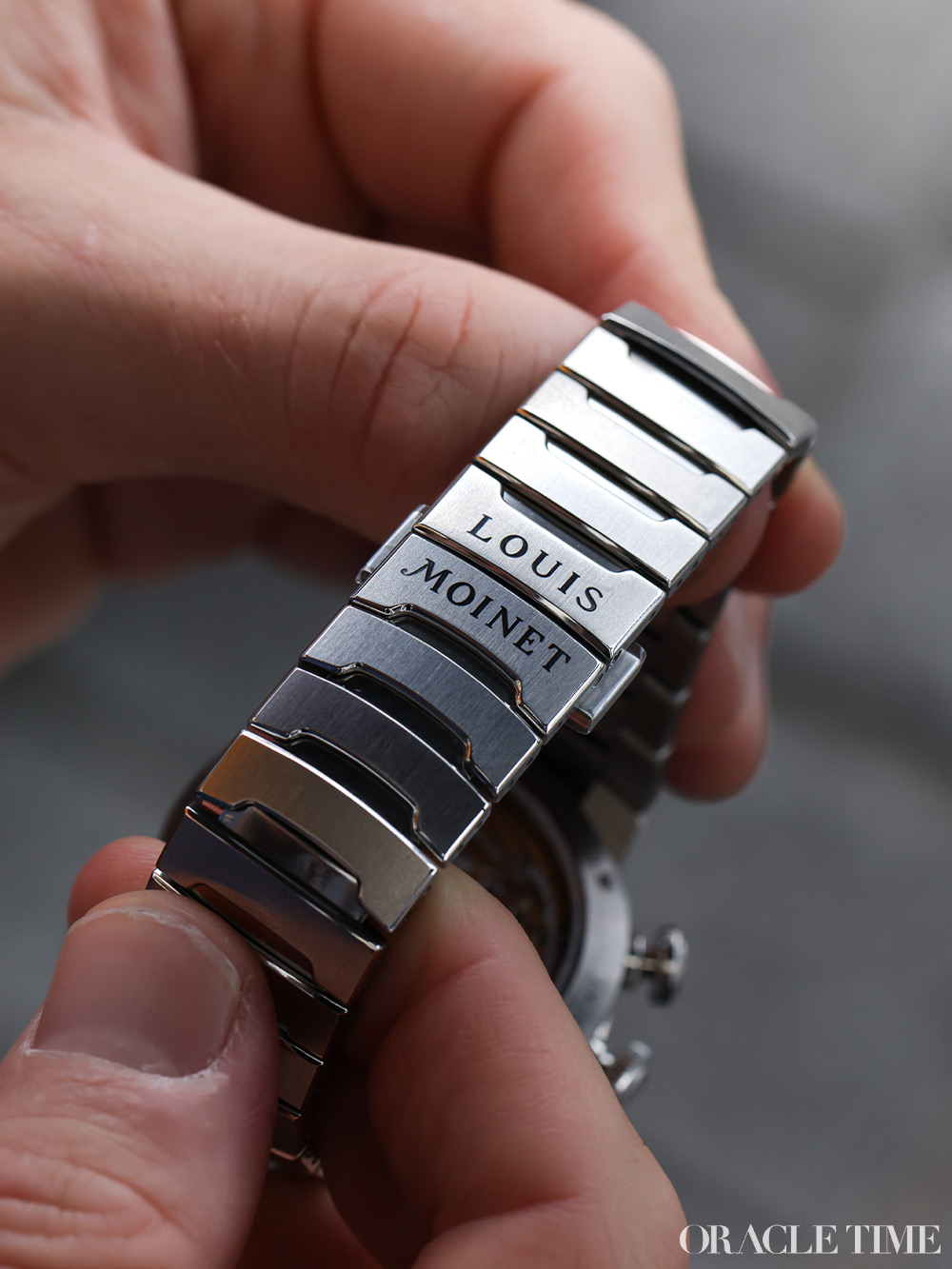
While the case may be rooted in Louis Moinet history, the bracelet that keeps it on the wrist feels anything but. A curvaceous, integrated sports bracelet has a lot of competition these days, but the 1816’s is up there with the big boys. The top links are brushed while the links in between, normally hidden underneath, are polished. It’s a technique I’ve clocked a few times (cough, Moser) and I always love the result, when flashes of that polished surface come through as you move your wrist. It never gets old.

So far, so aesthetic. But if you’re going to pay homage to a technical feat, you also want to do it technically. Well, the original chronograph had two things. First, it had a central second hand, singular. That’s because it rotated around the dial once per second, splitting it into 60ths. Think Zenith’s insane El Primeros or the TAG Heuer Mikrogirders. That takes a lot of specialised engineering of a scale Louis Moinet just isn’t at, so it’s no surprise that they took that out. The other, smaller element, however, is a novel jumping minutes that the 1816 does include. The chronograph seconds hand hits 60, it jumps by one.
Is there much point to it? Not really. But like any jump indicator, it’s fun to watch and anticipate, a novel nod to the compteur de tierces. Still, it would have been nice to see the second hand g-forcing around the dial. Maybe next time. For now at least, the movement is spectacularly finished, column wheel on full show and the depth of the case, while odd on the wrist, makes for the perfect backdrop when you flip the watch over. Sanded, gold-plated, polished, bevelled, it ticks off the classic Swiss finishes you’d expect to see in style.
Obviously, the Louis Moinet 1816 is a prestige timepiece, there’s no denying that, so don’t expect something particularly accessible. But I have to admit, at CHF 28,900 – just under £27,000 (and funnily enough almost the same number as its 28,800 frequency) – it’s not too bad. More importantly, this isn’t a limited edition so that you can be reminded, time and again, just who did indeed build the world’s first chronograph.
Price and Specs:
More details at Louis Moinet.


Well, let me start by stating the obvious, it’s a lot of money, but, honestly, it’s a lot of watch for that sum of money, and a beautiful watch too.
I’m not a great lover of chronographs, nor of integrated bracelets or indeed overly complicated dials faces, but this watch, with it’s classic styling has hit the button for me in pretty much every sense. Whilst talking of buttons, this is where it all goes wrong, (and normally does with Chrono pushers). I personally don’t like the rod style pushers that most of these watches have, they just totally spoil the aesthetic. Some makers have taken this on board (I have a Chrono in my collection that dates back to approx 2008 that has semi integrated “bar style” buttons, that look superb), and some recent releases have this feature, that looks lovely, sadly, this new release (but almost looks vintage – my favourite style) lacks this better looking feature, which lets it down and frankly, surprises me as they would have looked seamless with the styling and curvature of the bracelet links. Styling cue, next generation, change the pushers, this will make the watch look perfect in every way.