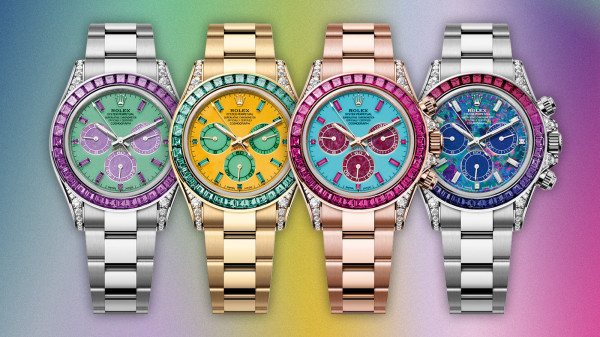
Artisans de Genève Honey Green (Rolex Daytona)
When is a Rolex not a Rolex? This isn’t a question from a first-year philosophy course, but rather a legal dilemma which had to be decided by the Swiss Supreme Court in January of this year when dealing with the subject of Rolex customisation. If you are interested, the full details are here.
What the court decided was that it was OK for the small firm of Artisans de Genève to modify customer’s watches but it was not OK for AdG to buy watches, modify them and then sell them on whilst they still bore the Rolex trademark. The interesting point about this case lies in who the defendant was – Rolex went after AdG. Now, there are tons of companies who modify Rolex watches, but I would argue that nobody does it with more craftsmanship and skill than AdG.

Artisans de Genève Honey Green Sketch (Rolex Daytona)
They recreate perfect ‘Paul Newman’ dials, they skeletonise movements and they even transformed a modern automatic Daytona calibre into a manual wind movement. They are the crème de la crème amongst the watch customisers, meaning that it if Rolex could go after AdG, nobody in the business was safe.
Creative watch customising is a pretty recent innovation, very much a 21st century phenomenon, although the less scrupulous have been slapping on aftermarket diamond bezels on Day-Dates and Datejusts ever since they were launched. Aftermarket bezels are, strangely, one of the most dangerous modifications you can do to a Rolex – not just because they are an offence against good taste – but because they can seriously affect the impermeability of the watch.


Bamford Watch Department SAS II (Rolex Explorer II)

Everyone knows that the watertightness of a Rolex Oyster is guaranteed by the screwed back and screw-down crown, but it is also dependent on the precision fit between the bezel, the crystal and the case. And this isn’t a screwed fit, rather it is an extremely tight push fit whose performance is conditional on incredibly tight manufacturing tolerances – tolerances usually beyond the abilities of your average aftermarket bezel maker.
The modified Rolex market really took off when people like Bamford Watch Department and Project X began to market radically modified versions of current production watches. Crown guards were dispensed with, unusual finishes (Ceracote, coloured DLC) were applied and dials radically redesigned.

AET REMOULD Loong (Rolex Daytona)
The modifications finally went as far as completely new cases in forged carbon, but in the last few years these extreme modifications seem to have disappeared, as Tudor have brought out versions of their dive watches in materials as diverse as ceramic and titanium, showing that people would much sooner have an original factory product than an aftermarket one.
In some ways, Tudor can now be seen as the Lockheed ‘Skunk Works’ for the mothership; the Tudor Pelagos in titanium was introduced in 2012 and it took just over a decade before Rolex introduced their titanium Yacht Master. So if Rolex follow this pattern we might see a ceramic Submariner around 2031 – but don’t hold your breath.

Designa Individual Submariner Racer S (Rolex Submariner)
My gut feeling is that there will always be a small subset of the market which wants to personalise their Rolex watch in some way, but as the trend swings towards smaller and more discreet watches – see the recent launches of the Parmigiani Toric and the Louis Vuitton Escale for example, as well as the revived interest in the Cartier Tank and Santos – I predict that the extreme modifications we have seen in the last decade will become a thing of the past and looked at with the same distaste we now reserve for the platform boots and long collar points of 1970s fashion.