I think we can all agree on the existence and usefulness of established design principles – archetypal traits we expect certain categories of watches to exhibit. These principles encompass both stylistic and functional aspects that are similarly malleable in the pursuit of novelty. While a certain degree of tweaking should be expected and encouraged, the omission of certain core criteria is often frowned upon, and quite rightly so.
Imagine this: a tachymeter with no scale, a tool watch with a gold case or a pilot watch that actually doesn’t glow in the dark. Aesthetically, these flawed designs could be absolutely idiosyncratic of their genre – and practically they would be endlessly disappointing. Would they therefore be seen as bad examples of their type? Or could they, if marketed quite cleverly and correctly, be statement pieces, worthy the world-round of admiration and future emulation?
Founded in 2005 by Maximilian Büsser, MB&F (the ‘F’ stands for ‘Friends’) is a crazily creative company that has so far produced 11 calibres to power the collaborative creations of industry trailblazers. Büsser has been part of the watchmaking landscape for a long time and obviously knows how to put together a formidable work-force, reputedly hand-picking each successive team to produce the latest watch in the Horological Machine (HM) series. These crack units are composed of the crème de la crème of modern watchmaking, and are, quite crucially, people Büsser feels a certain connection to.

MB&F Aquapod HM7 Horological Machine (Titanium Blue)
Whenever MB&F do anything, I reach for the salt. Taking their designs literally is often too shallow a way to interpret the intentions of these paradigm-pulverising horological howitzers. That’s not to say Max Büsser and his buddies don’t care about creating something useable (2015’s easy-to-set Legacy Machine Perpetual and 2016’s super-luminous collaboration with Black Badger are both highly functional), but their main goal – I believe – is to challenge us with their visual reinterpretations of the classics too many brands are afraid to mess about with.
From chaos, new order can be born; from madness, a slither of sideways sanity can also emerge. MB&F have proven themselves to be thoroughly bonkers with the release of the HM7 Aquapod – thoroughly bonkers, and yet oh-so brilliant in equal measure.

The MB&F Horological Machine 7 Aquapod (to give this beautiful mechanical muse its full name) is the latest horological machine to emerge from watchmaking’s foremost creative collective. In fact, the HM7 is so special indeed that it was preceded by HM8, which was rubber-stamped before MB&F’s first attempt at a dive watch made it to production. This leap-frogging appears to be the unintentional revelation of the technical challenges encountered during the development of the HM7 itself. On first examination, however, it’s pretty easy to see why it might have taken longer than expected to finish this three dimensional standout.

The profile of the Aquapod is absolutely stunning. The high-dome glass, shaped to resemble the crown of a jellyfish, must have been a serious artisanal challenge to create. The centrally mounted 60-second tourbillon is the cynosure of the piece, and, in terms of positional prominence, has few peers. In addition to this fluttering fancy, the HM7 displays the hours and minutes in luminous Arabic numerals on two vertically-stacked discs that encircle the tourbillon and populate the middle third of the predominantly sapphire case.
The luminosity of the piece is an aesthetic nod to the phosphorescence of some real-life jellyfish. The lume is very good – if not the boldest or the brightest we’ve seen from the brand – but for me, the real game-changing component of this watch is the satellitic bezel flawlessly formed in blue or black ceramic. The contrast between the coloured ceramic and the engraved Arabic numerals is achieved by first laser-cutting the digits into the ceramic before filling the recesses with metallised titanium. The effect is, quite simply, beautiful.
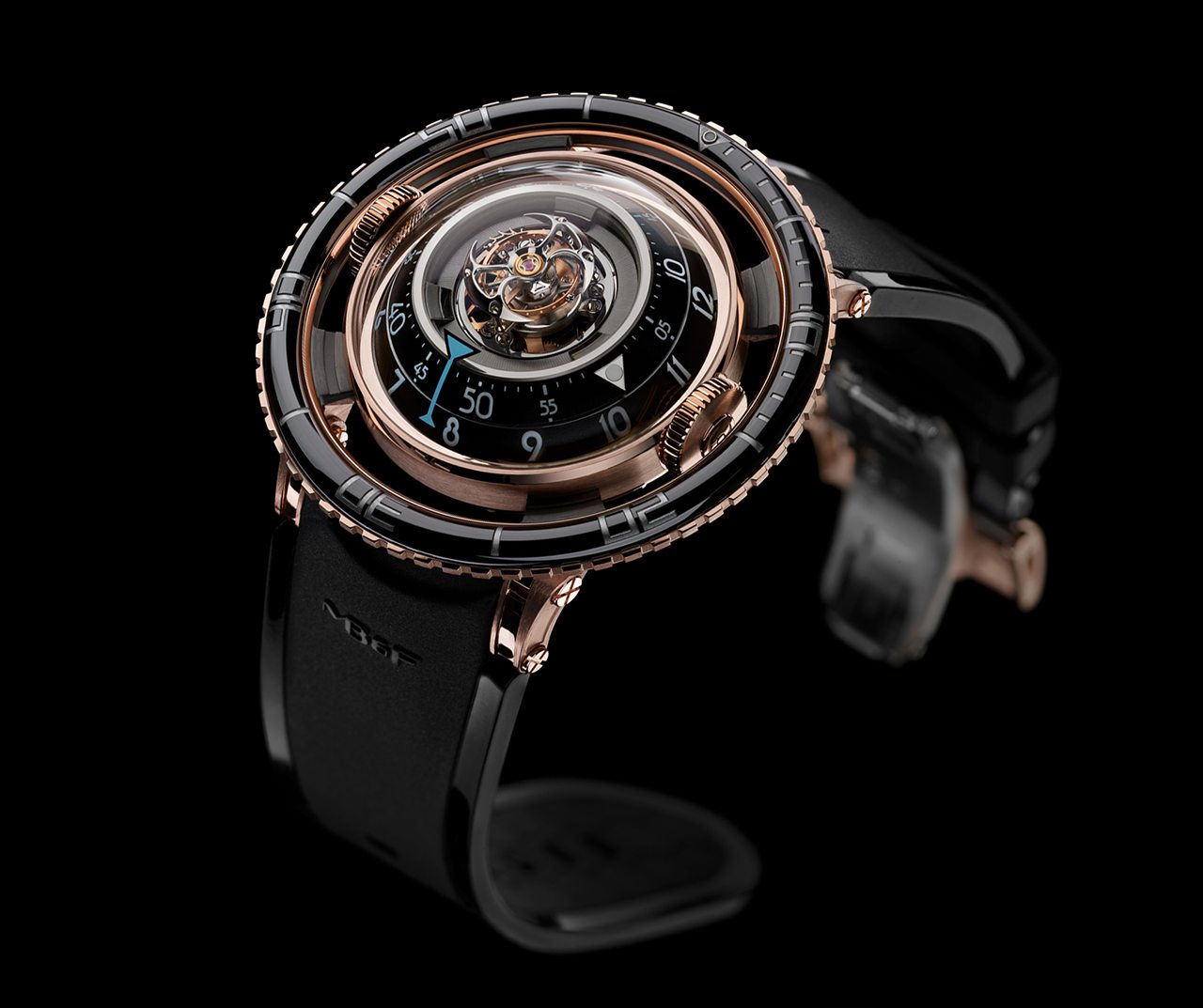
The unidirectional bezel has a luminous marker at 12, which is an ISO 6425 requirement for all certified dive watches. Unfortunately for the HM7, another requirement is water resistance of 100 metres or more (the HM7 is only designed to withstand five atmospheres – half the required depth). Put simply, in order for a watch to be considered a dive watch, one must actually be able to dive with it.
You might think this is a gargantuan oversight by the creators, but a watch like this could never seriously be intended for the rigours of deep-sea exploration. With 303 components, this piece, available in either titanium or 18K red gold, is a concept watch, a vision, a fever dream, a masterpiece. It takes well-worn principles and turns them on their head.
We should ask: does the HM7 benefit the industry as a whole, or are MB&F simply taking advantage of their well-deserved position for their own amusement? In my opinion, watches like this absolutely have a place in our industry.
Watchmaking has long since ceased to be a necessary craft in the way it once was. This is a luxury game, a trivial challenge, a war waged by man on the materials made available to him by nature. What can we do? How far can we go? How beautifully can we create instruments to measure time? On a philosophical level, how much are we able to exert our power over nature by manipulating its offerings into a machine capable only of reminding us how little command we have over it when all is said and done?
Watchmaking is supposed to be about pieces like the MB&F HM7 Aquapod; it’s supposed to be about what’s next and not what went before. Just like Formula One tests new technology that might one day find its way into a road car, so too do brands like MB&F push the envelope in terms of design, format and manufacturing.
At 53.8mm, the HM7 is one hell of a statement piece. More arresting still, however, is the height of this briny beast. Standing 21.3mm tall, the HM7 is just about as likely to have your eye out as it is to catch it from across the room.
A generous 72-power reserve improves the wearability of this architecturally imposing watch, and is underpinned by 35 jewels and a cathartically slow 18,000vph operating speed that helps to extend the lifespan of the mainspring torque thanks to its lower consumption rate.
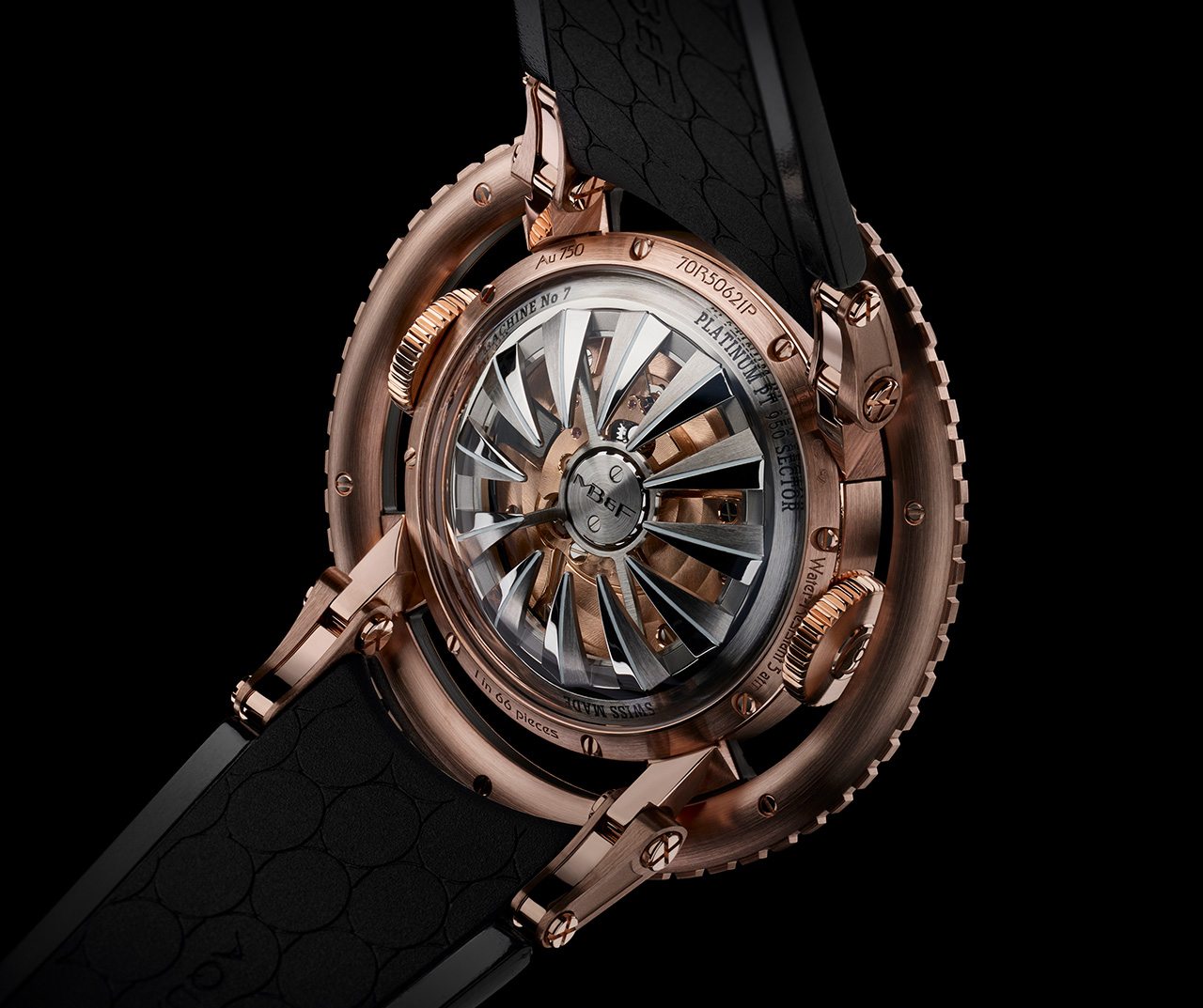
The tentacle rotor weight, machined from a single block of titanium, is perhaps my favourite individual component of the whole piece. Like a miniature Pit of Sarlacc, the threatening wreath of spikes adds to the organic feel of the HM7. It’s the kind of element that makes me sick with excitement. I often struggle to explain or justify this feeling to my non-watch loving friends, but I think anyone who is genuinely connected to the craft of watchmaking knows what I mean. Encountering a component that, without rhyme or reason, physically moves you to euphoria is not, thankfully, wholly uncommon in our community.
I’ve followed MB&F since they began producing these mechanical miracles, and they’ve frequently featured on my past lists of best brands and watches of the year. I thought they’d created pretty much the perfect perpetual calendar complication in 2015, and until now it was that watch that was my unquestionable favourite from the entire brand.
But now I’m not so sure. The MB&F HM7 Aquapod is something special. It is something very new. There’s nothing quite like it anywhere on the market. Where the Legacy Machine Perpetual was, in my opinion, a glittering example of how to execute an old idea to perfection, the HM7 Aquapod has no lineage, no direct ancestor, no context that enables me to fairly compare it to anything else. With a ticket price of roughly £79,000 for the titanium model, and approximately £95,000 for the red gold variant – as well as limited runs of 33 and 66 pieces respectively – the MB&F HM7 Aquapod is a highly priced, highly exclusive watch that is sure to find many a willing suitor.
If I had to wear the same watch every day of my life I would not choose the Aquapod. It’s too insane, too cartoonish, too cumbersome a piece to wear with confidence. But if I knew I had but seconds to live and wanted to count down my remaining time with a mechanical companion, I might well choose to see out my own time with the HM7. Why? Because whenever I look at it I smile. And that, perhaps above all else, is all we can ever ask of a watch.
Price: £79,000; www.mbandf.com