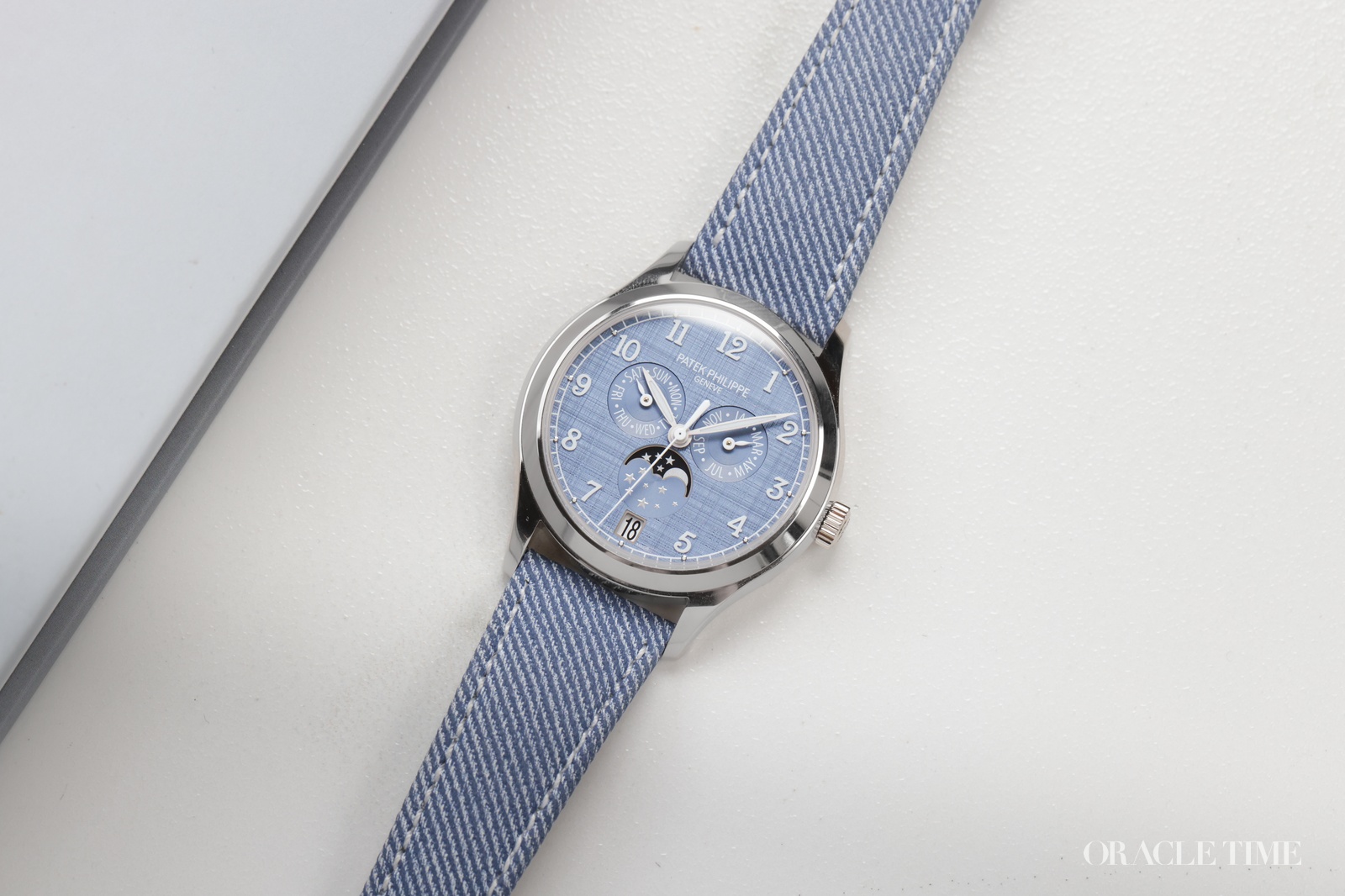
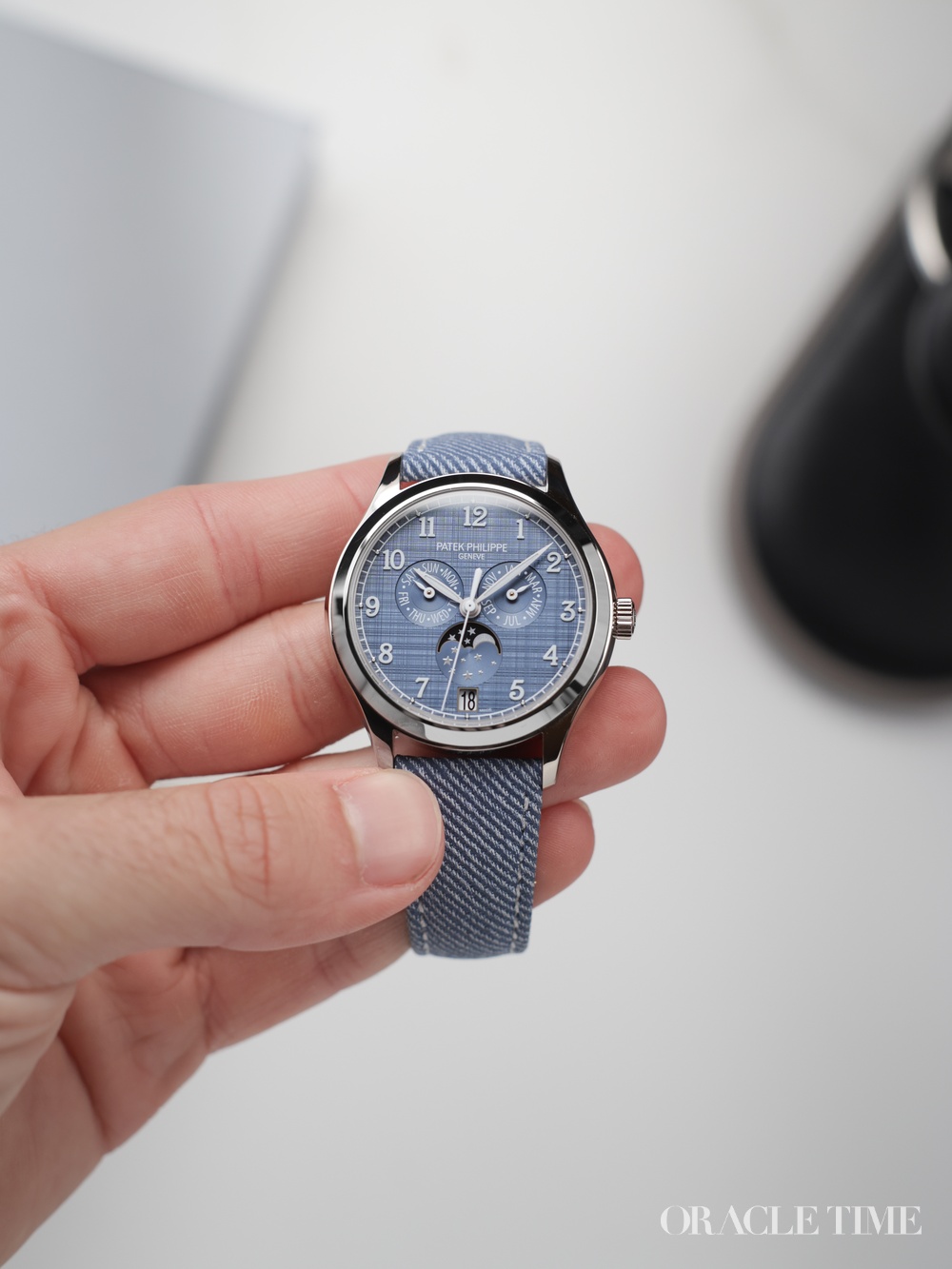
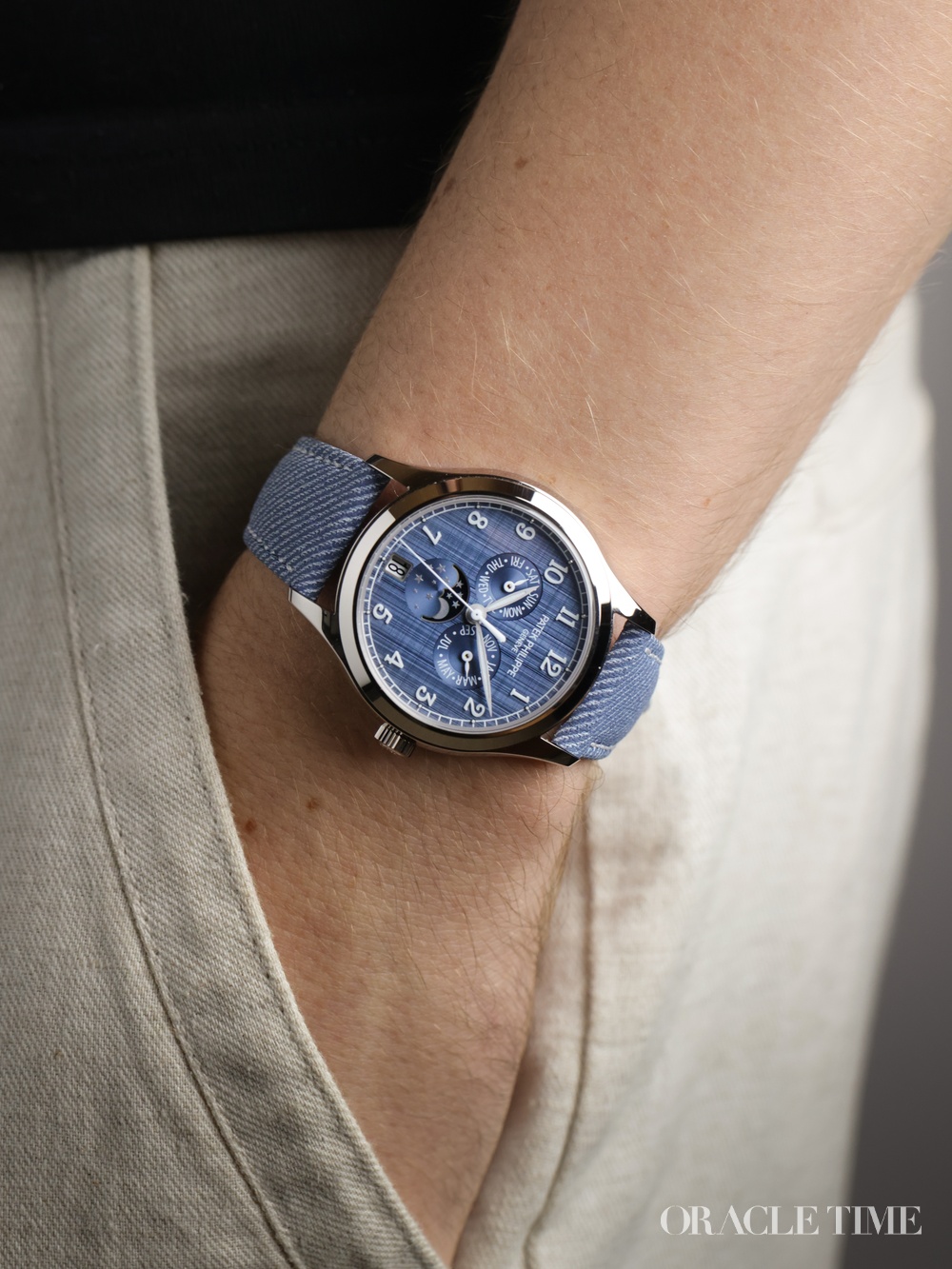
I first got hands-on with the Patek Philippe Annual Calendar 4946G-001 at Watches & Wonders in Geneva this April, and it appealed instantly. The blue-grey shantung dial, the usable annual calendar, and the vintage proportions left me reeling, and longing for a watch that in all but name sits in Patek’s women’s line. Patek files it under Complications and says the 38mm case is “designed to suit all wrists”, yet every image online has it on a woman’s wrist. In an age where genderless watches rule, that really doesn’t matter. It shares its 38mm case with refs 4947 and 4948, ladies’ models since 2015. Strip the diamonds and it reads as a different watch altogether.
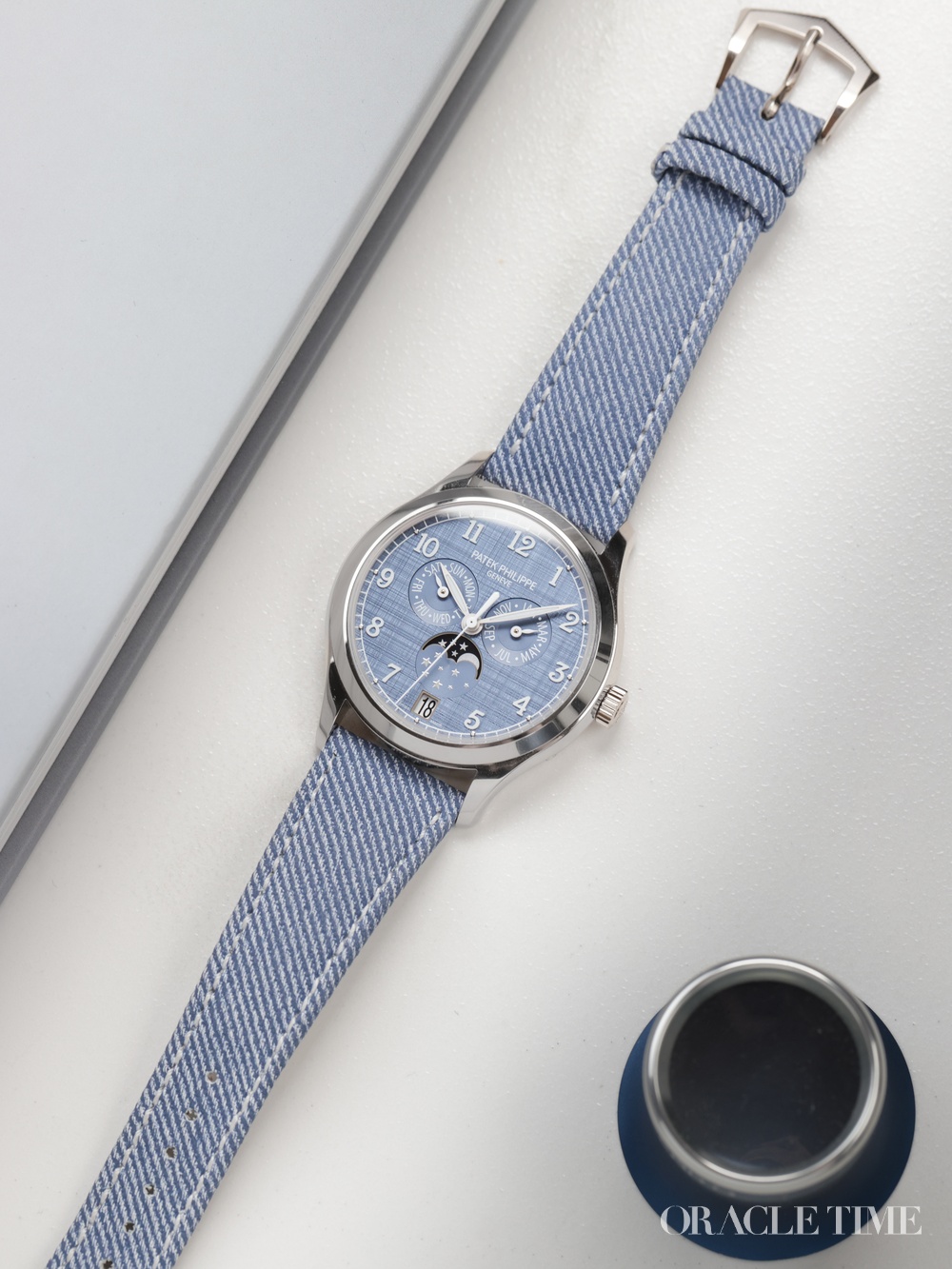
Start with the dial, because that’s what drew me in. From across the room it reads as denim, a pale, washed-out blue that matches the strap. Up close it’s more like linen: shantung, the fabric it’s named after, is a raw silk weave, and Patek achieves the effect by brushing the dial vertically, then horizontally, so the two grains cross and catch the light as the wrist turns. The finish first appeared on the steel ref. 4947/1A in 2021, but this is the first time it has been paired with lume. The applied Arabic numerals are formed as single blocks of luminescent material rather than metal with a lume fill, something Patek says it has never done before, and on a brand that keeps lume for the Aquanaut and Nautilus, that’s a statement in itself. The layout is classic 4946: day and month on snailed subdials at 10 and two o’clock, a date aperture at six with the moonphase above it, and white gold leaf hands. My one quibble is that date. Black numerals on a white disc are a small jolt in an otherwise monochrome dial, and a colour-matched disc would have finished the job.
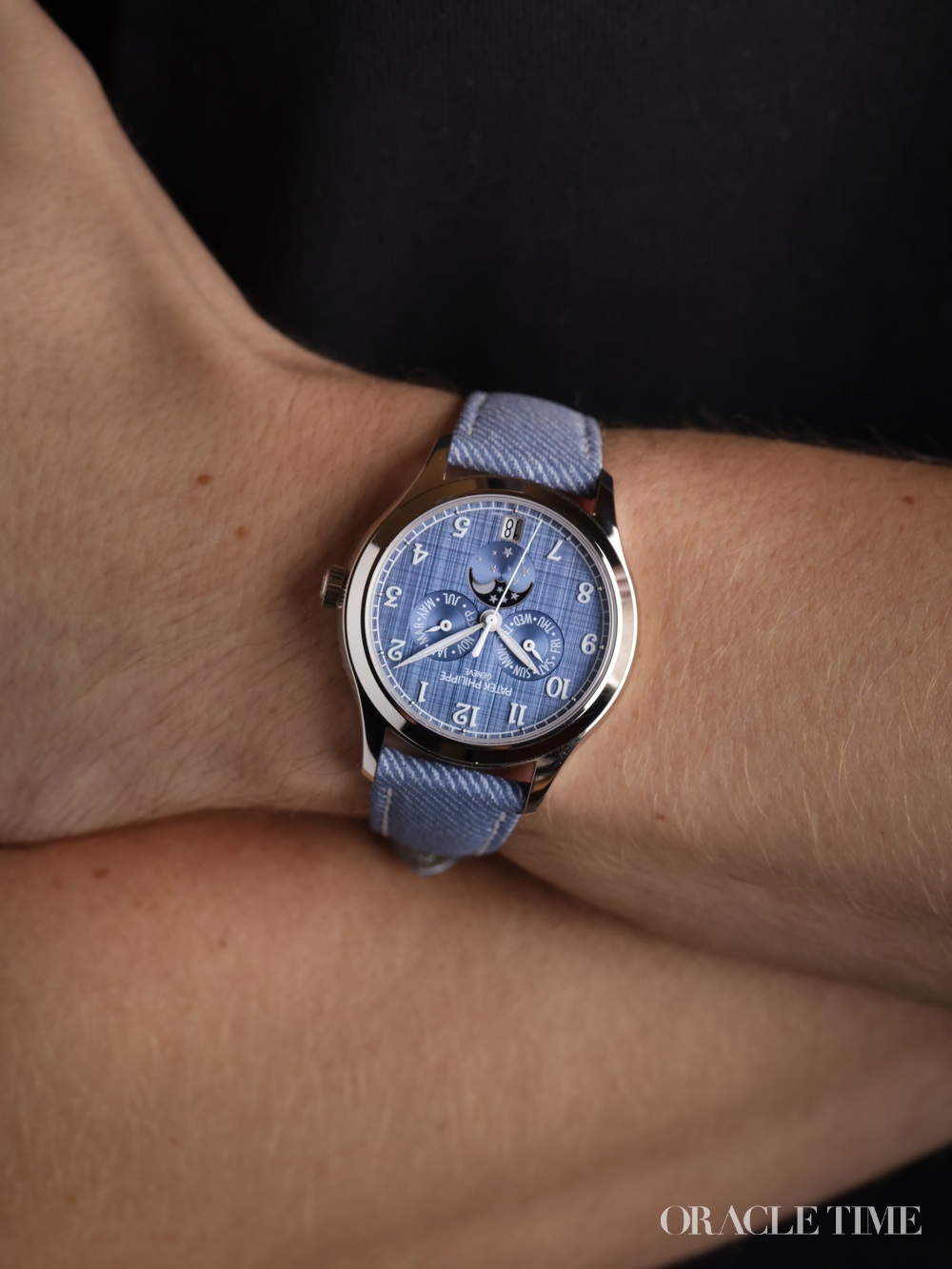
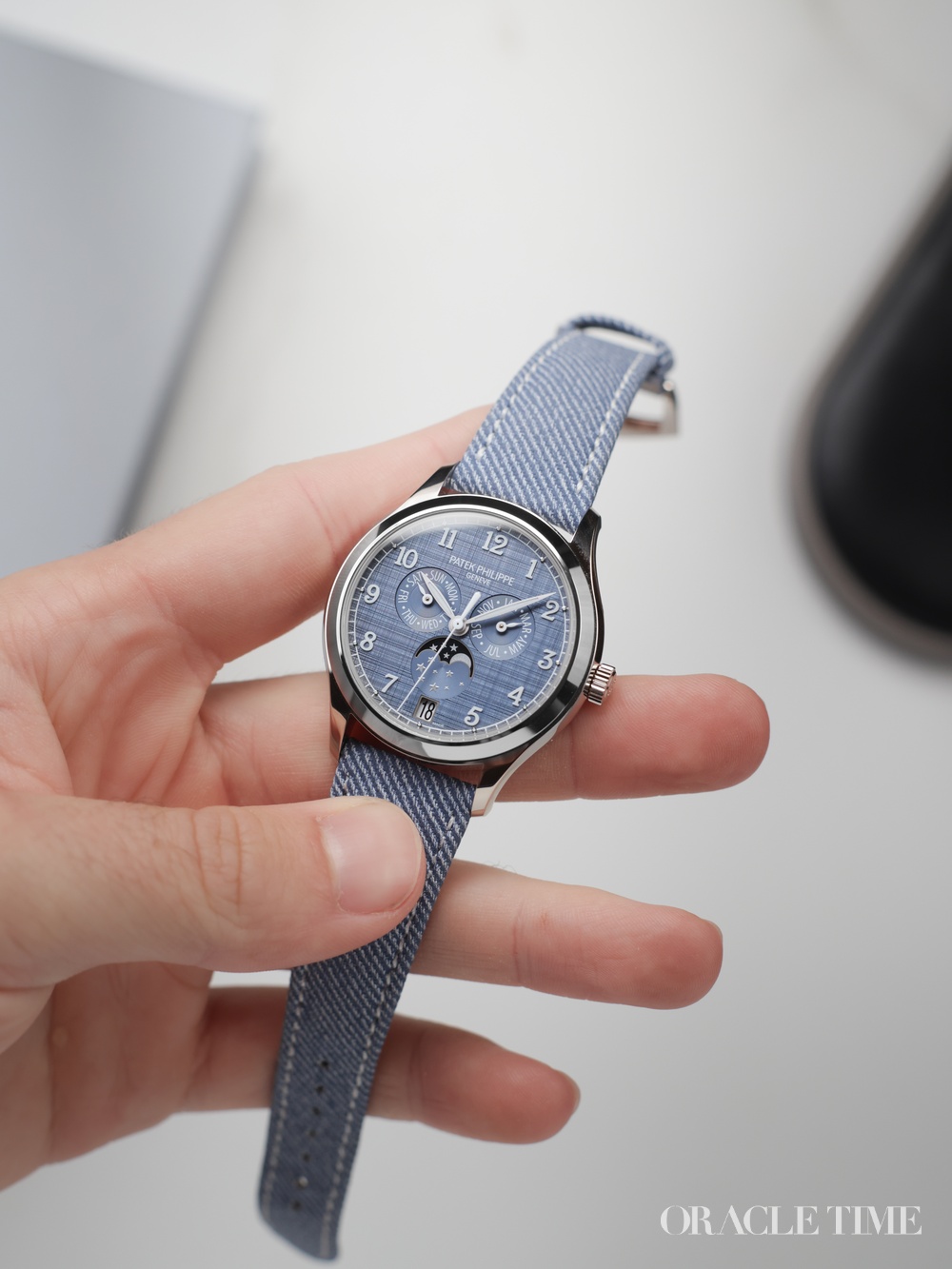
At 38mm by 11mm, 44mm lug to lug, it wears smaller than the numbers suggest. The Calatrava-style case steps down in angled tiers from bezel to caseband, pulling the eye inward so the dial reads smaller. It’s flattering on the wrist without ever feeling diminutive. The only real giveaway of its lineage is the strap: blue-grey calfskin printed with a denim pattern and white contrast stitching, which barely closed around my wrist on the third from last hole. Paired with the jeans I was wearing at the fair it felt a touch cowboy; a Canadian tuxedo for the watch world.
Patek has more claim to this complication than anyone. It invented and patented the annual calendar in 1996 with the ref. 5035, the first wristwatch to tell 30-day months from 31-day months on its own and require a single correction a year, at the end of February. As I argued in my recent piece on the Rolex Perpetual Padellone, which runs on the same once-a-year logic, it is a far more accessible complication than its bigger brother the perpetual calendar.
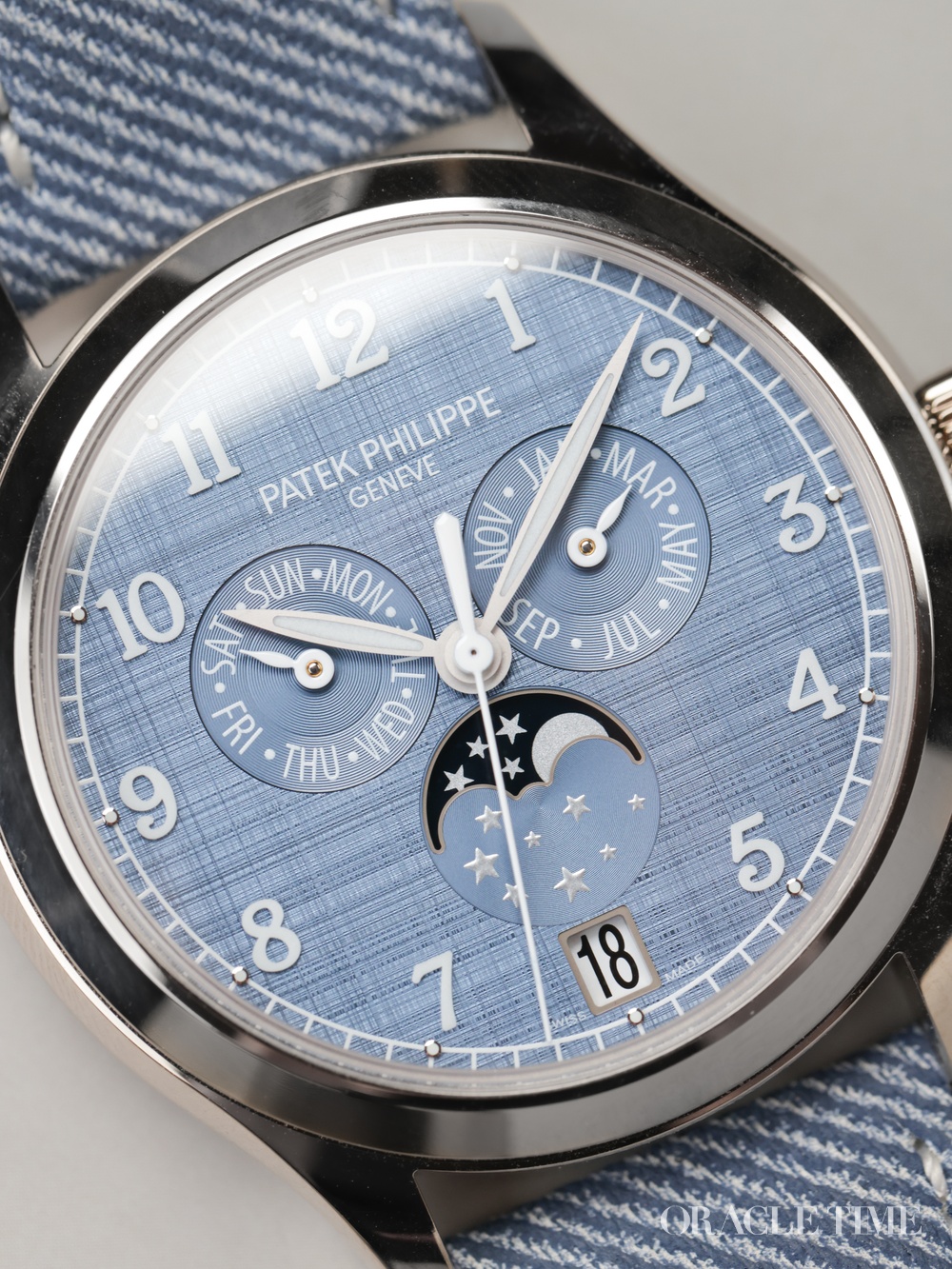

Setting the 4946G-001 still involves the faff of a stylus, and the usual rules apply: make sure the watch has power, no calendar corrections between 8pm and 3am, and no moonphase corrections between 9am and 11am. Wind the hands round to 6am, then work through the four correctors in the caseband: month at two o’clock, date at four, day at 10 and moonphase at eight, consulting an almanac for the last of those. Et voilà. It sounds like a chore, but it beats sending the watch back to Geneva every time it stops.
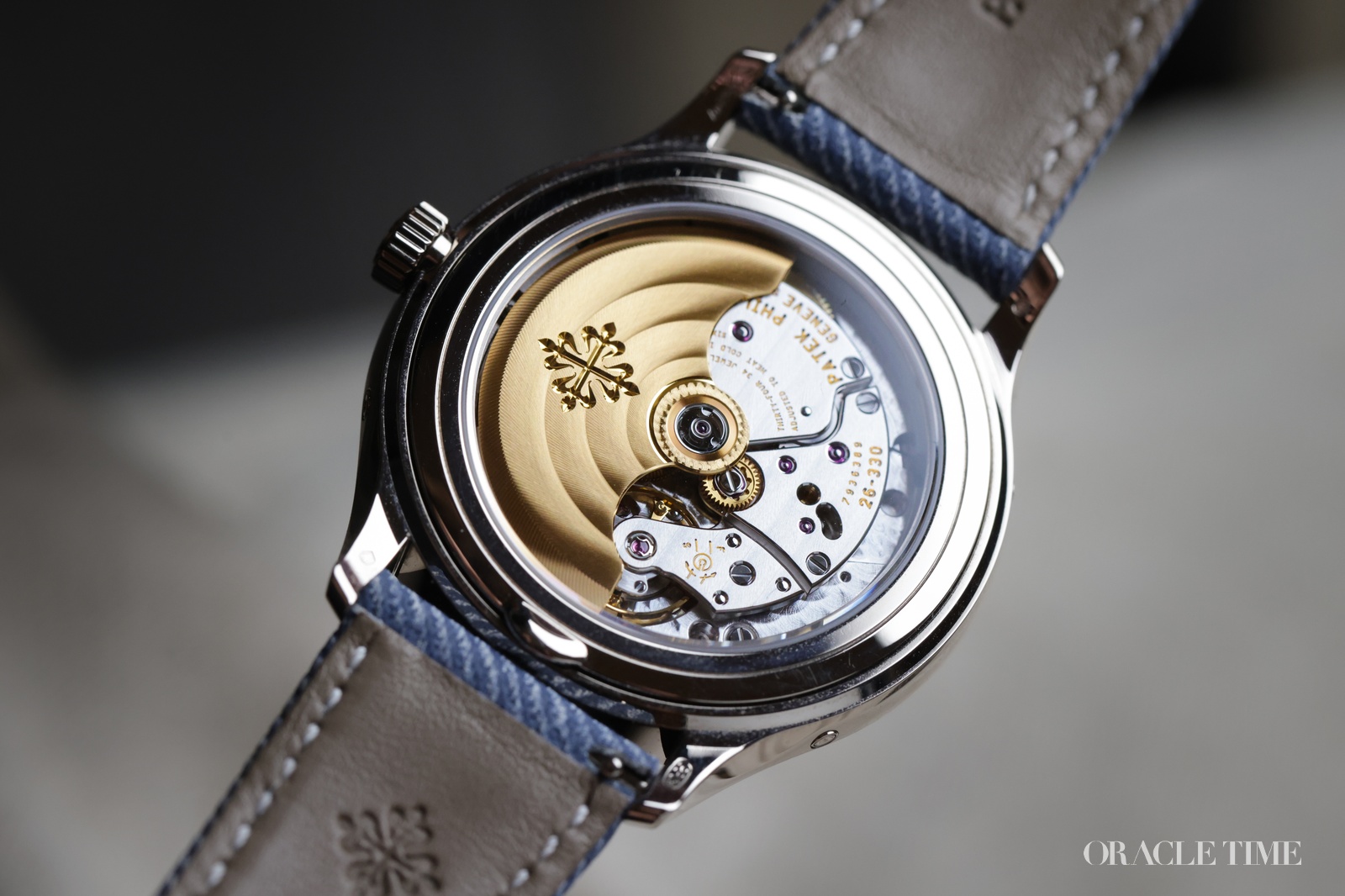
The starry moonphase is charming without tipping into tweeness, and the view through the sapphire caseback of the calibre 26-330 S QA LU is unpretentious: 319 parts, a 21k gold central rotor, the Patek Philippe Seal, and impeccable perlage and Côtes de Genève. The 35 to 45 hour power reserve is the one spec that shows its age, and the reason the setting routine matters. In low light the lume completes the monochrome look. It feels far more modern than much of the rest of Patek’s catalogue.
Then there’s the price. The 4946G-001 is £49,350. The Rolex Perpetual Padellone in Everose on alligator is £49,150. Two hundred pounds separates the two most talked-about calendars of the year, both correcting once a year, both 38 or 39mm, both on leather. The Rolex is the more technically ambitious watch, with its new 5Hz calibre 7190 and meteorite moon, and at 12.2mm it is also the thicker and more conservative-looking of the two. The Patek has three decades of annual calendar pedigree, a dial you can’t find anywhere else, and a daring strap combo.
Against perpetuals it gets harder to argue, at least on paper. Jaeger-LeCoultre’s Master Ultra Thin Perpetual Calendar in pink gold is £43,300, six grand less than the Patek, for a full perpetual at 39mm and a svelte 9.2mm, with 70 hours of power reserve to the Patek’s 45 at best. Mechanically it’s the better deal. But let it stop and you’re back to the forbidden hours and the almanac for month, day, date and leap year, not just one February. It has no lume, a silver dial and dauphine hands, and it looks exactly like a perpetual calendar has looked for 40 years. Beautiful, but nobody will ask you about it.
That’s the case for the 4946G-001. It is not the most complicated calendar you can buy for fifty grand, and it’s not meant to be. It is the one you’d wear on a Tuesday, in jeans, without thinking about it. With 30m of water resistance it’s a watch for most days. Except those at the beach, but who wears jeans to the beach anyway?
Price and Specs:
More details at Patek Philippe.