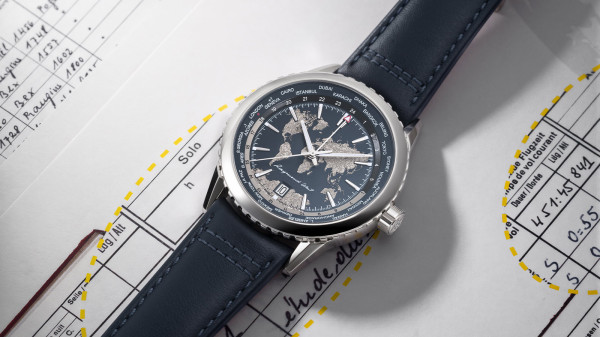
The pilot’s watch is one of the core tool watch archetypes. Designed for use in the cockpit, they are designed to assist pilots during the high stress procedures of flying a plane by making things as easy as possible, which is why certain functions show up more often than others in this archetype. A large display keeps things visible, a chronograph function lets you time your travel intervals, and a GMT lets you track time zones when you cross them. However, the new Watch Angels x Alpina Startimer Pilot Chronograph Automatic IFR introduces a new type of aviation-based function.

I am going to profess now that I have not undertaken the hundreds of hours of training that it takes to become a professional pilot and as such, some of the niche terminology that accompanies this launch is a mystery to me, but I shall endeavour to explain it as simply as possible. The new function in question is an IFR approach pattern calculator. IFR stands for Instrument Flight Rules and is essentially the normal method of commercial piloting, using the full might of a plane’s cockpit instruments – the alternative being VFR, or Visual Flight Rules, where you look out the window with a compass and a map.

The ‘approach’ is when a plane is arriving at its destination and is preparing to land. However, the approach is different at every single airport due to factors such as natural landscape, nearby buildings, length of runway and so on. Plus, at busy airports there will likely be a queue of planes waiting to land before you still in the air. These factors mean you have to enter a ‘holding pattern’, which is a racetrack-like oval where all the planes fly in the same direction before being allowed to land. The function on the Watch Angels x Alpina Startimer Pilot Chronograph Automatic IFR tells pilots how to join a holding pattern.

In order to understand that you need to know that there are three paths to join a holding pattern – all of which are shown in diagrams on the caseback. Which of the three you use is based on what direction you are arriving from in relation to the holding pattern’s ‘fixed point’, which is essentially where that oval track path is deemed to begin at. A direct path means you are approaching the fixed point traveling in the same direction as traffic and you can simply join the flow of traffic. A teardrop path means you are approaching against the flow of traffic but the oval leads away from you – so you essentially fly through the fixed point and join the loop on the other side of the oval. A parallel path means you are approaching against the flow of traffic but the oval leads back towards you, so you essentially do half the oval backwards before cutting across back to the fixed point in the correct direction.

Knowing which of those to do and also the heading to execute them properly is essential. That’s where the watch helps. The bidirectional bezel has two settings, depending on if it is pushed in or released. When pushed the pilot rotates it so that the inbound heading of the fixed point is at 12 o’clock – in my over simplified description, that’s the direction of the flow of traffic in the holding pattern as it passes through the fixed point. Then, when the bezel is released, you enter the current heading of the plane, which is the direction you are currently approaching from. The watch then displays the correct heading to take in order to execute the appropriate type of path, which is colour-coded for ease of reference.

And there you have it. A fully mechanical function built into the watch’s bezel and case to aid professional pilots in one of the most niche ways possible. Fortunately, if you are a watch nerd like me, you probably find the logistics of aviation interesting too. But as we are primarily here for the watch nerd side of things, let’s dig into the actual specs and design of the Watch Angels x Alpina Startimer Pilot Chronograph Automatic IFR.

At 43mm in steel it’s a large watch, which is unsurprising given it has to contain the additional mechanical features of the calculator function. In fact, because of that function the bezel is even larger than the case bringing its total diameter to 44.5mm with a ceramic insert. The case also has a 100m water resistance rating for any emergency splash downs. It’s based on the new Startimer case introduced earlier this year.

For the dial, it’s a relatively understated blue sunray brushed design that serves as a minimal backdrop to the wealth of information on display. The edge of the dial and flange is given over to the calculator function and then inside that is your normal hour and minute scales. Interspersed between the primary 12-hour scale is a 24-hour scale that relates to the central GMT hand to display a second time zone. There’s then a vertical tricompax layout of chronograph subdials with a 15-minute timer at 12 o’clock, a 12-hour timer at 6 o’clock and a running seconds indicator at 9 o’clock. Powering these complications is an un-named Swiss automatic movement with 62-hour power reserve.
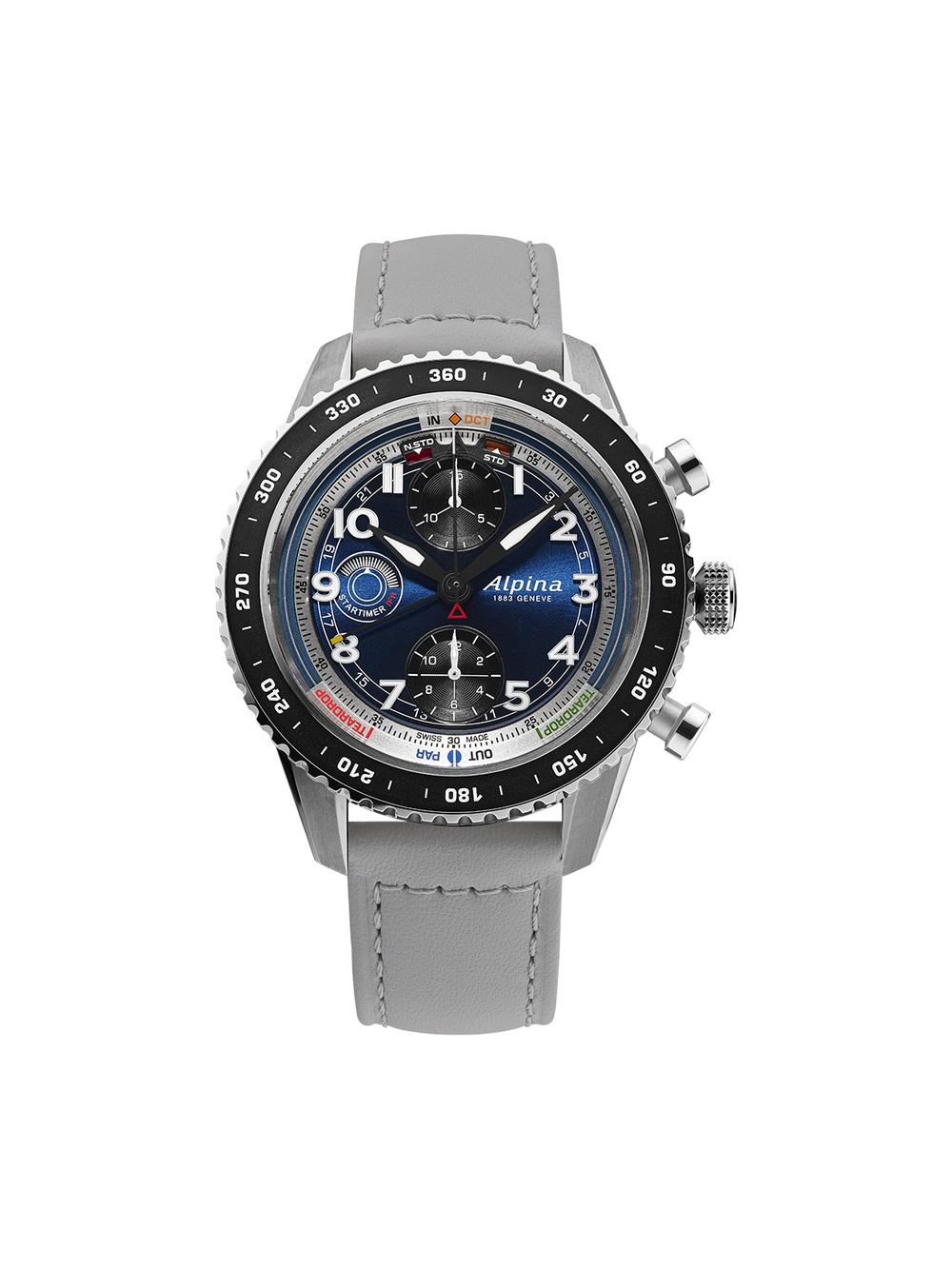
The Watch Angels x Alpina Startimer Pilot Chronograph Automatic IFR is available exclusively through Watch Angels in a limited edition of 300 pieces at a price of €4,295 (approx. £3,700). Whether you’re a professional pilot in need of a back-up tool in case of emergency or just an avid aviation fan, this is as serious as pilot’s watches can possibly get.
Price and Specs:
More details at Watch Angels.