
The 1930s was a formative time for racing. Cars had already become aspirational status symbols with the well-heeled stylings of the Bentley Boys, but there were still plenty of questions about how far mechanical speed could go. They were questions that one Reid Railton was more than happy to try and answer.
If you’ve not heard of Reid Railton, you have done his work. He was the engineer in charge of Sir Malcolm Campbell’s incredible Blue Bird Land Speed Record Cars. If you have heard of him however, it’s likely because of his other seminal achievement: the Napier-Railton car.
This legendary 1933 aero-engined race car was a masterpiece. Built by car-makers Thompson & Taylor and equipped with a 24-litre Napier Lion engine. The engine’s 12 cylinders were arranged in three banks of four, giving it the moniker Triple-Four. It was basically a jet on wheels.

Railton built the car specifically for driver John Cobb, who in 1935 proceeded to take it around the outer lap of Brooklands racetrack at 143.44mph. As an aside, the Napier-Railton was such a beast, it also set an endurance record a year later, averaging 150.6mph over 24 hours across the legendary Bonneville salt flats.
Cobb went on to set multiple land speed records in his career, peaking at 394.14mph in 1947. That record has since been broken (multiple times) but his Brooklands record still stands today. Granted, that’s because the track closed in World War II, never to reopen, but it’s a legacy of car and driver that looms large over the Brooklands name – the watches, as much as the track itself.
Indeed, Brooklands’ debut watch, the Triple-Four draws inspiration from the glory days of the Napier-Railton, with a classical chronograph layout designed by the inimitable, late Sir Terence Conran. It was a streamlined beauty inspired by trackside pocket watches with its vertical bi-compax subdials and flashes of racing red against a crisp white dial. I say ‘was’ because the debut Triple-Four collection has long since sold out. But if you’re keen to get your hands on one of Sir Terrence’s last designs, there’s good news: the new Triple-Four Spectrum Collection. And this time, you get colour.
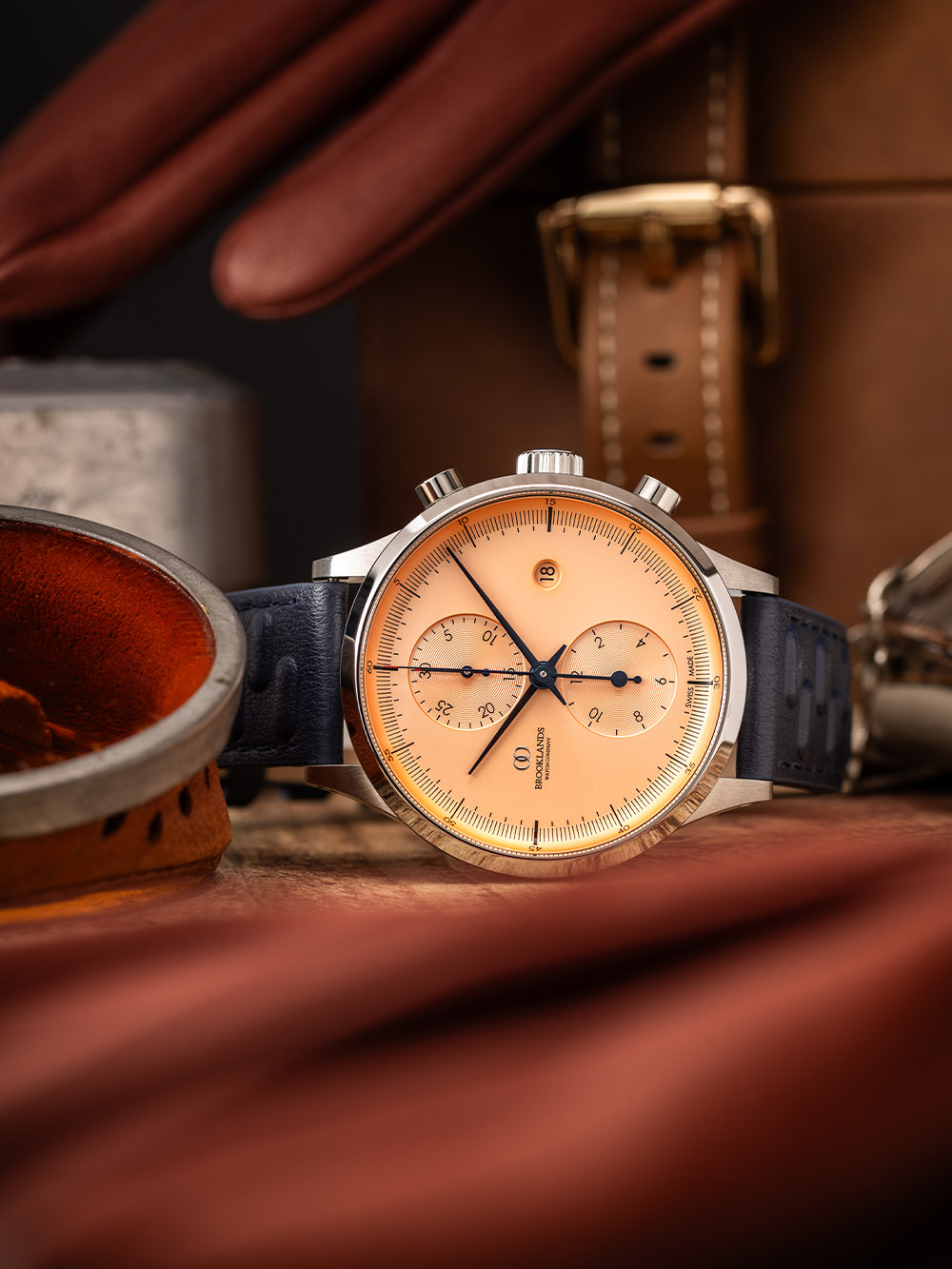

There are actually two different versions of the Triple-Four Spectrum. The first is relatively straightforward, adding solid colours in black, blue, very dark British racing green and an unusual Navajo Sand colour. That last is kind of like salmon if it went on a desert holiday and is definitely the outlier not just it’s eye-catching brightness, but because the hands that are normally silver are black instead. All four are solid options, but there are no prizes for guessing which I lean towards.
However, if you’re considering a Brooklands watch, you’re likely already a racing fan – and no dial says racing quite like the classic panda. That’s precisely what you get in the Triple-Four Spectrum II, a high-contrast white dial with black or dark green subdials. Honestly, this is what I’ve been waiting for Brooklands to do as it emphasises the unusual vertical subdials and makes great use of the clean space inside that 41mm case. These two have the black handset of the Navajo Sand (and the original Triple-Four at that) and to me offer the most succinct summary of what Brooklands as a watch brand is: heritage racing in an incredibly refined package.
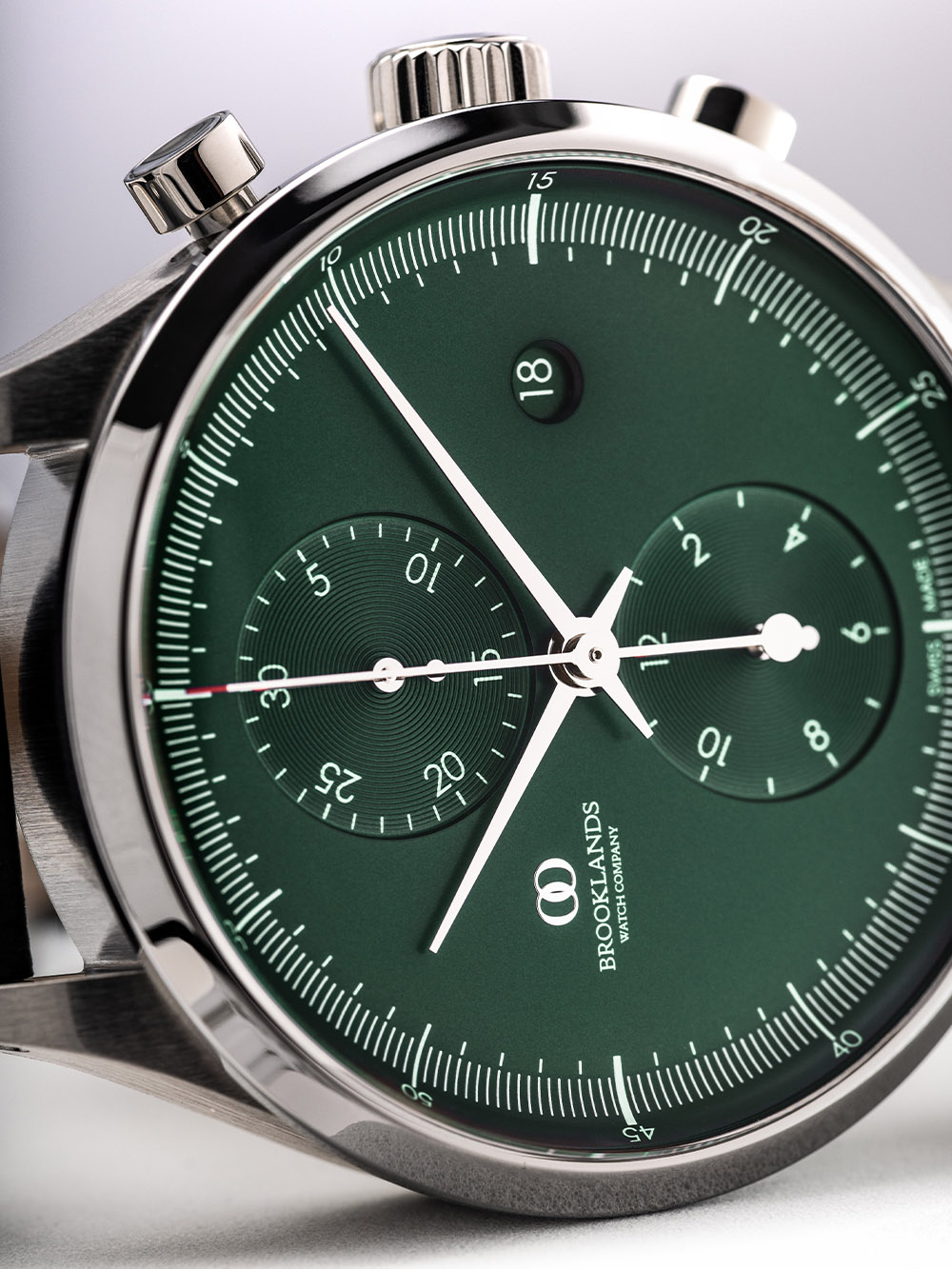

Regardless of which version of the Spectrum you steer towards, the specs are the same throughout. That means the aforementioned 41mm stainless steel case with a 100m water resistance (ideal for trackside timing in a storm), a funky tyre-tread strap and a workhorse Sellita SW500 chronograph movement, all the same as the original Triple-Four model. It still has the signature rotor directly taken from the roaring Napier Lion Triple-Four engine that powered the Napier-Railton and a subtly banked chapter ring one-piece face taken from the curve of the Brooklands track the car was powered along.
What really separates the Spectrum from what came before though isn’t the specs. It’s not even really the colours. It’s the price. My only qualm with the initial batch of Brooklands watches was that £5,750 felt like a lot, even for the work of a legendary British designer. The Spectrum is instead a much more reasonable £3,900. That’s almost more than a third less for the same watch in some cool, racing-flavoured colours.
Brooklands has a racing history that few tracks can hope to emulate and these watches do it justice in timekeeping form. And while each Spectrum colourway is still strictly limited (to 50 each), it’s now more accessible than ever to get that racing heritage on your wrist.
More details at Brooklands.


Yet another chrono watch release into the already overly populated arena of this watch type, but having said that, this is a very attractive watch, (particularly the Navajo Sand coloured variant), as I’m personally not keen on the twin colored Panda types, so that would be the one to go for IMO. The other reason for this colour choice is the ease of readability in varying weather conditions.
I’m with Sam on the final point, price is a little on the high side for an unrecognised brand.