Many features of watchmaking are often characterised by circles. Dials are traditionally circular, hands move through 360 degrees, and the balance wheel is just one of many movement parts that are also circular. Despite all of this one of the most visually interesting displays in watchmaking is the retrograde scale. It’s a style scale that decided to throw away a circular display in favour of a linear one often in order to display the date or days of the week. But how does the retrograde work when everything around it likes to move through 360 degrees?
Spotting a retrograde complication is simple. Whatever information is being displayed will be shown in a linear scale with an obvious start and end. Think of days of the week, the start of the scale would show Monday and the end, Sunday. A hand is most commonly used to point to the correct point on the scale. In a non-retrograde display the information would be displayed in a circular format so once the end of the scale is reached it would just continue its rotation back to the start.
Where the retrograde differs, and where it pulls out its party piece, is once the end of the scale is reached the hand will instantaneously ‘snap’ back to the start. You have to be quick or you’ll miss it but this rapid movement is a little piece of theatre, similar to the reset on a chronograph except it happens automatically without the use of a pusher.

The Patek Philippe Grand Complications has a horseshoe shaped retrograde display
The retrograde is primarily a design feature, it gives an alternative method of displaying information so not everything has to be in circles or disks. It also frees up some dial real estate. Subdials tend to take up a lot of room, so you’ll often find the retrograde in more complicated timepieces where space is at a premium. It does have some practical application, the defined start and end points improve legibility and avoids any confusion over exactly where the hand is pointing but that just feels like watch brand justification. Let’s just say it as it is, a retrograde is mechanical artistry that’s cool to look at.
One of the most common uses of the retrograde is for displaying the date. And if we are honest date windows are pretty uneventful so a retrograde brings some much needed drama to its display. The Patek Philippe Grand Complications Retrograde Perpetual Calendar highlights this beautifully with the date indicator displayed horse shoe style around the centre of the dial.

The Vacheron Constantin has two crystal clear retrograde displays
You’ll also find the retrograde in the Vacheron Constantin Patrimony Moonphase Day-Date which utilises not one but two retrograde indicators. With the addition of the day complication at least you’ll get to see the retrograde ‘snap’ once a week rather than just once a month.
If you’re Longines, displaying two retrograde displays is barely noteworthy. The Longines Master Collection Retrograde is a quadruple retrograde with indicators for the date, day, seconds (you can really see the seconds fly across the dial) and secondary time zone. A Sunday 31st at midnight will be quite the spectacle seeing all four retrogrades jump simultaneously.

The Longines Master Collection Retrograde Moon Phase has 4(!) retrograde displays
Overall, a retrograde indicator can be used to display almost anything, hours, minutes and even seconds are reasonably common in watchmaking. However, true to form, H. Moser & Cie. decided to top trump everyone and created a 30-second retrograde counter for the H. Moser Pioneer Retrograde Seconds. This ‘just because we can’ complication shows the retrograde return to its start position twice a minute. With the Pioneer Retrograde Seconds you also get a window into how the retrograde complication works.
The majority of retrograde watches will create the linear display with the help of a snail cam. Look to the six o’clock position of the H. Moser and you can see the double sided snail cam on the dial. This cam has two distinct features. Firstly, similar to a snail’s shell, it’s shaped like a spiral and increases in size as you get further from the centre. Secondly, you’ll notice a sharp cliff-like edge where the spiral comes to an abrupt stop (the H. Moser has two cliff edges because of the cam needing to complete two rotations for a single minute).
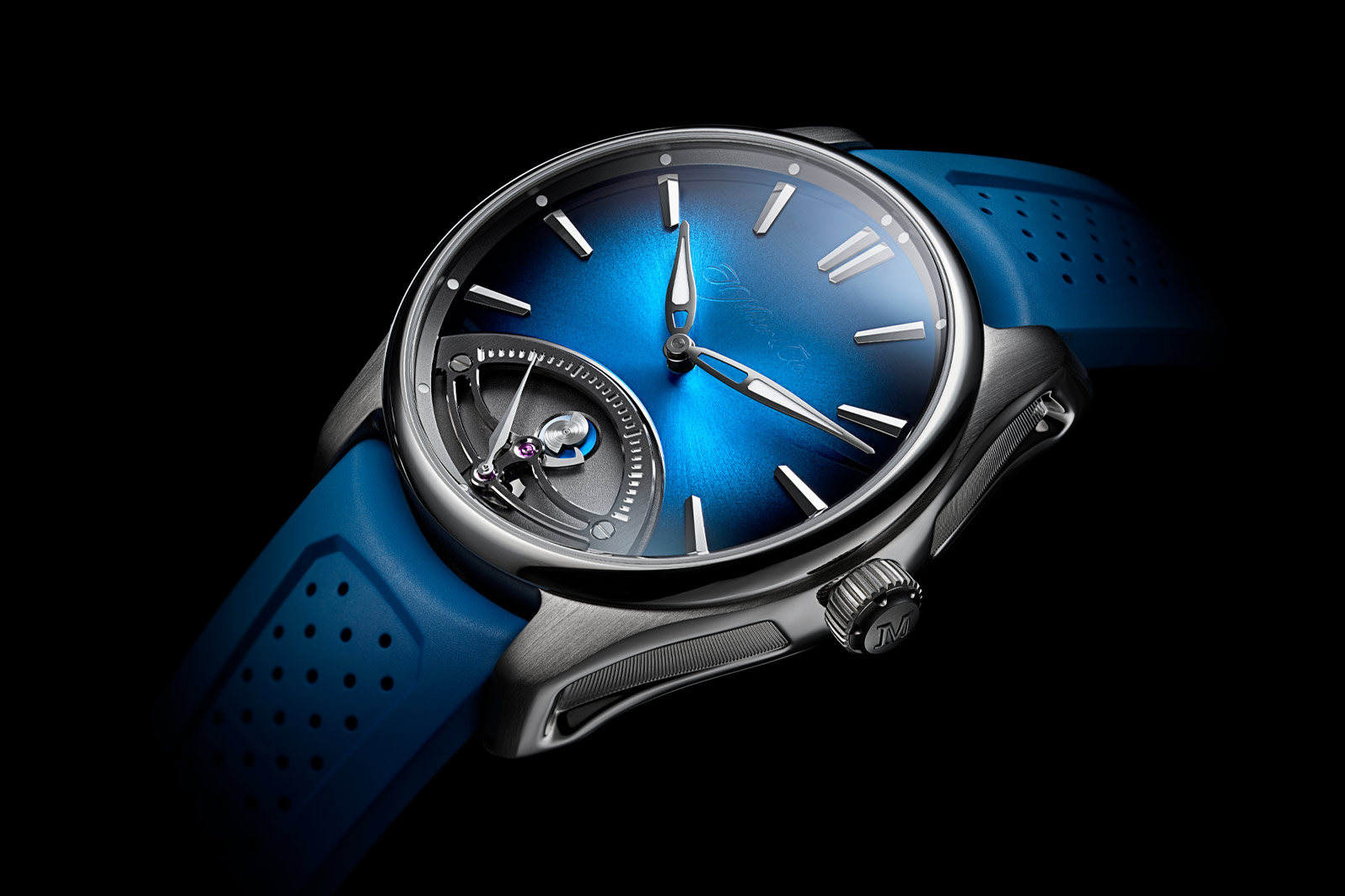
On the H. Moser & Cie Pioneer Retrograde Seconds the snail cam be seen at 6 o’clock
As the cam rotates the increasing radius is what causes the retrograde hand to move across the dial indicator. The short radius will be the start of the retrograde and the long will be the end. Once the cam reaches the end of its rotation, at the cliff edge, the lever in contact with the cam will ‘drop’ causing the hand to snap back to where it started. And so it begins again.
In watchmaking terms the snail cam is a relatively simple solution when compared to the engineering required to create a chronograph or a chiming mechanism. However, what it provides is creative freedom to watchmakers and designers to be able to display information in a whole new format that isn’t just another subdial or aperture. Over the years brands have used the retrograde to showcase different types of information in different forms of linear display. From horseshoe shapes to arcs, semi circles and straight line displays it’s enticing to see something different every once in a while.