Ok, this might be my favourite Santos to date. You clicked on this article for some first impressions and there you go. On a more serious note, the Cartier Santos de Cartier Dual Time is absolutely lovely. A beauty in monochrome grey that gives a watch known for its piloting heritage a complication commonly associated with air travel. What’s not to like?

If you’re unfamiliar with the history of the Santos, the short version of the story is that the original watch was designed by Cartier for a Brazilian pilot called Santos-Dumont around 1916, making it the very first professional pilot’s watch in history.
Aesthetically it’s features a broad case in a square shape with curved corners and an integrated bracelet. The raised bezel with visible screws gives it an industrial vibe similar to the integrated sports watch revolution of the 1970s, which when the collection was relaunched as we know it today.

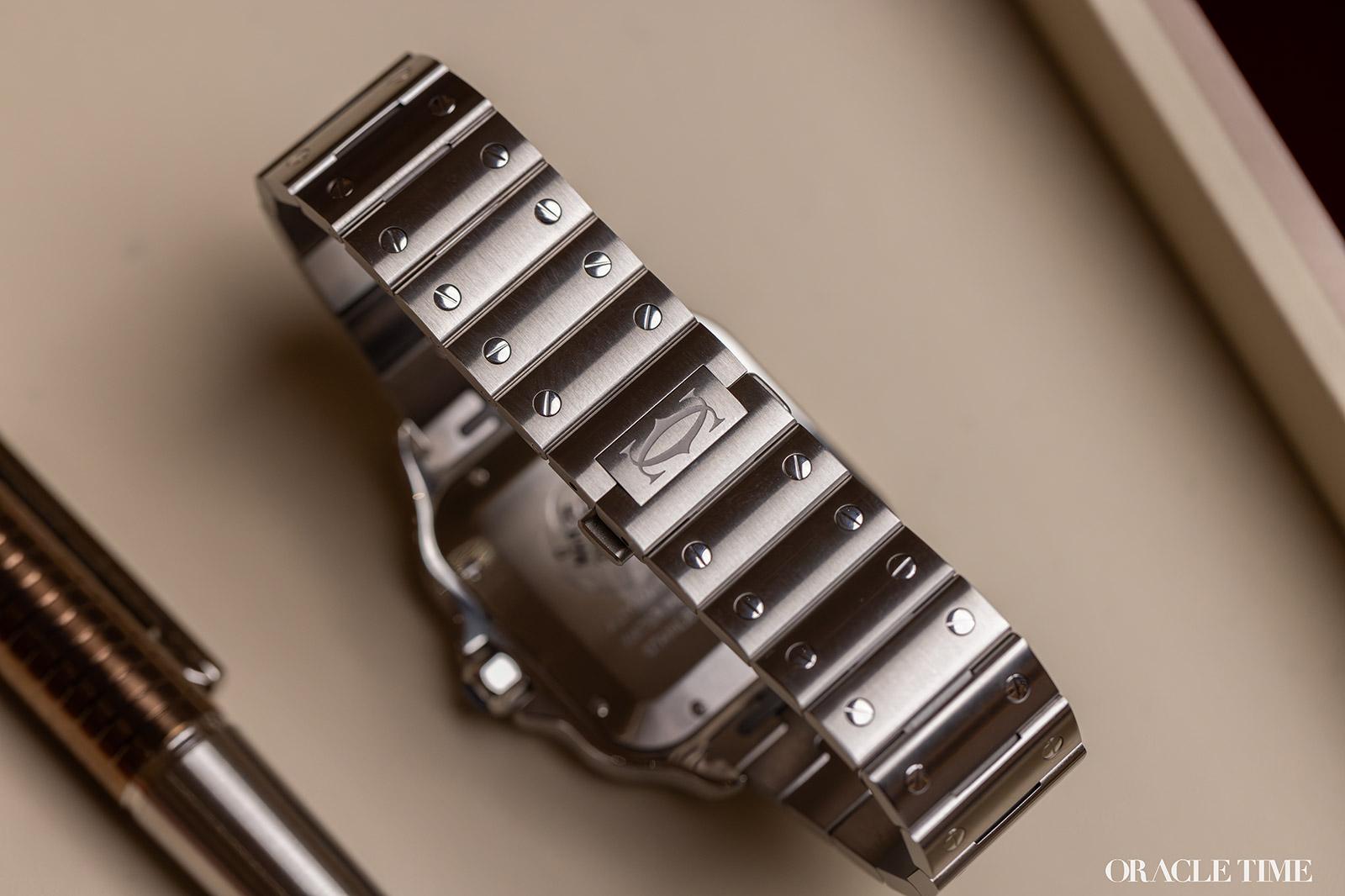
The new watch follows those same design codes measuring 40.2mm x 47.5mm in steel with matching steel bracelet. It’s a really nice bracelet too and the SmartLink adjustment system makes it easy to change its size without resorting to a tool. Another feature of all Cartier watches is their cabochon crown and the Santos Dual Time is no different.


Coming to the dial, this is where the Dual Time earns its keep. I’m a sucker for a sunray grey brushed dial. One of my favourite tool watches in my own collection is the Seiko Alpinist SPB243J1 which has a similar rugged, utilitarian feel to it while also having an element of flair thanks to its retro elements. For the Santos those retro elements are the Art Deco influences of the railway minute track and Roman numerals that give it that 1920s graphic, geometrical vibe.
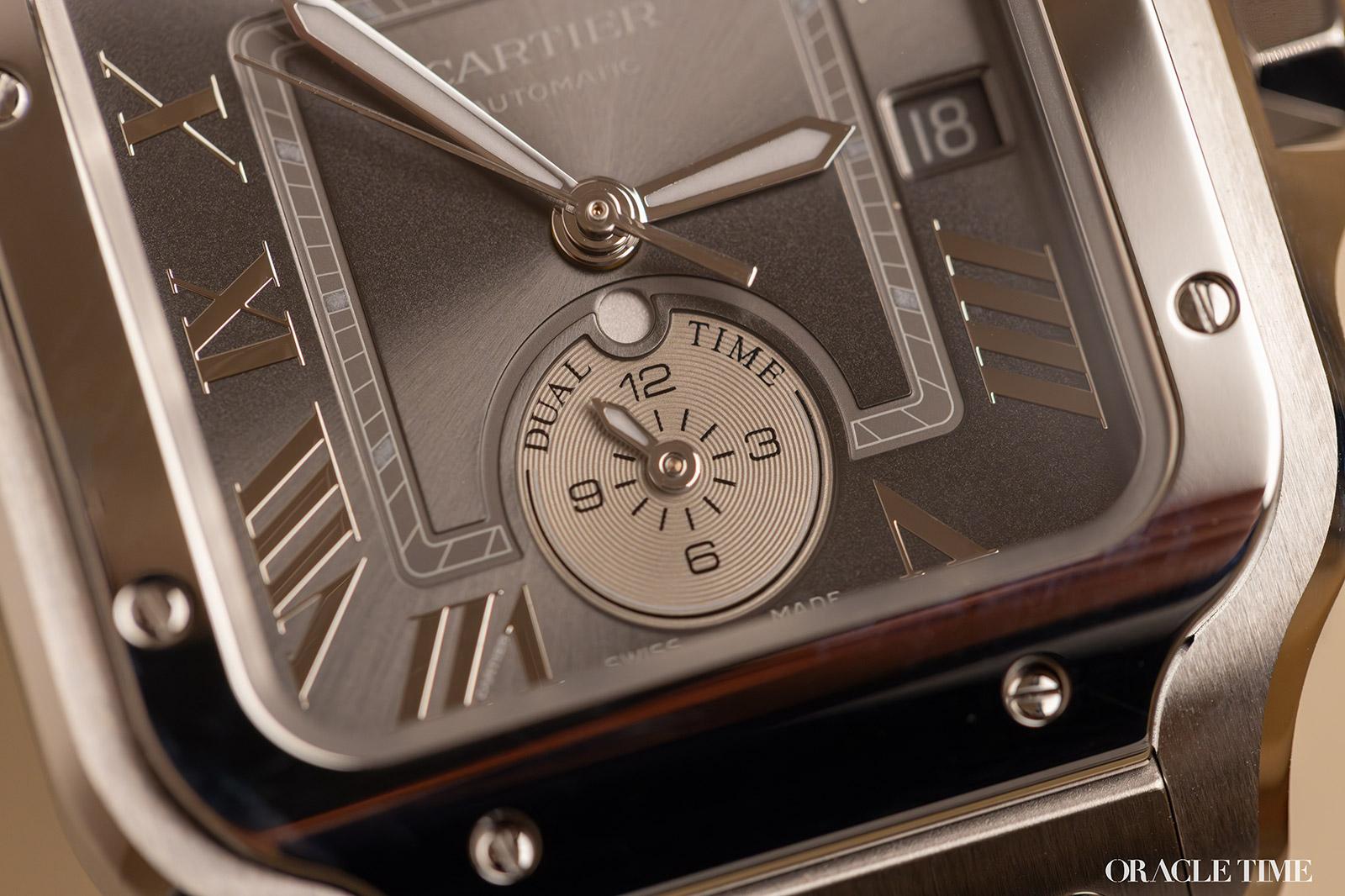
The highlight though is the brand new subdial at 6 o’clock with snailed finishing and a 12-hour scale. The finishing is beautifully precise and the minimalist scale helps it to ride that stylish but utilitarian line. At the top of the subdial is the inscription “Dual Time” and a day/night indicator. That indicator actually means that while the scale runs from 1-12, it’s actually a 24-hour display. As the name implies, it allows you to keep track of two time zones simultaneously, functioning in a similar manner to a GMT complication.
As for the movement inside, Cartier have decided not to disclose who the manufacture is, although it is confirmed not to be in-house. We do know that it has a 4Hz frequency and a 40-hour power reserve meaning it could be a movement by virtually anyone. In this day and age, I don’t see a reason not to disclose that information but here we are. Anyone spending a substantial amount of money should be allowed to know every detail of their purchase.

Especially as the Cartier Santos de Cartier Dual Time is priced at CHF 8,800 (approx. £7,670). It’s hard to judge the value of a watch when you don’t know everything about it so I honestly couldn’t tell you if that’s a good price. It’s the one sour note in what is otherwise a fantastic edition of the Santos.
Price and Specs:
More details at Cartier.